White House Interest Rate Mandate Sends Shockwaves Through Wall Street: The 10% Credit Card Cap Arrives
As of January 20, 2026, the American financial landscape is facing a seismic shift as the White House’s proposed 10% cap on credit card interest rates moves from a campaign-trail firebrand to a looming regulatory reality. The mandate, which President Trump aggressively revived earlier this month, seeks to provide immediate relief to consumers burdened by record-high household debt, which eclipsed $1.23 trillion in late 2025. While populists in Washington cheer the move as a long-overdue check on "predatory" banking practices, the immediate implications for the nation’s credit infrastructure are profound, threatening to upend the business models of the world's largest payment networks and lenders.
The announcement has already triggered a significant repricing of risk across the financial sector. In the wake of the President's formal directive, major credit providers have warned of a looming "credit crunch" that could see millions of subprime borrowers lose access to traditional lines of credit overnight. For investors, the uncertainty has translated into a sharp sell-off, as the market weighs the potential for a massive contraction in net interest income against the possibility of protracted legal battles between the executive branch and the banking industry.
A Mandate for Affordability: The Road to the 10% Cap
The journey to this moment began in late 2024 when the proposal to cap interest rates at 10% became a cornerstone of the presidential campaign. Following the election, the momentum shifted to the legislative arena in February 2025 with the introduction of the "10 Percent Credit Card Interest Rate Cap Act" by an unconventional bipartisan coalition led by Senator Josh Hawley (R-MO) and Senator Bernie Sanders (I-VT). Although the bill faced stiff resistance within the Senate Banking Committee throughout 2025, the political pressure mounted as the Consumer Financial Protection Bureau (CFPB) released data suggesting that large banks were charging significantly higher rates than their smaller counterparts despite similar risk profiles.
The situation reached a fever pitch on January 9, 2026, when the White House issued a formal announcement calling for a one-year "affordability mandate" that effectively caps all credit card annual percentage rates (APRs) at 10%, beginning today, January 20, 2026. The administration framed the move as an emergency intervention to protect middle-class families from "extortionate" rates that often exceed 30%. Key stakeholders, including Treasury officials and consumer advocacy groups, have argued that the cap is a necessary tool to stimulate consumer spending by reducing the debt-service burden on the average American household.
Initial market reactions were swift and punishing. On Monday, January 12, the first full trading day following the weekend announcement, the financial sector led the broader market indices lower. Banking executives, including JPMorgan Chase (NYSE: JPM) CEO Jamie Dimon, immediately went on the offensive, labeling the cap as "market-distorting price controls." During emergency calls with analysts, bank leaders warned that such a cap would make it impossible to price for risk, potentially forcing the closure of millions of accounts and fundamentally altering the availability of credit in the United States.
Winners and Losers: The Brutal Math of Interest Caps
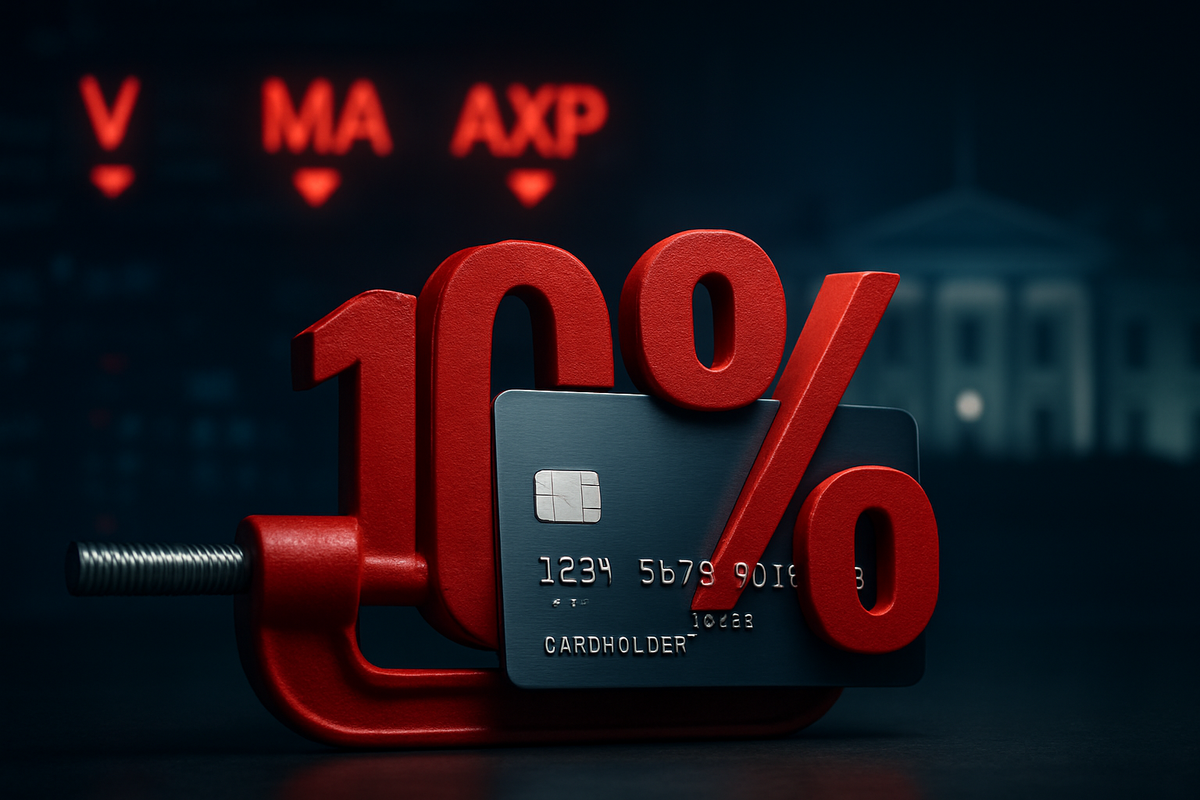
The market's verdict on the 10% cap has been particularly harsh for major payment networks and card issuers. American Express (NYSE: AXP) saw its shares slide by approximately 4.4% following the news. As a company that functions as both a lender and a network, American Express is uniquely exposed; investors fear that its premium net interest margins will be squeezed to unsustainable levels, particularly for its revolving credit products. The company's high-spend, high-reward model relies heavily on the flexibility of its interest income to fund its industry-leading loyalty programs.
While they do not set interest rates themselves, the "Big Two" payment networks were not spared. Visa (NYSE: V) and Mastercard (NYSE: MA) both saw their share prices decline by roughly 2% in the days following the announcement. The logic behind the sell-off is twofold: first, a 10% cap is widely expected to lead to a significant reduction in card issuance and lower credit limits, which would directly reduce the transaction volume flowing through their networks. Second, the threat of a broader "credit crunch" could dampen overall consumer spending, the lifeblood of the global payment ecosystem.
The most severe damage, however, was reserved for specialized "pure-play" credit card lenders. Capital One (NYSE: COF) and Synchrony Financial (NYSE: SYF) saw their valuations tumble by between 7% and 9%. These institutions are heavily reliant on interest income from a diverse range of credit tiers, including subprime and near-prime borrowers. Analysts at major brokerages have noted that at a 10% cap, many of these portfolios would become instantly unprofitable after accounting for default risks and operational costs, potentially forcing these lenders to abandon the very consumers the White House claims it wants to help.
The Broader Significance: Regulatory Overreach or Social Safety Net?
This event represents a radical departure from the decades-long trend of credit deregulation that began in the late 1970s. For years, the industry has operated under the precedent set by the Supreme Court’s 1978 Marquette decision, which allowed national banks to export the interest rates of their home states across the country. A federal 10% cap effectively nullifies that landscape, creating a standardized ceiling that the industry hasn't seen in the modern era. This shift fits into a broader global trend where populist governments are increasingly using "junk fee" bans and interest rate caps as a form of direct economic intervention.
The ripple effects extend far beyond the banks. Retailers that rely on store-branded credit cards to drive loyalty and sales—such as department stores and electronics chains—could see their credit programs decimated. If Synchrony Financial or Capital One are forced to tighten lending standards, the "buy now, pay later" (BNPL) sector may see a massive influx of users. However, even these fintech players are watching closely, as regulators have signaled that interest caps could eventually be extended to any form of deferred payment product that carries a cost to the consumer.
From a policy perspective, the 10% cap raises significant constitutional and statutory questions. Legal experts are already preparing for a showdown over whether the executive branch has the authority to impose such a cap without a clear mandate from Congress. The banking industry’s trade groups, including the American Bankers Association, have signaled they will file for immediate injunctions, arguing that the White House is overstepping its bounds under the Consumer Financial Protection Act. This legal uncertainty creates a "limbo" state for the market, where companies must prepare for the cap while simultaneously fighting its implementation in the courts.
The Road Ahead: Strategic Pivots and Potential Crises
In the short term, the market should expect a period of extreme volatility as banks begin to adjust their lending criteria. Many institutions have already begun "de-risking" their portfolios by reducing credit limits for borrowers with scores below 700. This preemptive move is likely to lead to a contraction in consumer liquidity, which could have a cooling effect on the broader economy. If the cap holds, banks will likely pivot their business models toward fee-based income, potentially introducing new "maintenance" or "participation" fees to offset the loss of interest revenue—a move that would undoubtedly draw further scrutiny from the CFPB.
Long-term, the 10% cap could lead to a permanent restructuring of the American credit market. We may see a "flight to quality," where only the most creditworthy individuals have access to traditional credit cards, while the rest of the population is pushed toward alternative—and perhaps less regulated—financial products. For the major networks like Visa and Mastercard, the focus will likely shift even more aggressively toward international markets and non-card payment rails, such as real-time payments and cross-border B2B transactions, to diversify away from the regulatory risks of the U.S. consumer credit market.
Wrap-Up: A New Era of Financial Regulation
The White House’s 10% interest rate cap marks a watershed moment for the financial services industry. It represents a bold, if controversial, attempt to redefine the relationship between lenders and borrowers. The key takeaway for the market is that the era of "easy credit" fueled by high-interest revolving debt is under direct assault from a populist regulatory agenda. While the move is designed to save consumers billions, the unintended consequences—ranging from reduced credit availability to a potential slowdown in consumer spending—could create a new set of economic challenges.
Moving forward, the market will be characterized by a "wait-and-see" approach as the legal challenges play out in the federal courts. Investors should closely monitor the quarterly earnings of major card issuers for signs of portfolio contraction and watch for any signs of a "credit freeze" in the subprime market. The lasting impact of this mandate will likely be measured not just in saved interest for consumers, but in how it reshapes the competitive landscape of the American financial system for the next decade.
This content is intended for informational purposes only and is not financial advice.