Wall Street Surges as Peace Signals Emerge: Trump Forecasts End to Iran Conflict Within Weeks
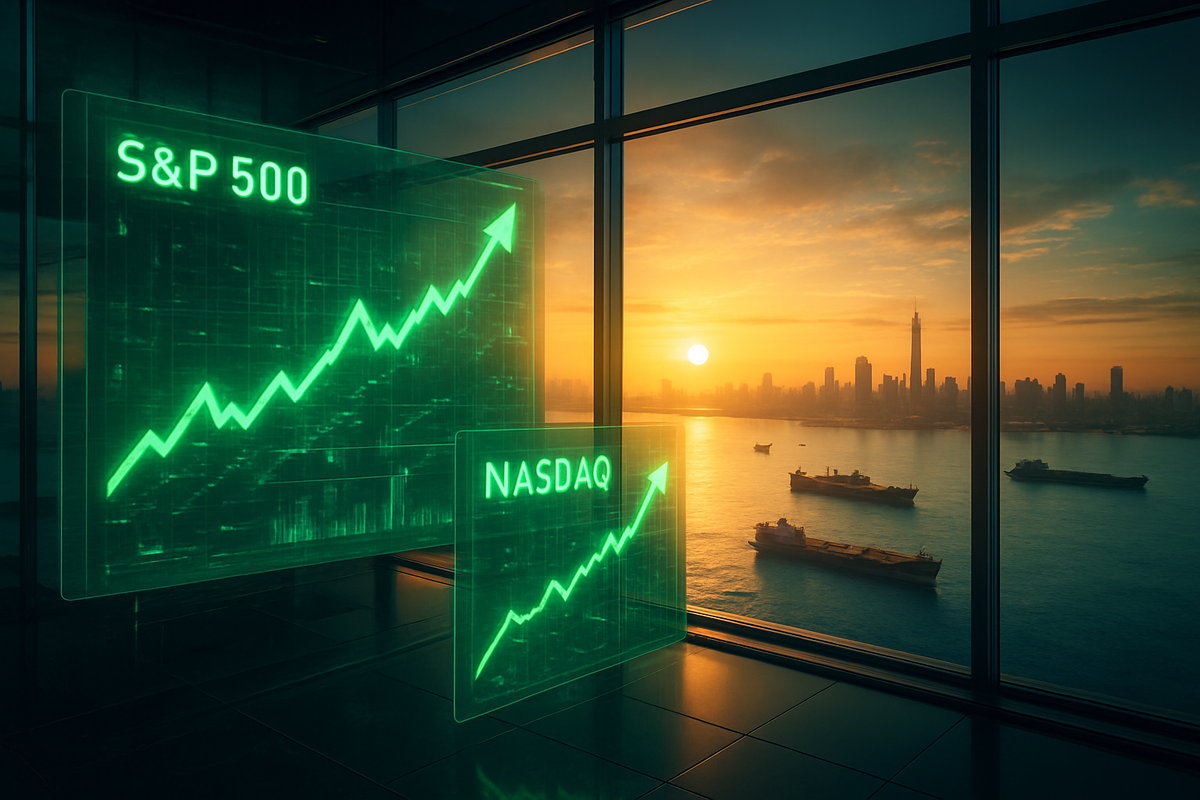
Financial markets experienced a historic "relief rally" today, April 1, 2026, as investors worldwide pivoted from a war footing to a peace narrative. The rally was ignited by unexpected comments from President Trump, who suggested that a resolution to the month-long conflict with Iran is within reach, potentially concluding within a two-to-three-week window. The optimism was palpable across trading floors, with the S&P 500 (NYSE:SPY) climbing a staggering 2.9%, while the tech-heavy Nasdaq Composite (NASDAQ:QQQ) jumped 3.8% in its best single-day performance of the year.
The surge marks a dramatic shift in market sentiment after weeks of volatility and supply-chain fears. As the "war premium" began to evaporate from commodity prices, capital flowed aggressively back into growth-oriented sectors and beaten-down travel stocks. For a market that has spent much of early 2026 bracing for a prolonged regional struggle, the prospect of a diplomatic breakthrough mediated by regional partners has provided the strongest "buy" signal since the peak of the 2025 bull run.
A 15-Point Path to Peace
The catalyst for the day's market euphoria was a mid-morning press conference where President Trump detailed a "15-point Framework Agreement" currently being brokered by mediators in Oman and Qatar. The proposed deal aims to resolve the hostilities that escalated in early March following "Operation Epic Fury," the joint coalition strikes on Iranian infrastructure. According to the President, the framework includes a verifiable freeze on uranium enrichment and a "Regional Stability Pact" that would see Iran curtailing its support for proxy groups in exchange for the unfreezing of over $100 billion in overseas assets.
The timeline for this resolution—estimated at just 14 to 21 days—surpassed even the most optimistic analyst forecasts. The conflict reached a critical juncture following the death of Ayatollah Ali Khamenei in March, which led to the swift ascension of his son, Mojtaba Khamenei. Reports from intelligence circles suggest the new leadership is adopting a "differential reconstruction doctrine," prioritizing the stabilization of a domestic economy currently reeling from 60% inflation and the devastating impact of the coalition's blockade.
Central to the market's reaction is the planned reopening of the Strait of Hormuz. In the weeks leading up to today, oil transits through the narrow waterway had dropped by an estimated 96%, sending West Texas Intermediate (WTI) crude to a peak of $120 per barrel. The announcement that a phased reopening could begin as early as next week sent oil prices tumbling back toward the $80 range, providing immediate relief to global logistics and transportation sectors.
The Peace Dividend: Winners and Losers
The prospect of de-escalation has triggered a massive sector rotation, as investors sell off defensive "safe havens" in favor of "Peace Dividend" beneficiaries. The travel and leisure sector, which bore the brunt of the March drawdown due to jet fuel spikes and airspace closures, saw a massive influx of capital. Delta Air Lines (NYSE:DAL) and United Airlines (NASDAQ:UAL) were among the top performers, gaining 7.4% and 8.1% respectively, as the threat of a prolonged energy crisis subsided.
In the technology sector, giants like Nvidia (NASDAQ:NVDA) and Microsoft (NASDAQ:MSFT) spearheaded the Nasdaq's 3.8% jump. These companies, which underpin the broader market's growth narrative, benefited from a decline in the "geopolitical risk premium" that had recently weighed on valuation multiples. Consumer discretionary stocks like Amazon (NASDAQ:AMZN) and Tesla (NASDAQ:TSLA) also saw significant gains, as lower energy prices are expected to act as a de facto tax cut for consumers, boosting disposable income.
Conversely, the aerospace and defense sector, which had traded at record highs during the height of the conflict, faced a valuation reset. Lockheed Martin (NYSE:LMT) and Northrop Grumman (NYSE:NOC) saw their shares dip as investors anticipated a slowdown in immediate "active conflict" procurement. However, analysts note that the downside for these firms remains limited by massive backlogs and the ongoing "Peace through Strength" modernization programs that were front-loaded in the 2026 federal budget.
Analyzing the Macro Shift
This rally is not just a reaction to a single headline but a reflection of how this event fits into the broader 2026 economic landscape. Coming off a resilient 2025, where the S&P 500 gained 16.39%, the market was already primed for growth but was being held back by the specter of "sticky" inflation driven by energy costs. A resolution to the Iran conflict effectively removes the largest hurdle to the S&P 500 reaching its much-discussed 8,000 target by year-end.
The ripple effects extend far beyond Wall Street. A stabilized Middle East ensures the continuity of global trade routes, reducing the "geopolitical surcharge" that has plagued international retail and manufacturing supply chains. Historically, markets have shown a tendency to bottom within 16 to 19 days of a conflict’s start, followed by a rapid recovery. The April 1st rally follows this precedent almost perfectly, suggesting that the "Peace Dividend" is being priced in with high conviction.
Furthermore, the diplomatic shift represents a significant pivot in U.S. foreign policy. By focusing on a "15-point Framework" that emphasizes economic reintegration over prolonged military occupation, the administration is signaling a return to a "stability-first" approach. This has broad regulatory implications, particularly for energy policy and international sanctions, which may be eased faster than anticipated to ensure the new Iranian leadership remains at the negotiating table.
The Road to Resolution
While today’s gains are substantial, the path forward is not without its challenges. The next two to three weeks will be a period of "trust but verify." The short-term focus for investors will be on the formal signing of the framework agreement and the first measurable signs of de-escalation on the ground. Any delay in the reopening of the Strait of Hormuz or a breakdown in the 15-point proposal could lead to a sharp reversal of today's gains.
In the long term, companies will need to adapt their strategic pivots. Energy majors like ExxonMobil (NYSE:XOM) and Chevron (NYSE:CVX), which saw profit-taking today, will likely refocus on long-term production stability rather than the high-margin volatility of a war economy. Meanwhile, the travel sector must prepare for a surge in demand as international routes that were closed or rerouted during the conflict begin to normalize.
Market opportunities will emerge in the reconstruction and regional development sectors. If the "Peace Dividend" holds, there will likely be a renewed interest in emerging markets and infrastructure projects across the Middle East. For now, the "wait and see" approach has been replaced by a "buy the peace" frenzy, but the sustainability of this rally depends entirely on the diplomatic progress made in the coming fortnight.
Market Wrap-Up and Outlook
The events of April 1, 2026, will likely be remembered as a turning point for the mid-decade bull market. The 2.9% gain in the S&P 500 and the 3.8% jump in the Nasdaq have wiped out the "war-induced" losses of the previous month, restoring investor confidence in the face of significant geopolitical uncertainty. President Trump’s optimistic timeline has provided the market with a clear horizon, allowing for a return to fundamental-driven investing.
Moving forward, the market is expected to remain highly sensitive to diplomatic cables and verification reports from the Middle East. Investors should keep a close eye on oil price stability and the performance of consumer discretionary stocks as a barometer for the "Peace Dividend’s" health. While the immediate threat of a wider war appears to have receded, the lasting impact will be determined by how well the 15-point framework is implemented.
In the coming months, the focus will shift back to corporate earnings and the Federal Reserve's response to the easing of energy-led inflation. If the 2-3 week resolution timeline holds, the "Peace Dividend" of 2026 could very well provide the necessary fuel to propel global markets to historic new heights.
This content is intended for informational purposes only and is not financial advice