Wall Street Ignites Santa Claus Rally: S&P 500 Erases December Slump in Broad-Based Surge
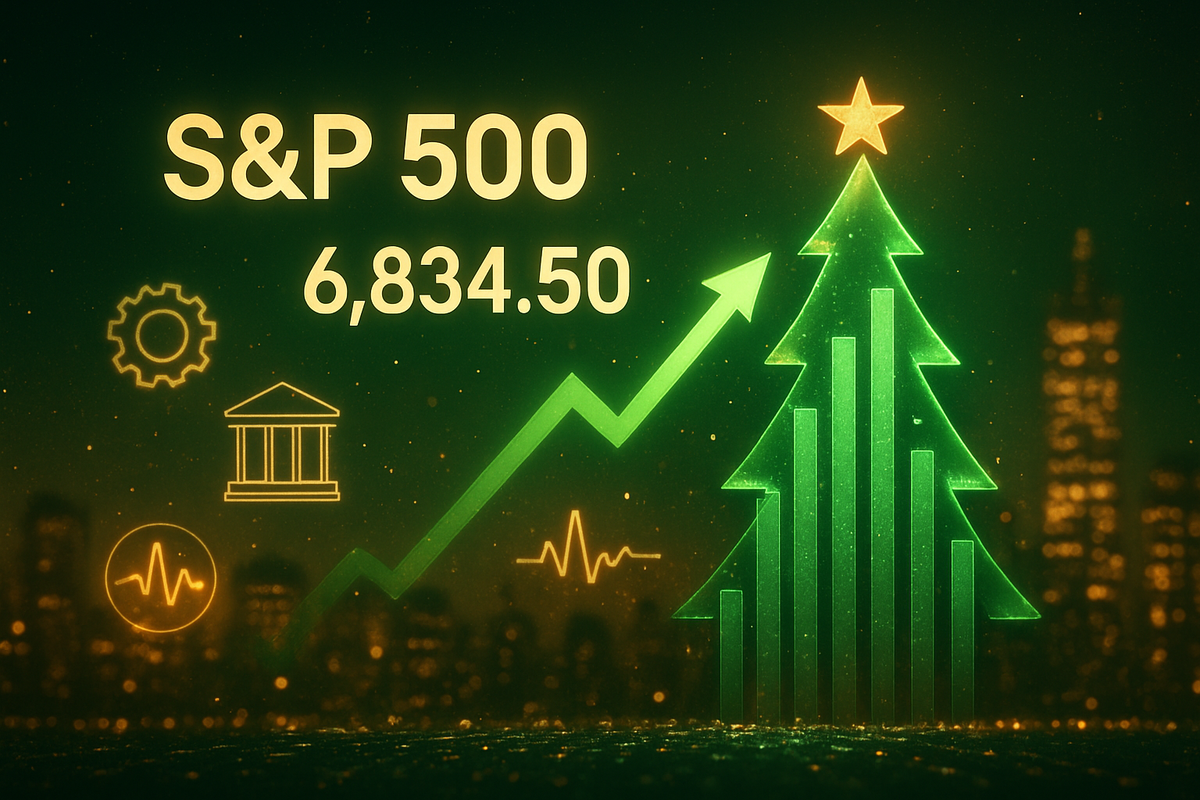
As the final full trading week of 2025 begins, Wall Street has shaken off a mid-month malaise to position itself for a classic year-end surge. On Monday, December 22, the S&P 500 climbed 0.6% to reach 6,834.50, effectively erasing the losses incurred during a volatile second week of December. This rebound marks the unofficial start of the "Santa Claus Rally," a seasonal phenomenon that investors hope will cap off a year of resilient, albeit uneven, growth.
The rally is particularly notable for its breadth. Unlike the tech-heavy gains that dominated much of the early 2020s, the current market strength is distributed across nearly every corner of the economy. Ten of the eleven S&P sectors closed in positive territory on Monday, signaling a shift in investor appetite from overextended AI plays toward cyclical and value-oriented sectors like Materials, Financials, and Healthcare. This "everything rally" suggests that despite a holiday-shortened week, market participants are eager to lock in gains before the 2026 calendar turns.
The Mid-December Reversal: From AI Anxiety to Holiday Cheer
The path to this week’s gains was far from linear. Just days ago, the market was reeling from a sharp "AI unwind" trade that began on December 17. The catalyst was a high-profile setback for Oracle Corporation (NYSE: ORCL), which saw its shares tumble 46% after a major funding partner withdrew support for a $10 billion data center project linked to a TikTok-related deal. This sparked a contagion of doubt regarding the immediate return on investment for massive artificial intelligence infrastructure, pulling down industry leaders such as Nvidia (NASDAQ: NVDA) and Broadcom (NASDAQ: AVGO).
However, the tide turned on Thursday, December 18, following a blowout earnings report from Micron Technology (NASDAQ: MU). Micron’s strong guidance provided the necessary reassurance that demand for high-bandwidth memory remains robust, stabilizing the semiconductor sector. Simultaneously, the release of cooling inflation data—with the Core PCE price index hovering between 2.8% and 2.9%—gave the market permission to focus on growth rather than price pressures. By the time the closing bell rang on December 22, the S&P 500 had not only recovered its mid-month losses but was trending toward a positive monthly return.
Sector Rotation: Identifying the Winners and Losers
While the broader market is rising, the internal dynamics of the rally reveal a significant "K-shaped" rotation. The primary winners in this year-end push are the Materials and Financial sectors. As the U.S. economy continues its "soft landing" trajectory, investors are moving capital into companies that benefit from steady consumer spending and industrial activity. Financial institutions are also benefiting from a stabilizing yield curve following the Federal Reserve’s latest policy move.
Conversely, the "Magnificent 7" tech giants, which fueled the majority of the year's 15-16% year-to-date gains, are seeing more tempered performance. While Nvidia and Broadcom have bounced off their mid-December lows, they are no longer the undisputed engines of the market. Meanwhile, defensive stocks like Walmart (NYSE: WMT) and Costco (NASDAQ: COST) remain in a complex position; while they are viewed as safe havens, analysts at Morningstar have cautioned that these consumer staples are currently trading at premiums of 7% to 11%, potentially limiting their upside in the immediate future.
The Fed Factor and the Broader Macro Landscape
The backdrop for this rally was set on December 10, when the Federal Open Market Committee (FOMC) delivered a 25-basis-point interest rate cut, bringing the federal funds rate to a range of 3.50%–3.75%. However, the decision was far from unanimous. In a rare display of internal division, three voting members dissented—the highest number since 2019. This friction highlights the delicate balance the Fed is trying to strike between supporting a cooling labor market and ensuring that "sticky" inflation does not reignite.
This event fits into a broader trend of market normalization. After years of extreme volatility driven by the pandemic and subsequent rapid-fire rate hikes, 2025 has been a year of transition. The 43-day government shutdown earlier in the autumn created a data vacuum that briefly rattled investors, but the subsequent resolution and revised Q3 GDP growth of over 3.0% have restored confidence. The current rally is a reflection of a market that has learned to navigate geopolitical uncertainty and domestic political gridlock, focusing instead on the fundamental resilience of American corporate earnings.
The Road to 2026: What Comes Next?
The official "Santa Claus Rally" period—the last five trading days of December and the first two of January—is set to begin on Wednesday, December 24. Historically, this period has a high probability of positive returns, and after two consecutive years of disappointing year-end performance in 2023 and 2024, the 2025 setup appears primed for a breakout. Investors will be watching the low-volume, holiday-shortened sessions closely to see if the S&P 500 can sustain its momentum into the new year.
Looking into early 2026, the market faces a "wait-and-see" environment. The Federal Reserve has signaled that it may only implement one additional rate cut in the entirety of 2026, a hawkish stance that could cap equity valuations. With S&P 500 price-to-earnings ratios currently sitting around 21-22, the margin for error is slim. Strategic pivots toward small-cap stocks, represented by the Russell 2000, may become more prevalent as investors seek value outside of the mega-cap tech space.
Final Assessment: A Resilient Finish to a Turbulent Year
The 2025 Santa Claus Rally is more than just a seasonal quirk; it is a testament to the market's ability to absorb shocks and rotate into new areas of strength. From the AI-driven panic of mid-December to the broad-based recovery of the past few days, Wall Street has demonstrated a clear preference for staying invested rather than retreating to cash. The erasure of December’s losses provides a psychological boost that could carry the indices to new record highs before the year is out.
Moving forward, investors should keep a close eye on the January "Barometer"—the idea that as January goes, so goes the year. While the current rally is encouraging, the internal dissent at the Fed and the high valuation of defensive staples suggest that 2026 will require a more disciplined, stock-picking approach. For now, the "Santa" trade is in full swing, offering a festive conclusion to a year defined by its remarkable capacity for recovery.
This content is intended for informational purposes only and is not financial advice