Treasury Bonds Surge as Geopolitical Storm and Recession Shadows Drive Yields Below 4%
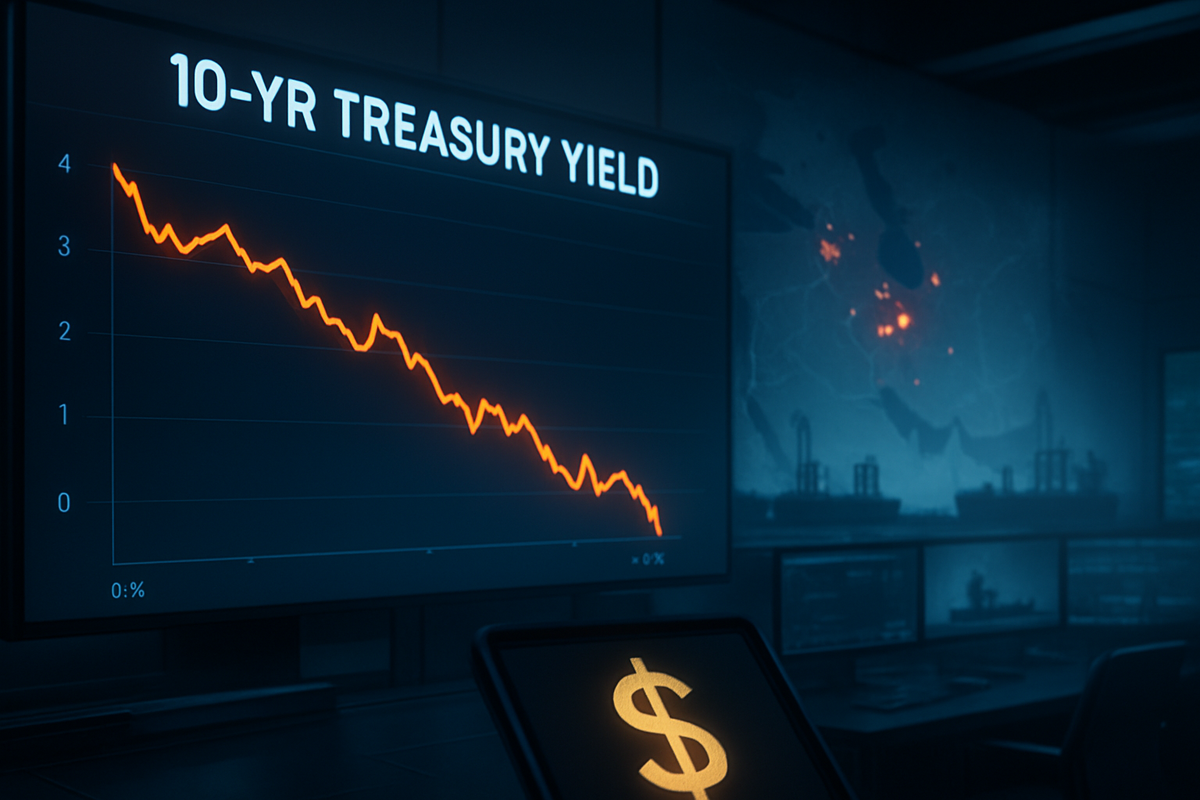
In a dramatic shift for global markets, U.S. Treasury bonds staged a massive rally on March 30, 2026, as investors fled a deteriorating geopolitical landscape and growing evidence of an impending economic downturn. The benchmark 10-year Treasury yield, a critical barometer for global borrowing costs, tumbled below the psychologically significant 4% threshold, hitting a low of 3.92%. This move reflects a desperate "flight to quality" as the dual threats of a widening conflict with Iran and a potential U.S. recession outweigh the inflationary pressures of soaring energy prices.
The bond market’s sudden move lower in yield (higher in price) comes as the "safety trade" enters a new, more urgent phase. Despite Brent crude oil prices hovering near $120 per barrel following the disruption of supply routes in the Middle East, the market is signaling that it fears an economic contraction more than it fears the resulting inflation. As of today, the inverted yield curve and the rapid descent of long-term rates suggest that institutional investors are bracing for a prolonged period of stagnant growth and a likely policy pivot from the Federal Reserve.
The Convergence of Conflict and Contraction
The current market volatility traces back to a series of escalations that began in late February 2026. On February 28, a coordinated military operation by U.S. and allied forces targeted critical Iranian military and energy infrastructure in response to regional provocations. The situation spiraled on March 4, when Tehran effectively closed the Strait of Hormuz, a maritime chokepoint responsible for approximately 20% of the world’s petroleum and 25% of its liquefied natural gas exports. The International Energy Agency (IEA) has since characterized this as the "largest supply disruption in history," sending shockwaves through global supply chains.
Initially, the bond market was paralyzed by the conflicting forces of "war inflation" and "safe-haven demand." Throughout early March, yields remained elevated as the surge in energy prices suggested that the Federal Reserve would be forced to keep interest rates higher for longer. However, the narrative shifted decisively in the last 72 hours. New economic data released on March 27 showed a sharp decline in U.S. consumer sentiment and a surprise contraction in manufacturing activity. This evidence of "stall speed" growth convinced many traders that the U.S. economy is no longer robust enough to withstand both high interest rates and triple-digit oil prices.
The rally on March 30 was further fueled by reports of increased military mobilization in the Persian Gulf, which prompted a massive wave of capital to exit riskier assets like equities and move into the relative safety of U.S. government debt. For the first time in nearly a year, the 10-year Treasury note is trading with a "3-handle," a milestone that has caught many aggressive short-sellers off guard and triggered a short-covering rally that accelerated the yield’s decline.
Markets in Flux: Winners and Losers in the "Safety" Era
The shift to a sub-4% yield environment has created a stark divide in the equity markets. Large-cap defense contractors have emerged as clear winners as the conflict with Iran necessitates a massive increase in procurement and military readiness. Lockheed Martin (NYSE: LMT) and Raytheon Technologies (NYSE: RTX) have seen their shares hit record highs this month, buoyed by the prospect of long-term defense spending. Similarly, energy giants such as ExxonMobil (NYSE: XOM) and Chevron (NYSE: CVX) have remained resilient, acting as a natural hedge against the supply-side shock in the Middle East.
Conversely, the technology sector has faced significant headwinds. Companies like NVIDIA (NASDAQ: NVDA) and Microsoft (NASDAQ: MSFT) have seen their valuations pressured by the broader "risk-off" sentiment. While lower yields typically benefit growth stocks by reducing the discount rate on future earnings, the current environment is different; the "recession fear" is so pervasive that it is overshadowing the benefit of lower rates. Investors are increasingly concerned that a severe economic slowdown will gut corporate spending on AI and cloud infrastructure, leading to a rare period of earnings contraction for the tech titans.
The transportation sector is perhaps the hardest hit by the current crisis. Airlines, including American Airlines (NASDAQ: AAL) and United Airlines (NASDAQ: UAL), are grappling with the "double whammy" of skyrocketing fuel costs and a looming drop in consumer travel demand. With Brent crude at $120, the operating margins for major carriers are being decimated, leading to widespread sell-offs in the travel and leisure space. Meanwhile, interest-rate-sensitive sectors like Real Estate Investment Trusts (REITs), including Prologis (NYSE: PLD), are seeing high volatility as they balance the benefits of lower benchmark rates against the risks of a commercial real estate slump triggered by a recession.
Analyzing the Macro Shift: A Policy Trap for the Fed
The bond rally of March 2026 is more than just a momentary reaction to a headline; it represents a fundamental shift in the global macroeconomic consensus. For the past two years, the prevailing "higher for longer" narrative dominated market thinking. However, the current "stagflationary" shock—characterized by stagnant growth and high energy-driven inflation—has placed the Federal Reserve in a precarious position. The central bank is currently trapped between the need to fight oil-induced inflation and the need to support a rapidly weakening economy.
Historically, this scenario echoes the oil shocks of the 1970s, but with a modern twist: the U.S. is now a major energy exporter, yet its domestic economy remains highly sensitive to global price fluctuations and the health of the technology sector. The "flight to safety" we are witnessing today suggests that the market believes the Fed will eventually be forced to choose growth over inflation. By driving yields below 4%, investors are effectively "pricing in" a series of interest rate cuts later this year, regardless of where the Consumer Price Index (CPI) stands.
Furthermore, this event highlights the increasing fragility of the global supply chain. The closure of the Strait of Hormuz has not only spiked energy prices but has also disrupted global shipping routes, leading to a "deglobalization" of trade that could have long-term structural impacts on inflation. In this context, U.S. Treasuries are regaining their status as the world’s ultimate "safe haven," even as the U.S. government deals with its own fiscal challenges.
The Road Ahead: What to Watch in Q2 2026
As we move into the second quarter of 2026, the primary focus for investors will be the Federal Reserve’s upcoming policy meeting in May. The market is currently pricing in a 65% chance of a "dovish pivot," where the Fed signals a pause or even a reduction in its quantitative tightening program to provide liquidity to a straining financial system. Any indication that the central bank is prioritizing economic stability over inflation targets could lead to a further drop in yields, potentially pushing the 10-year note toward 3.5%.
In the short term, the military situation in the Middle East remains the ultimate "wild card." Any signs of de-escalation or a partial reopening of the Strait of Hormuz would likely trigger a massive reversal in both oil and bond markets, as the "fear premium" is priced out of the assets. Conversely, if the conflict expands to include other regional powers, the flight to safety could intensify, leading to a "dash for cash" where even high-quality bonds might see liquidity issues as investors move into the most liquid asset of all: the U.S. Dollar.
Market participants should also keep a close eye on upcoming employment and retail sales data. If the labor market, which has been remarkably resilient through 2025, begins to show signs of cracking, the recession narrative will move from a "possibility" to a "certainty." For now, the bond market is sounding the alarm, and the sub-4% yield on the 10-year note is a signal that the era of aggressive interest rate hikes has come to an abrupt and violent end.
Conclusion: A Market at a Turning Point
The events of March 30, 2026, mark a significant turning point for the global financial landscape. The rally in U.S. Treasury bonds and the drop in the 10-year yield below 4% are clear indicators that the "safety" trade is once again dominant. While the conflict with Iran provided the immediate catalyst, the underlying fear of a deep and persistent recession is what is truly driving the massive reallocation of capital. Investors have decided that the risk of holding equities in a stagflationary environment is simply too high, opting instead for the guaranteed, albeit lower, returns of government debt.
Moving forward, the market will be characterized by extreme sensitivity to both geopolitical developments and macroeconomic data. The "soft landing" that many hoped for in 2025 appears to have been derailed by external shocks, leaving the global economy on a much more precarious path. For investors, the coming months will require a defensive posture, with a focus on liquidity, quality, and assets that can withstand both geopolitical instability and economic contraction.
As the 10-year yield continues to hover in this new territory, the primary takeaway is clear: the market is no longer looking for growth; it is looking for a place to hide. Whether the U.S. Treasury remains that hiding place or becomes part of a broader inflationary storm will be the defining story of the rest of 2026.
This content is intended for informational purposes only and is not financial advice.