The War for Warner: Netflix and Paramount-Skydance Square Off in a $100 Billion Media Armageddon
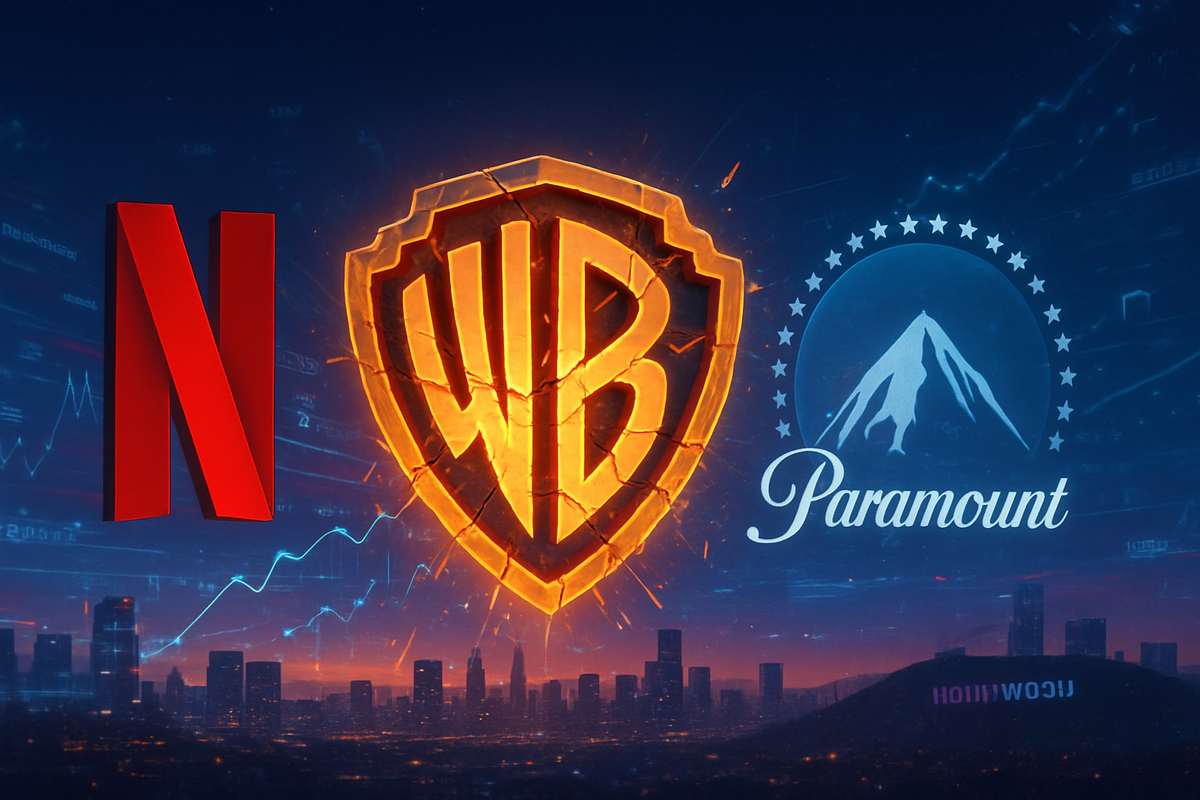
The global media landscape is currently witnessing its most transformative upheaval in decades as a fierce bidding war for Warner Bros. Discovery (NASDAQ: WBD) reaches a boiling point. Following years of post-merger integration and aggressive debt reduction, WBD has become the ultimate prize in a consolidation race that pits the streaming supremacy of Netflix, Inc. (NASDAQ: NFLX) against the newly minted titan Paramount, a Skydance Corporation (NASDAQ: PSKY). This battle for the "crown jewels" of Hollywood—including HBO, the Warner Bros. film studio, and the DC Universe—represents more than just a merger; it is a final struggle to determine which entities will survive the transition from the legacy cable era to a purely digital future.
As of January 19, 2026, the situation has devolved into a high-stakes legal and financial chess match. Netflix has secured a preliminary, board-approved agreement to acquire WBD’s premium studio and streaming assets, a deal that would effectively dismantle the legacy Discovery cable networks into a standalone entity. However, this "friendly" arrangement has been blindsided by a massive $108.4 billion hostile takeover bid from David Ellison’s Paramount-Skydance. With both bidders now offering all-cash deals and the Delaware Court of Chancery becoming the latest battlefield, the outcome will likely dictate the power dynamics of entertainment for the next generation.
The Battle Lines Are Drawn: A Timeline of the Hostile Pursuit
The current frenzy was ignited in October 2025 when Warner Bros. Discovery (NASDAQ: WBD) leadership announced they were exploring "strategic alternatives" to unlock shareholder value. This pivot came after the company successfully pared its massive debt load down to $34 billion, making it a viable acquisition target for the first time since the 2022 merger of WarnerMedia and Discovery. By December 2025, Netflix (NASDAQ: NFLX) appeared to have won the day, announcing a $82.7 billion deal to acquire the studio and streaming segments. This "asset-light" approach was designed to let Netflix bolster its library with HBO’s prestige content while avoiding the "melting ice cube" of WBD's linear cable channels like CNN and TNT.
The peace was short-lived. On December 8, 2025, the recently combined Paramount-Skydance (NASDAQ: PSKY)—which finalized its own merger in August 2025—launched a rival hostile bid. Backed by a $40 billion equity cushion from Oracle Corporation (NYSE: ORCL) co-founder Larry Ellison and several sovereign wealth funds, David Ellison’s PSKY offered $30.00 per share for the entirety of WBD. This move was intended to prevent the dismemberment of Warner Bros., with Ellison arguing that the "synergies of a unified studio" outweighed the benefits of Netflix’s selective acquisition.
Market reaction has been volatile but generally optimistic for WBD shareholders. Since the hostile bid was announced, WBD stock has surged, trading near the $29.00 mark, significantly above its 2024 lows. Analysts at major firms have noted that while Netflix provides the most stable "exit" for the streaming assets, the Paramount-Skydance offer represents a higher immediate valuation for the total company. The WBD board’s official rejection of the PSKY bid on January 14, 2026, has only intensified the conflict, leading to a proxy war and a lawsuit in Delaware to force the board to consider the higher offer.
The Spoils of War: Winners, Losers, and the "Orphaned" Networks
If Netflix (NASDAQ: NFLX) emerges victorious, it would cement its status as the "Global Content Utility." By absorbing the Warner Bros. film library and the HBO production machine, Netflix would effectively end the "streaming wars" by owning the most prestigious content pipeline in existence. This would be a massive win for Netflix subscribers but potentially a loss for creative diversity as another major studio falls under a single corporate banner. However, the "losers" in this scenario would be the legacy cable networks—CNN, Discovery, and TNT—which would be spun off into "Discovery Global," a company burdened with the declining linear business and stripped of its marquee streaming growth engine.
Conversely, a Paramount-Skydance (NASDAQ: PSKY) victory would create a "mega-major" studio capable of rivaling The Walt Disney Company (NYSE: DIS) in sheer scale. This would be a victory for David Ellison’s vision of a revitalized, artist-led Hollywood powerhouse. However, the financial strain of such a massive acquisition could be a significant risk. PSKY would inherit WBD's remaining debt plus the new financing required for the $108.4 billion purchase. Investors in PSKY are currently weighing whether the combined library of Paramount, Skydance, and Warner Bros. can generate enough cash flow to service this mountainous debt in a high-interest-rate environment.
For WBD shareholders, the battle is a win-win in the short term, as the bidding war has provided a significant floor for the stock price. The "losers" may ultimately be the consumers, who could face higher subscription prices as the number of independent streaming options shrinks. Furthermore, employees at both companies face the grim prospect of massive layoffs as the winning bidder looks to "optimize" operations and eliminate redundant roles across the two vast organizations.
A New Era of Consolidation: Industry Trends and Regulatory Hurdles
This M&A battle is the culmination of a decade-long trend toward vertical integration and the collapse of the mid-sized media company. The market has signaled that being a "pure-play" content creator is no longer enough; survival requires the massive scale and distribution power that only entities like Netflix or a combined Paramount-Warner can provide. This event mirrors the historical consolidation of the 1930s studio system, but with a digital twist. It also highlights the failure of the "streaming-lite" models of the early 2020s, which failed to achieve the necessary subscriber density to remain independent.
Regulatory scrutiny remains the largest hurdle for either deal. The Department of Justice (DOJ) and the Federal Trade Commission (FTC) have signaled deep concerns over the "Netflix-Warner" tie-up, fearing a monopsony in the market for creative talent. Meanwhile, the Paramount-Skydance bid faces its own unique challenges; because it is heavily backed by foreign sovereign wealth funds, the Committee on Foreign Investment in the United States (CFIUS) is expected to conduct a rigorous review. This regulatory "double-bind" means that even if a winner is declared in the boardroom, the deal may not close until late 2027.
The industry is also watching the "ripple effects" on other players. If WBD is taken off the board, companies like AMC Networks Inc. (NASDAQ: AMCX) or Lions Gate Entertainment Corp. (NYSE: LGF.A) become even more vulnerable, potentially leading to a final "clean-up" phase of media consolidation. The precedent set here—where a tech-first giant like Netflix acquires a 100-year-old studio—could also embolden Apple Inc. (NASDAQ: AAPL) or Amazon.com, Inc. (NASDAQ: AMZN) to make similar moves for remaining legacy assets.
The Final Act: What to Expect in 2026
The immediate future will be dominated by the Delaware Court of Chancery. A ruling on PSKY’s lawsuit is expected by late February 2026. If the court finds that the WBD board breached its fiduciary duty by favoring the lower Netflix offer, it could force a formal auction of the company. This would likely drive the price even higher, potentially attracting a "dark horse" bidder like a tech conglomerate or a private equity consortium.
In the short term, WBD management must maintain focus on its 2026 content slate, including high-stakes releases like the new DC Universe films. Any significant failure at the box office or a dip in Max subscriber numbers could weaken the company’s negotiating position. Conversely, if Netflix (NASDAQ: NFLX) manages to close its acquisition of the streaming assets, expect an immediate and aggressive integration of HBO content into the Netflix interface, a move that would likely trigger a massive shift in subscriber churn across the industry.
For the market, the coming months will be a period of intense "event-driven" trading. Investors should brace for headline-driven volatility as proxy votes are tallied and regulatory trial balloons are floated. The ultimate outcome will serve as a bellwether for whether the future of entertainment belongs to the tech-native platforms or the legacy-rich "mega-studios" that are attempting to reinvent themselves through sheer scale.
Closing Thoughts: The End of the Independent Major
The battle for Warner Bros. Discovery (NASDAQ: WBD) marks the definitive end of the "Post-AT&T" era of media. What began as a hopeful spin-off to find a new path has ended in a fight for survival. Whether the company is carved up by Netflix (NASDAQ: NFLX) or absorbed into the Paramount-Skydance (NASDAQ: PSKY) empire, the "Warner Bros." that existed for a century as an independent pillar of American culture is essentially a thing of the past.
Investors should watch for three key indicators in the coming months: the specific language of the Delaware court ruling, the stance of the FTC on the "Discovery Global" spin-off, and the participation of Larry Ellison in the proxy fight. If Ellison increases his equity backstop, it may signal that PSKY is willing to go even higher to secure the deal. This is more than a transaction; it is the final consolidation of the Golden Age of Content into the Age of the Platform.
This content is intended for informational purposes only and is not financial advice.