The Volatility Thaw: VIX Retreats to 24.54 as Geopolitical Shadows Recede
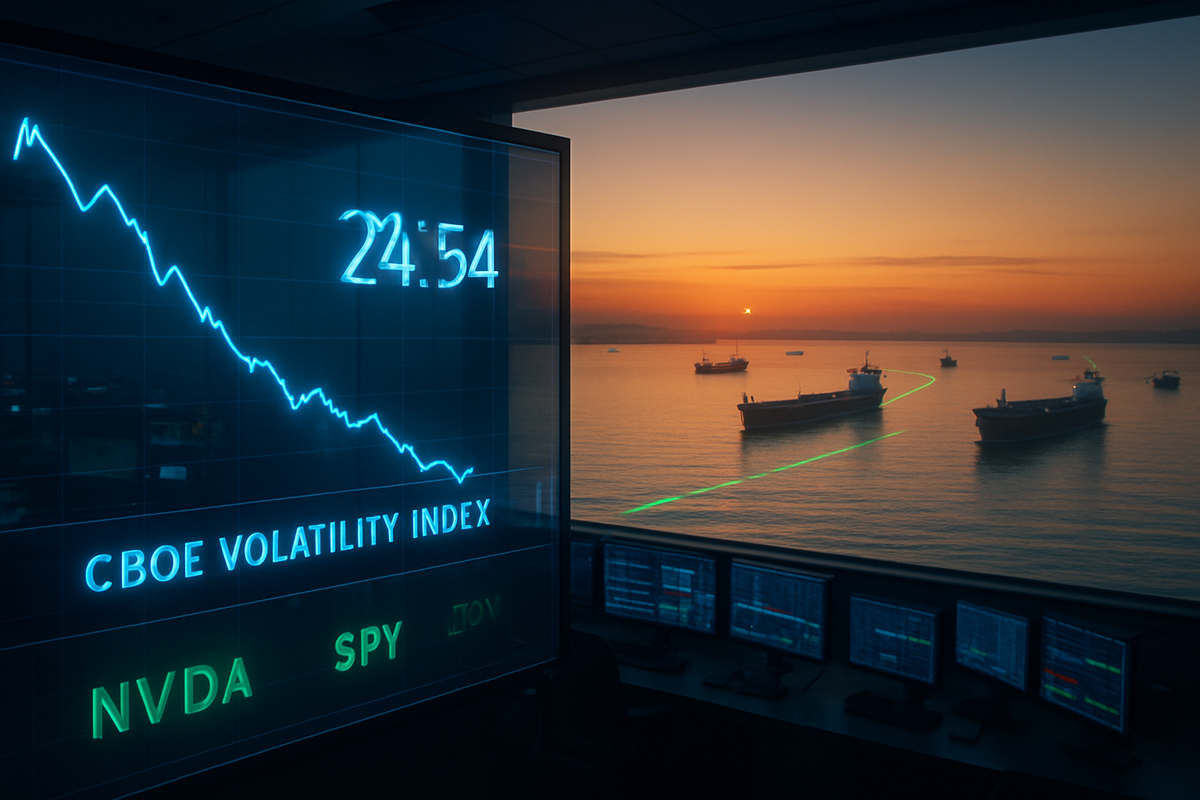
CHICAGO — April 6, 2026 — The "fear gauge" of Wall Street has finally shown signs of exhaustion. Following weeks of intense regional instability and energy supply threats, the CBOE Volatility Index (VIX) contracted to a closing level of 24.54 today. The retreat marks a significant cooling from the panic-induced heights of mid-March, where the index breached the 30-point threshold, signaling a reduction in the "geopolitical tail risks" that had kept investors on a defensive footing for the first quarter of the year.
While the descent to 24.54 is a welcome relief for equity bulls, market analysts are quick to point out that the current climate is far from serene. Historically, during sustained bull markets, the VIX typically oscillates between 12 and 18. Today’s reading remains nearly 40% above that long-term baseline, suggesting that while the immediate threat of a global energy blockade has subsided, a "new normal" of higher baseline volatility may be taking root in the mid-2020s.
The "Muscat Protocol" and the De-escalation of the Hormuz Crisis
The primary catalyst for this week’s volatility contraction was the surprise signing of the "Muscat Protocol" over the weekend. The diplomatic breakthrough, brokered by Oman, established a guaranteed "Green Channel" for commercial maritime traffic through the Strait of Hormuz. This region had become a flashpoint for global markets following "Operation Midnight Hammer"—a series of drone interdictions and infrastructure strikes that had previously pushed crude oil prices toward $120 per barrel and sent the CBOE Global Markets (BATS:CBOE) volatility products into a frenzy.
The timeline leading up to this moment was characterized by three months of escalating tensions. In early January 2026, fresh trade tariffs and regional disputes in the Middle East created a perfect storm of uncertainty. By February, the VIX had spiked as institutional investors rushed to purchase downside protection, driving up the cost of options across the board. The signing of the Muscat Protocol effectively neutralized the most extreme "tail risk"—the possibility of a total maritime blockade—allowing the SPDR S&P 500 ETF Trust (NYSEARCA:SPY) to reclaim key moving averages as the "panic premium" evaporated.
Initial market reactions have been tentatively positive. As the VIX dipped below 25, we saw an immediate unwinding of defensive hedges. Trading desks reported a significant decrease in the demand for protective puts, while short-volatility strategies, which had been dormant during the March volatility spike, began to see renewed inflows as the market bet on a continued reversion to the mean.
Winners and Losers in the Lower-Volatility Regime
The contraction of the VIX has created a clear divergence in corporate performance. Growth-oriented leaders, most notably Nvidia (NASDAQ:NVDA), have emerged as primary beneficiaries. As the "risk-off" sentiment faded, Nvidia saw a sharp rebound in its share price, recovering nearly 8% in the first week of April. For high-beta tech giants, a VIX reading below 25 acts as a green light for institutional re-allocation, as the cost of capital and the risk of sudden, gapped openings decrease.
On the other side of the ledger, leveraged volatility products have faced a brutal correction. The ProShares Ultra VIX Short-Term Futures ETF (BATS:UVXY), which provides 1.5x leveraged exposure to VIX futures, has plummeted more than 20% since the announcement of the Muscat Protocol. Investors who used these instruments as a "disaster insurance" during the February peak are now facing heavy drawdowns as the futures curve shifts back into contango. Conversely, products like the ProShares Short VIX Short-Term Futures ETF (BATS:SVXY) have seen a resurgence as traders seek to capture the "volatility risk premium" by betting against further spikes.
Financial institutions and exchanges have also seen a shift in momentum. While CBOE Global Markets (BATS:CBOE) benefits from high volume during periods of uncertainty, a stabilizing market allows for more structured product launches and a return to retail participation in standard equity options. Meanwhile, consumer-facing companies in the Consumer Discretionary Select Sector SPDR Fund (NYSEARCA:XLY) have gained ground as lower energy prices—tied to the geopolitical de-escalation—begin to ease the inflationary pressures on the American household.
A New Regime: Why 24.54 is Still a Warning Signal
The move to 24.54 represents a critical shift in the broader financial landscape. Since the early 2020s, the market has moved through distinct "volatility regimes." The current environment, while improved, is a far cry from the "Goldilocks" era of the late 2010s. Market historians point out that a VIX staying above 20 usually coincides with a "muddle-through" economy rather than a runaway bull market. The persistence of volatility at these levels suggests that structural issues—such as the 2025-2026 tariff adjustments and ongoing AI infrastructure spending debates—continue to weigh on investor confidence.
Furthermore, the "tail risk" may have shrunk, but it has not disappeared. Comparisons are being drawn to the post-2008 recovery and the 2020 post-pandemic rebound, where the VIX took nearly two years to return to sub-15 levels. The policy implications are significant: the Federal Reserve is unlikely to see a VIX of 24 as a sign that "financial conditions" are loose enough to justify a return to ultra-low rates. Instead, the current level of volatility provides a "higher floor" that keeps central bankers on a cautious path.
This persistent elevation also affects how competitors and partners interact. In a high-VIX environment, mergers and acquisitions (M&A) often stall because valuing companies becomes difficult amid constant price swings. The current retreat to 24.54 might be the minimum threshold needed to restart the stalled deal-flow between major tech and healthcare players that was frozen during the March panic.
Navigating the Higher Floor: The 2026 Outlook
Looking ahead, the market faces several potential "pivot points" in the remaining months of 2026. The most immediate challenge is the upcoming U.S. Midterm Elections. Historically, volatility tends to ramp up 90 days before an election as participants price in policy shifts. If the VIX cannot break below 20 before the summer, it is highly probable that the election cycle will push it back into the 30s, creating a "double-top" in volatility that could stifle annual gains for the broader indices.
Strategically, investors are being forced to adapt. The "buy the dip" mentality of the 2010s is being replaced by "active hedging." Asset managers are increasingly incorporating volatility-targeting strategies that automatically scale exposure based on the VIX level. If the index settles in a 20-25 range, we can expect to see more "market-neutral" and "long-short" funds outperforming traditional long-only benchmarks like the Vanguard Total Stock Market ETF (NYSEARCA:VTI).
Short-term, the focus remains on the implementation of the Muscat Protocol. Any violation of the "Green Channel" in the Middle East would likely result in a violent "volatility spike," as the market would view the failure of diplomacy as a sign that tail risks are unhedgeable. However, if the peace holds, the opportunity for a "volatility crush" toward the high teens remains the most attractive trade for the second quarter.
Investor Outlook: Caution Amidst the Calm
In summary, the contraction of the VIX to 24.54 is a necessary first step toward market normalization, but it is not a "clear all" signal. The reduction in geopolitical tail risk has removed the immediate threat of a systemic shock, yet the underlying market structure remains fragile. Investors should take heart in the resilience of mega-cap leaders like Microsoft (NASDAQ:MSFT) and Nvidia, but they must remain cognizant of the historical context.
The market moving forward will likely be one of "high-frequency rotations" rather than a singular upward trend. Moving from a regime of "extreme fear" to "moderate concern" allows for tactical opportunities, but the elevated VIX floor reminds us that we are still in a high-interest-rate, high-friction global economy.
Watch for the VIX to test the 20.00 psychological level in the coming weeks. A sustained break below that mark would signal the true return of a bull market. Until then, 24.54 serves as a reminder that while the storm has passed the harbor, the seas remain choppy.
This content is intended for informational purposes only and is not financial advice.