The Transcontinental Titan: Inside the $85 Billion Battle to Redraw the American Rail Map
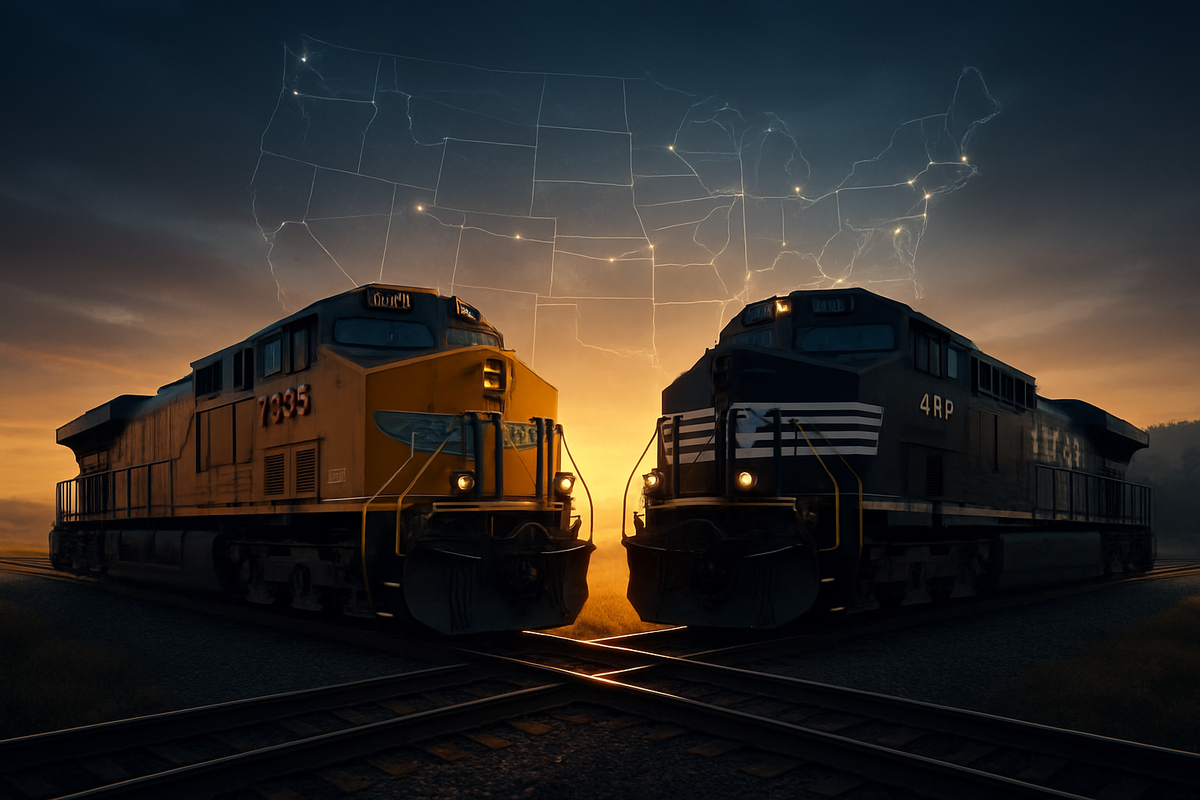
OMAHA, NE and ATLANTA, GA — In a move that has sent shockwaves through the global logistics industry and ignited a firestorm of regulatory scrutiny, Union Pacific (NYSE:UNP) and Norfolk Southern (NYSE:NSC) are aggressively pursuing a historic $85 billion merger. The deal, which aims to create the first truly transcontinental railroad in United States history, would establish a single-line freight network stretching across 43 states and connecting over 100 ports from the Pacific to the Atlantic.
However, as of February 6, 2026, the path to consolidation has hit a significant regulatory wall. The Surface Transportation Board (STB), the federal agency tasked with overseeing rail competition, recently issued a unanimous decision labeling the companies' merger application "incomplete." This setback has paused the momentum of what would be the most significant industrial realignment in over a century, leaving investors and industry stakeholders questioning whether the "Great Connection" will ever leave the station.
A $320-Per-Share Bet on the Future of Freight
The merger, first announced in July 2025, is structured as a massive stock-and-cash acquisition of Norfolk Southern by Union Pacific. Under the terms of the agreement, Norfolk Southern shareholders are set to receive $320 per share—a premium that reflects the high stakes of the deal. The consideration is split into 1.0 share of Union Pacific common stock plus $88.82 in cash for each share of Norfolk Southern owned. If finalized, Norfolk Southern shareholders would retain approximately 27% of the combined entity.
The timeline leading to this moment has been a whirlwind of high-stakes negotiations and mounting opposition. After reaching a definitive agreement last summer, the companies spent the latter half of 2025 preparing a massive, 7,000-page application to the STB. The vision presented was grand: eliminating the "East-West" divide that has plagued U.S. rail travel since the 1800s. Currently, freight moving across the country must be handed off between carriers at congested "gateways" like Chicago and St. Louis, often resulting in 24–48 hour delays. The merger proposes to bypass these bottlenecks entirely.
However, on January 16, 2026, the STB threw a wrench in the plans. Led by Chairman Patrick Fuchs, the board ruled that the application failed to meet the rigorous "Major Merger Rules" established in 2001. Specifically, the board critiqued the railroads for using outdated 2023 data for their market-share projections instead of providing forward-looking analyses. The railroads now face a February 17, 2026, deadline to state their intent to refile, with a revised application not expected until at least June.
Identifying the Winners and Losers in a Two-Railroad Nation
The potential creation of a transcontinental giant has created clear divides between those who stand to gain and those who fear obsolescence.
The Winners: Shareholders of Union Pacific (NYSE:UNP) and Norfolk Southern (NYSE:NSC) are the most immediate beneficiaries, with the companies projecting between $2.5 billion and $2.75 billion in annual synergies within three years. Intermodal shippers—those moving goods that can easily switch between truck and rail—also see potential in the "truck-competitive" solution. The combined network aims to convert two million truckloads from highways to rail annually, a move that could lower carbon emissions and reduce road wear.
The Losers: Rival railroads and small-scale shippers are sounding the alarm. BNSF Railway—owned by Berkshire Hathaway (NYSE:BRK.B)—and CSX Transportation (NASDAQ:CSX) face the prospect of a competitor with unparalleled scale. While CSX has responded by forming a "Triple Alliance" with Canadian Pacific Kansas City (NYSE:CP) to link Mexico to the U.S. Southeast, industry analysts warn that these partnerships may not be enough to counter a unified UNP-NSC network. Agricultural groups, including the National Grain and Feed Association, are perhaps the most vocal opponents, fearing that a "duopoly" in the rail sector will lead to higher rates and reduced service for "captive" shippers who have no other transportation options.
A Stress Test for the 2001 Merger Rules
The significance of this merger extends far beyond the financial balance sheets of two companies; it represents a fundamental test of the STB’s 2001 Major Merger Rules. These rules were designed to be so stringent that they would effectively end the era of rail consolidation. Since then, no major merger has been approved until the recent, smaller-scale combination of Canadian Pacific and Kansas City Southern. This $85 billion proposal is the first time the "Big Four" U.S. railroads have attempted to merge under this modern regulatory framework.
The "Great Connection" also highlights a broader shift in industry trends: the pivot from "Precision Scheduled Railroading" (PSR)—which focused on cost-cutting—to a growth-oriented model. By creating a single-line service, UNP and NSC are betting that they can compete directly with the long-haul trucking industry. However, the regulatory hurdle remains high. Bipartisan groups in Congress, including the "Monopoly Busters Caucus," have urged the STB to remain skeptical, citing concerns over safety following the 2023 East Palestine derailment and the potential for a "permanent restructuring" of the U.S. economy.
The Tracks Ahead: What Comes Next?
The immediate future of the merger rests on the railroads' willingness to offer significant concessions. To appease the STB and skeptical shippers, Union Pacific has already proposed "Committed Gateway Pricing," a mechanism intended to guarantee competitive rates for third-party railroads at key interchanges. However, industry experts believe the STB will demand even more, such as "reciprocal switching" rights—allowing a competing railroad to use the combined company’s tracks to serve specific customers.
The June 2026 refiling will be the most critical milestone. If the railroads cannot satisfy the STB’s demands for modern data and competitive safeguards, the $2.5 billion reverse termination fee could become a reality. Investors should also watch for strategic pivots from BNSF and CSX. If the merger begins to look likely, a "defensive merger" between BNSF and CSX, though legally difficult, could be the only way for the remaining players to maintain parity.
The Bottom Line for Investors
The proposed Union Pacific-Norfolk Southern merger is a high-reward, high-risk gambit that could either revolutionize American logistics or lead to a protracted legal battle that ends in a historic collapse. The vision of a 52,000-mile network is compelling, but the regulatory climate in 2026 is far more hostile to consolidation than it was in decades past.
For investors, the key watch-items in the coming months will be the STB’s reaction to the refiled application and the stance taken by the Department of Justice’s Antitrust Division. While the $320-per-share offer remains on the table, the stock prices of both (NYSE:UNP) and (NYSE:NSC) are likely to remain volatile as they navigate a regulatory gauntlet that is only just beginning. The dream of a transcontinental railroad is closer than it has been in 150 years, but the "Great Connection" still has many miles of red tape to clear.
This content is intended for informational purposes only and is not financial advice.