The Silver Super-Cycle: How the 'White Metal' Shattered $70 and Redefined the Commodity Landscape
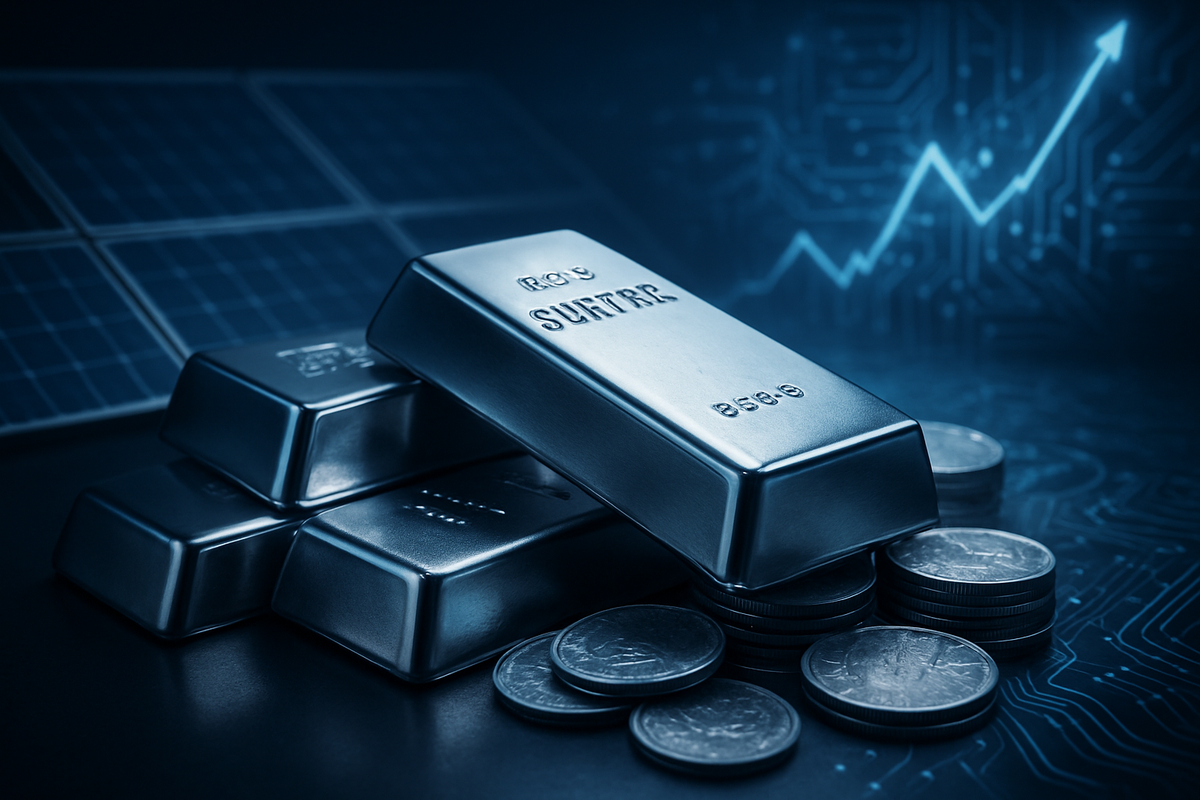
As of December 23, 2025, the global financial markets are witnessing a paradigm shift in the commodities sector as silver has officially breached the $70 per ounce mark. This historic milestone, reached during early trading on the COMEX in New York and mirrored in the London and Shanghai markets, represents a staggering 140% year-to-date return. Long overshadowed by its "yellow sibling," silver has finally broken out of its decade-long shadow, outperforming gold by a significant margin and cementing its status as the premier asset of the mid-2020s.
The immediate implications of this price surge are reverberating through every corner of the global economy. From the boardrooms of Silicon Valley to the solar farms of the Gobi Desert, the "white metal" is no longer just a speculative play for retail investors; it has become a critical bottleneck for the green energy transition. With global inventories at major exchanges like the London Bullion Market Association (LBMA) plummeting to twenty-year lows, industrial users are now competing directly with institutional funds in a desperate scramble for physical delivery, creating a "silver squeeze" that many analysts believe is only just beginning.
The Road to $70: A Multi-Year Physical Squeeze
The ascent to $70 per ounce was not an overnight phenomenon but the culmination of a structural supply-demand imbalance that has been building since 2021. The market entered 2025 on the heels of a 21.5% gain in 2024, but the rally intensified in the second half of this year. The psychological breakthrough occurred in October 2025, when silver finally surpassed its previous nominal all-time high of approximately $50 per ounce. Once that resistance level—which had held since 1980 and 2011—was shattered, technical buying and short-covering accelerated the price toward the current $70 level.
Key to this timeline was the realization that the world is currently in its fifth consecutive year of a structural silver deficit. Cumulative shortfalls between 2021 and 2025 are estimated to exceed 800 million ounces, nearly a full year's worth of global mine production. Unlike previous rallies, this surge has been driven by the "Green Revolution." Advanced solar technologies, specifically TOPCon and HJT cells, now require up to 50% more silver than older models, and global solar installations have far exceeded 2023 projections. Furthermore, the 2025 AI boom has added a new layer of demand, as silver's unmatched conductivity makes it essential for the high-performance servers and data centers powering generative artificial intelligence.
Market reactions have been swift and dramatic. In major global hubs like the Shanghai Gold Exchange (SGE), premiums for physical silver have soared as high as 15% over the London spot price, indicating a massive geographic dislocation in supply. Institutional players, including major pension funds and sovereign wealth funds, have reportedly begun shifting allocations away from traditional fixed-income assets and into silver-backed ETFs, viewing the metal as both a hedge against persistent global inflation and a high-growth industrial commodity.
Winners and Losers: The Corporate Fallout
The primary beneficiaries of the $70 silver era are the pure-play mining companies and royalty firms. First Majestic Silver (NYSE: AG) has emerged as a top performer, with its stock price soaring over 220% in 2025 as it capitalized on its high-leverage exposure to the metal. Similarly, Coeur Mining (NYSE: CDE) saw a 179% return following its successful expansion of the Rochester Mine. Pan American Silver (NYSE: PAAS) and Hecla Mining (NYSE: HL) have also posted massive gains, with Hecla benefiting specifically from silver’s recent addition to the U.S. Critical Minerals List, which has streamlined domestic permitting processes.
However, the most efficient winners have been the royalty and streaming companies, led by Wheaton Precious Metals (NYSE: WPM). With a business model that allows it to purchase silver at fixed, low costs—often under $6 per ounce—Wheaton’s margins have expanded exponentially, driving its market capitalization past the $50 billion mark. Franco-Nevada (NYSE: FNV) and Royal Gold (NASDAQ: RGLD) have also seen record cash flows as their silver streams provide a massive tailwind to their diversified portfolios.
Conversely, the high price environment has created significant headwinds for industrial consumers. Solar manufacturers like JinkoSolar (NYSE: JKS) have faced severe margin compression, as silver now accounts for nearly 15% of total module costs, up from just 5% two years ago. While First Solar (NASDAQ: FSLR) has remained more resilient due to its thin-film technology which uses less silver, the broader solar industry is being forced to raise prices, potentially slowing the pace of global decarbonization. In the automotive sector, Tesla (NASDAQ: TSLA) and other EV makers are feeling the pinch in their battery management systems and power electronics, which are silver-intensive. While Tesla's stock reached record highs in late 2025 due to its AI and robotics initiatives, the rising cost of raw materials remains a persistent concern for its hardware margins.
Wider Significance: A Historic Departure from the Past
To understand the magnitude of the 2025 silver surge, one must compare it to the historical peaks of 1980 and 2011. In 1980, the price spike was largely driven by the Hunt Brothers' attempt to corner the market; in 2011, it was a reaction to the Eurozone crisis and quantitative easing. Both of those peaks were speculative bubbles that collapsed quickly. The 2025 rally, however, is fundamentally different because it is rooted in industrial scarcity. Silver has transitioned from being "the poor man’s gold" to a critical industrial mineral essential for the 21st-century economy.
This shift has profound policy implications. Governments are now treating silver as a strategic asset. China's recent announcement that it will restrict silver exports starting in January 2026 has sent shockwaves through the market, mirroring earlier restrictions on gallium and germanium. This "resource nationalism" is forcing Western nations to reconsider their supply chains, potentially leading to new subsidies for domestic silver recycling and mining. The gold-to-silver ratio, which historically averaged 80:1, has compressed to 64:1, signaling that silver is finally being valued for its utility rather than just its rarity.
The Outlook: Is $100 the Next Stop?
As we look toward 2026, the short-term outlook remains extremely bullish, though not without risks. The primary challenge for the silver market will be "thrifting" and substitution. If prices remain above $70, industrial users will accelerate efforts to replace silver with copper or nickel. However, such transitions are technically difficult and often result in lower efficiency and reliability, meaning a total substitution is unlikely in the next 24 to 36 months. Analysts at major institutions like Bank of America have already begun floating the possibility of $100 silver by late 2026 if the structural deficit is not addressed through massive new mining investment.
For investors, the key factor to watch will be the behavior of central banks and the movement of physical inventories. If COMEX and LBMA stocks continue to dwindle at their current pace, we could see a "force majeure" event or a total breakdown in the paper-to-physical pricing mechanism. Strategic pivots are already occurring; many electronics firms are moving toward long-term off-take agreements directly with miners to bypass the volatile spot market, a move that could further reduce liquidity on public exchanges.
Final Thoughts and Investor Takeaways
The silver market’s journey to $70 per ounce is more than just a price rally; it is a revaluation of one of the world’s most versatile elements. The convergence of the green energy transition, the AI revolution, and a decade of mining underinvestment has created a "perfect storm" that has finally unleashed silver’s potential. Moving forward, the market will likely remain volatile as it digests these gains, but the era of "cheap silver" appears to be firmly in the rearview mirror.
Investors should closely monitor the gold-to-silver ratio and the quarterly production reports from primary miners. While the current prices offer immense rewards for producers, the potential for government intervention and the rapid development of silver-free technologies are the primary risks to the long-term bull case. For now, silver remains the undisputed king of the 2025 commodity market, proving that the "white metal" can indeed shine brighter than gold.
This content is intended for informational purposes only and is not financial advice.