The S&P 500's New Frontier: Record Highs Meet the Great Sector Rotation of 2026
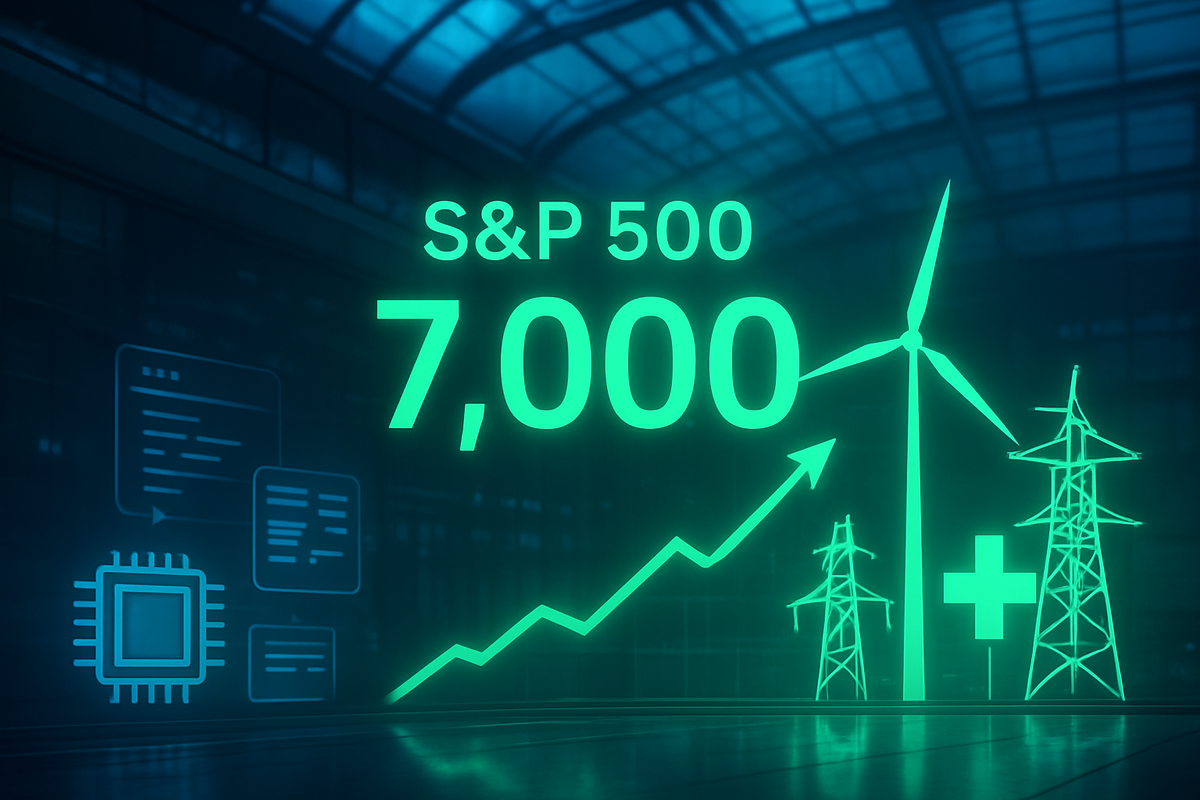
As the calendar turned to January 2026, the S&P 500 carved out a historic milestone, surmounting the psychological 7,000 level for the first time. This rally, coming off the heels of a robust 2025, initially appeared to be a continuation of the artificial intelligence-driven "melt-up" that has defined the post-pandemic era. However, beneath the surface of the index’s headline records, a more nuanced story is unfolding: the "Great Realignment." Investors are aggressively pivoting away from the mega-cap technology giants that have dominated the last three years, instead seeking refuge and value in the physical backbone of the economy.
This rotation is not merely a tactical shift but a structural sea change. The "Magnificent Seven" have begun to show signs of valuation fatigue, with their collective market cap stalling as the broader market participation widens. As capital flows out of software and silicon, it is pouring into "real-world" assets, including energy, utilities, and healthcare. For the first time in nearly a decade, the "other 493" stocks in the S&P 500 are not just participating in the rally but are actively leading it, signaling a transition from speculative growth to disciplined, infrastructure-led expansion.
The path to 7,000 was paved by a late-2025 surge in GDP growth, which hit an annualized rate of 4.3% in the third quarter. This economic resilience, combined with the Federal Reserve’s pivot to three consecutive rate cuts in late 2025, created a "Goldilocks" environment of easing financial conditions and steady growth. By the second week of January 2026, the S&P 500 had cemented its record-breaking status, though the mood on trading floors has shifted from exuberant to elective. The Federal Funds rate currently sits in the 3.5%–3.75% range, and while the Fed has entered a "wait and see" mode for January, the market is already pricing in a terminal rate of 3.0% by year-end.
The primary catalyst for this shift has been the evolution of the AI narrative. The era of "AI experimentation" has officially ended, replaced by a demanding "AI execution" phase. While the first two years of the boom were characterized by massive capital expenditures (capex) from hyperscalers, early 2026 has seen a deceleration in that spending growth. Investors are no longer rewarding companies just for mentioning "agentic AI" in earnings calls; they are now scrutinizing the tangible return on investment. This cooling of hype has triggered a massive redistribution of wealth within the index, as the market identifies the physical limitations of the digital revolution—specifically, the insatiable demand for power and hardware cooling.
The most visible casualties of this rotation are the former market darlings. Nvidia (NASDAQ:NVDA), while still a hardware titan, has seen its shares struggle to maintain their 2025 highs, falling roughly 2% in the first half of January as investors look toward the H2 2026 launch of the "Vera Rubin" chip with uncharacteristic caution. Similarly, Microsoft (NASDAQ:MSFT) has pulled back approximately 12% from its late-2025 peak, trading near $475 as it transitions into a more "mature" phase of AI integration. Apple (NASDAQ:AAPL) remains under pressure as well, with investors questioning its reliance on a stagnating smartphone market despite its new AI partnerships with Google.
In contrast, the "New Engines" of the 2026 market are found in the most traditional of sectors. NextEra Energy (NYSE:NEE) has emerged as a quintessential AI play, re-rated by analysts as critical "AI infrastructure." NextEra’s success in securing turbine slots and restarting nuclear plants, such as the Duane Arnold facility, has allowed it to provide 24/7 carbon-free power directly to data centers, bypassing a congested national grid. ExxonMobil (NYSE:XOM) has similarly pivoted, leveraging its natural gas assets as a "reliability product" for tech giants, leading the energy sector to a 7.5% gain in early January. Meanwhile, UnitedHealth (NYSE:UNH) has become the go-to "quality and value" play, recovering from a bruising 2025 as medical cost inflation stabilizes and its Optum segment sees margin expansion.
The broader significance of this market shift is deeply tied to the implementation of the "One Big Beautiful Bill Act" (OBBBA), which became fully effective on January 1, 2026. This landmark legislation made permanent the 37% top individual tax rate and the 20% qualified business income deduction, providing a stable fiscal floor for corporate earnings. However, the bill also introduced the "Section 899 Revenge Tax," which imposes retaliatory tariffs on foreign entities from countries with "unfair" tax laws. This has caused a ripple effect through the financial sector, as domestic leaders like JPMorgan Chase (NYSE:JPM) are shielded from these taxes while foreign competitors face increased costs.
Historically, this rotation mirrors the "post-bubble" realignments of 2000 and 2022, but with a crucial difference: the current market is not crashing; it is broadening. The OBBBA’s deregulatory tilt, including a massive budget cut for the Consumer Financial Protection Bureau (CFPB), has emboldened big banks, even as the administration proposes new caps on credit card interest rates that have caused short-term volatility for JPM. This tug-of-war between deregulation and populist consumer policy is creating a "trader’s market" where stock selection is paramount, and the "rising tide" of the Mag 7 is no longer lifting all boats.
Looking toward the remainder of 2026, the short-term outlook is dominated by the upcoming midterm elections. Historically, election years bring a high degree of volatility, with the S&P 500 often experiencing mid-year drawdowns of up to 18% before recovering. Strategic pivots will be required for investors who have grown accustomed to a "tech-only" strategy. The focus is shifting toward "behind-the-meter" power solutions and the "turbine choke point," where companies that own the physical means of energy production hold the most leverage.
In the long term, the market's trajectory will depend on whether the Fed can successfully navigate the final mile of the inflation fight. With Headline CPI holding steady at 2.7%, the "glide path" to 2% remains elusive. If inflation proves stickier than expected, the defensive rotation into sectors like healthcare and utilities could accelerate. Conversely, if the Fed reaches its terminal rate of 3% by late 2026 without a recession, the "Real economy" stocks could see a multi-year bull run that eclipses the tech boom of the early 2020s.
The start of 2026 has marked the end of an era and the beginning of a more diversified, infrastructure-heavy market. The S&P 500 hitting 7,000 is a testament to the strength of the U.S. economy, but the rotation into Energy, Materials, and Utilities highlights a new reality: the digital world is only as strong as the physical grid that supports it. Investors should view this shift not as a sign of weakness in tech, but as a maturation of the market.
Moving forward, the key takeaway is "dispersion." The gap between winners and losers is widening, and the days of passive index-tracking providing easy double-digit returns may be fading. Investors should watch for the impact of the OBBBA on multinational earnings and keep a close eye on the "AI Power Boom" within the utility sector. In this new landscape, the "Magnificent Seven" have passed the torch to the "Essential Infrastructure," and those who adapt to this "Great Realignment" will be best positioned for the years ahead.
This content is intended for informational purposes only and is not financial advice