The Rust Belt Resurgence: Unexpected Manufacturing Surge Hits 52.6, Sparking Wall Street Rally
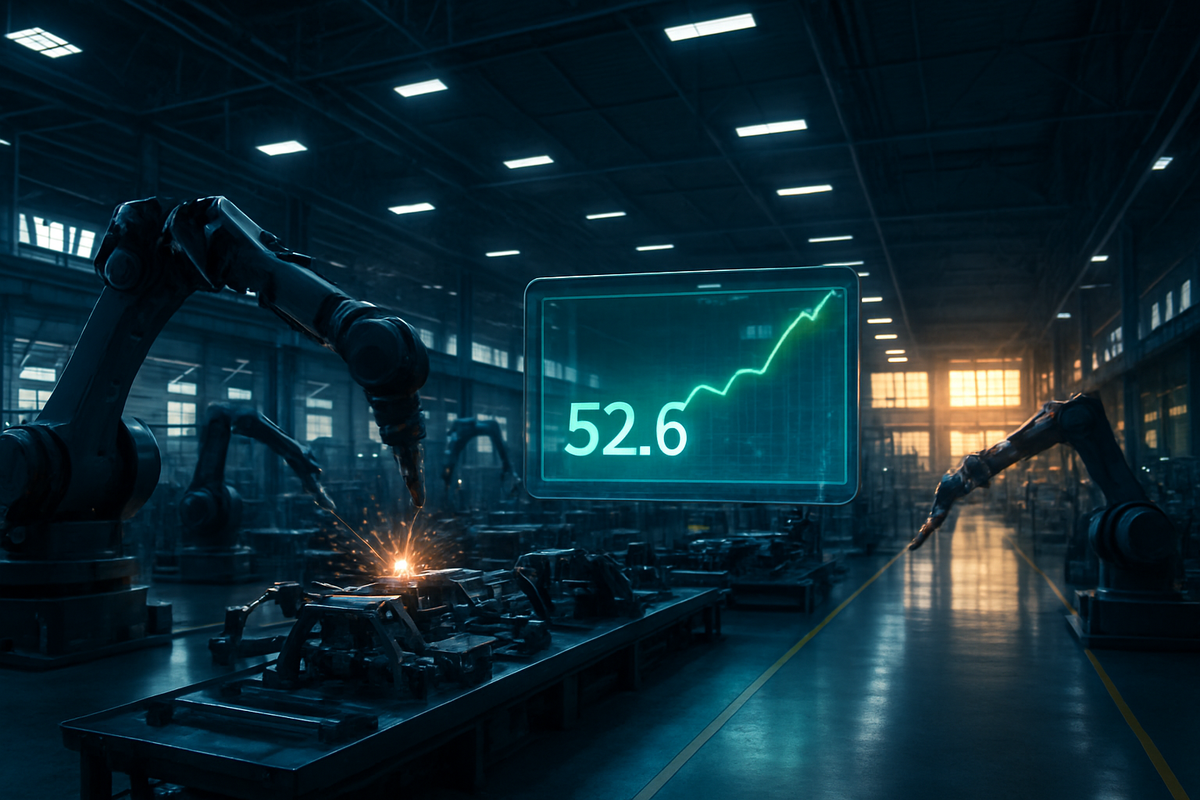
In a stunning reversal of a year-long industrial malaise, the U.S. manufacturing sector roared back to life this week as the Institute for Supply Management (ISM) released its latest Purchasing Managers' Index (PMI) data. The report, made public on February 6, 2026, showed the manufacturing PMI climbing to a robust 52.6—a figure that blew past the consensus Wall Street estimate of 48.5. This marks the first time in twelve months that the index has crossed the 50-point threshold, which separates industry expansion from contraction, signaling a potential new dawn for the American industrial core.
The immediate reaction on Wall Street was one of exuberant relief. Equity markets surged as the data suggested that the high-interest-rate environment of 2025 had finally failed to suppress the resilience of domestic production. With the PMI acting as a leading indicator for GDP growth, the "beat" of over four percentage points has recalibrated economic forecasts for the first quarter of 2026, turning what many feared would be a stagnant winter into a season of renewed industrial vitality.
The 52.6 Surprise: A Detailed Breakdown
The data released on February 6 represents a seismic shift in the manufacturing landscape. For much of 2025, the sector was mired in a contractionary phase, hampered by a Federal Reserve that held interest rates in the 3.5% to 3.75% range to combat "sticky" inflation. However, the January data (published in full this week) reveals a massive 9.7-point spike in the New Orders Index, which hit 57.1. This surge in demand was mirrored by a jump in the Production Index to 55.9, the highest level of output seen since the post-pandemic recovery years.
The timeline leading up to this moment was fraught with skepticism. In late 2025, a brief federal government shutdown and persistent trade uncertainties had led many analysts to project a "lower for longer" trajectory for U.S. factories. Instead, five of the six largest manufacturing industries reported growth this month, led by Transportation Equipment and Computer & Electronics. This broad-based recovery suggests that the momentum is not just a fluke in one sub-sector, but a systemic strengthening of the supply chain.
Key stakeholders, including the ISM Manufacturing Business Survey Committee, noted that a "tariff pull-forward" played a significant role in the data. With new trade policies and potential levies on international partners loomimg for mid-2026, domestic firms have accelerated their procurement cycles. This "buy now, produce now" mentality has temporarily offset the headwinds of high borrowing costs, creating a high-velocity environment for factory floors from Ohio to South Carolina.
Winners and Losers: Who Benefits from the Industrial Bloom?
Leading the charge in the equity markets was Caterpillar Inc. (NYSE: CAT), whose shares surged over 6% following the report. As a bellwether for global industrial health, Caterpillar is uniquely positioned to benefit from the rise in new orders. The company recently announced a $725 million investment in its Lafayette, Indiana, facility to ramp up production of high-output engines—not just for construction, but to meet the skyrocketing demand for backup power in AI-driven data centers.
Similarly, Deere & Company (NYSE: DE) has emerged as a significant winner. After a bruising 2025 that management described as the "bottom" of the agricultural cycle, the 52.6 PMI reading serves as a validation of their strategic pivot. Deere’s aggressive move to open a new excavator factory in North Carolina and a massive distribution center in Indiana allows them to bypass traditional overseas supply chains, perfectly aligning with the current trend of reshoring that the PMI data reflects.
On the other side of the ledger, the news was less welcoming for the bond market and defensive sectors. As the PMI data suggests a re-acceleration of the economy, Treasury yields spiked on the assumption that the Federal Reserve may delay further rate cuts. This put immediate pressure on capital-intensive utilities and "safe haven" stocks. Additionally, while steel producers like Nucor Corporation (NYSE: NUE) saw their stock prices rise alongside increasing prices for raw materials, the "Prices Index" component of the PMI hit 59.0, indicating that companies with low pricing power may soon see their margins squeezed by rising input costs for steel and copper.
Wider Significance: Tariffs, Trends, and the Fed’s Dilemma
The broader significance of the February 6 data lies in its timing and its implications for federal policy. The 52.6 reading is not just a number; it is a sign that the "near-shoring" movement is finally hitting its stride. For years, economists have debated whether the U.S. could truly rebuild its industrial base. The current expansion, fueled by investments in domestic computer and electronics manufacturing, suggests that the CHIPS Act and similar industrial policies are beginning to manifest in hard data.
However, this recovery presents a double-edged sword for the Federal Reserve. With the Prices Index rising at its fastest pace in three years, the ghost of inflation remains a persistent threat. If the manufacturing sector continues to run hot, it could lead to a "re-inflationary" cycle that forces the Fed to keep rates higher for longer, potentially stifling the very recovery we are seeing today. This creates a delicate balancing act for policymakers who must decide if the 52.6 PMI is a sign of a "soft landing" or an overheating engine.
Historically, such a sharp rebound in the PMI often precedes a period of sustained GDP growth. Compared to the post-2008 recovery, the current bounce is more localized and driven by high-tech manufacturing rather than housing. This shift toward "advanced manufacturing" means the U.S. economy may be becoming less sensitive to traditional interest rate cycles and more dependent on technological infrastructure and geopolitical trade stability.
Looking Ahead: Sustainability and the Q2 Outlook
The most pressing question for investors and industry leaders is whether this momentum can be sustained into the second quarter of 2026. While the surge in New Orders is promising, there is a risk of an "output-order mismatch." If companies have indeed "pulled forward" their demand to beat upcoming tariffs, we could see a significant drop-off in orders by the summer. Strategic pivots will be required; companies that have built up excess inventory may find themselves forced to discount if the demand side of the economy cools.
In the short term, the market will be hyper-focused on Q1 earnings calls, looking for confirmation that these PMI numbers are translating into bottom-line growth. We expect to see a surge in capital expenditure (CapEx) announcements from firms in the GE Aerospace (NYSE: GE) and GE Vernova (NYSE: GEV) ecosystems, as they look to capitalize on the 3.8% projected increase in industrial power consumption.
Longer-term, the challenge will be labor. Despite the production boom, the PMI's Employment Index remains in a slight contraction at 48.1. Factories are producing more, but they are doing so with more automation and fewer new hires. This "jobless industrial growth" could become a major political and economic theme as 2026 progresses, potentially leading to new regulatory discussions around AI in the workplace and domestic labor incentives.
Final Wrap-up: A New Chapter for the American Factory
The U.S. Manufacturing PMI of 52.6 is a watershed moment for the 2026 economy. It represents the end of a painful contractionary period and the beginning of what appears to be a robust, if complicated, expansion. The key takeaway for the market is clear: the American industrial sector is not just surviving the high-rate environment—it is evolving through it.
Moving forward, investors should keep a close eye on the "Prices" and "Employment" sub-indices. While the headline number is bullish, the underlying cost pressures could still derail the rally if not managed. The market has signaled its approval for now, but the true test will come in the next three months as we see if "near-shoring" and "tariff-front-running" can transition into a stable, long-term growth phase. For now, the "Rust Belt" is looking remarkably polished.
This content is intended for informational purposes only and is not financial advice.