The Nuclear Chill: Constellation Energy Shares Plunge 7% as 2026 Outlook Falls Short of AI Hype
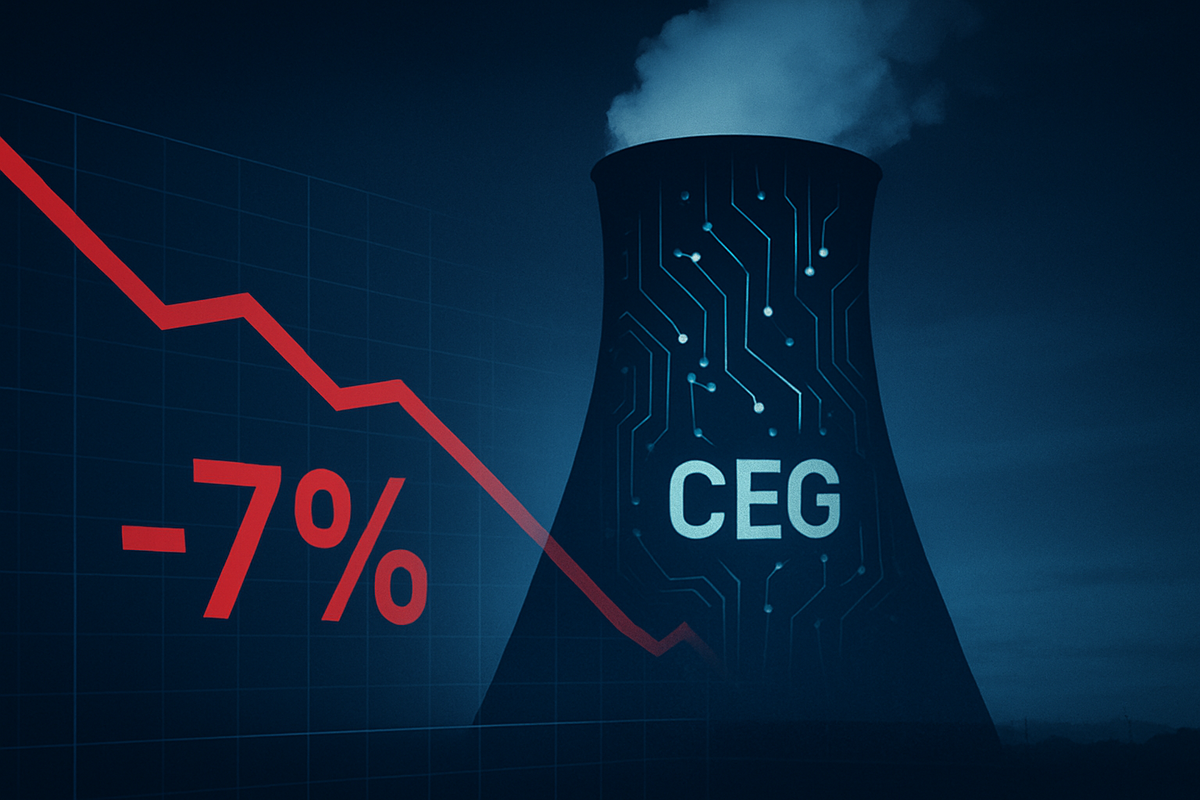
BALTIMORE — Shares of Constellation Energy (NASDAQ:CEG) tumbled more than 7% on Tuesday after the nation’s largest operator of carbon-free nuclear power issued a 2026 profit forecast that failed to live up to Wall Street’s lofty expectations. The sell-off represents a significant reality check for a sector that has been the darling of the equity markets over the past year, fueled by a relentless narrative of artificial intelligence (AI) and data center energy demand.
The Baltimore-based utility giant announced its full-year 2026 adjusted operating earnings guidance in the range of $11.00 to $12.00 per share. While the figures represent growth over previous years, the midpoint of $11.50 landed notably below the analyst consensus of $11.73. This discrepancy triggered an immediate retreat in the stock, as investors reconciled the high valuations of the "nuclear renaissance" with the practical financial headwinds of asset divestitures and rising operational costs.
Deciphering the Guidance Gap: Interest Rates and Regulatory Hurdles
The downward pressure on Constellation’s stock began early Tuesday morning following the company’s investor call. The management team highlighted several factors contributing to the softer-than-expected 2026 outlook. Chief among them were the lingering effects of Department of Justice (DOJ) mandated divestitures following the acquisition of certain Calpine assets, as well as a 25.6% surge in interest expenses. These financial burdens, coupled with a 22.3% rise in operating expenses, have begun to squeeze margins that many investors assumed would be protected by premium pricing from tech giants.
Timeline-wise, the market had been bracing for this update since late 2025, when the Federal Energy Regulatory Commission (FERC) began tightening rules on "behind-the-meter" data center co-location. This regulatory shift has slowed the pace at which utilities can connect massive AI server farms directly to nuclear plants. The lack of new, high-profile data center contract announcements during today’s call further deflated investor enthusiasm, leading to a sharp intraday drop that wiped out billions in market capitalization.
Key stakeholders, including institutional investors who had pushed CEG to a forward P/E ratio exceeding 35x, expressed concerns that the "AI premium" may have been priced in too aggressively. While the company still boasts landmark deals with Microsoft (NASDAQ:MSFT) for the Crane Clean Energy Center and Meta (NASDAQ:META), the 2026 guidance suggests that the timeline for these projects to hit the bottom line is longer than the market’s appetite for immediate returns.
The reaction across the trading floor was one of calibrated caution. Analysts from major investment banks noted that while the fundamental story of nuclear power remains intact, the "easy money" phase of the trade has likely concluded. The 7% drop is the largest single-day decline for the company in nearly two years, signaling that even the strongest players in the energy transition are not immune to the gravitational pull of earnings fundamentals.
Market Winners and Losers: A Divergent Utility Sector
The fallout from Constellation’s disappointing forecast sent ripples through the utility sector, but the impact was not uniform. Vistra Corp (NYSE:VST), often seen as the closest competitor to Constellation in the merchant nuclear space, saw its shares trade down 4% in sympathy. However, some analysts argue that Vistra may eventually emerge as a winner if it can demonstrate a more agile strategy in the Texas ERCOT market, where regulatory hurdles for data centers are perceived to be slightly lower than in the PJM Interconnection region where CEG primarily operates.
On the losing end of today’s news are the "hyperscalers" like Microsoft and Google, who are relying on firm, carbon-free power to meet their aggressive net-zero goals. If the largest nuclear provider in the U.S. is signaling slower profit growth due to regulatory and operational friction, it suggests that the cost of powering the AI revolution may be higher and the deployment slower than previously modeled. This could lead to a broader re-rating of the tech-energy nexus in the coming months.
Conversely, regulated utilities like Public Service Enterprise Group (NYSE:PSEG) showed more resilience, dipping only 1.2%. Investors appear to be rotating out of high-multiple "growth utilities" and back into stable, regulated players that offer a clearer path to modest but consistent earnings. PSEG, with its 21-year streak of meeting or beating guidance, is increasingly viewed as a "safe harbor" for those still wanting exposure to the nuclear theme without the extreme volatility seen in Constellation’s merchant-heavy model.
Broader Significance: The End of the 'AI Utility' Honeymoon?
The 7% slide in Constellation Energy’s valuation is more than just a reaction to a few cents’ miss in EPS guidance; it is a signal that the broader utility industry is entering a new phase of the energy transition. For the past 18 months, utilities have been traded like software stocks, with valuations detached from historical norms. Today’s event serves as a reminder that utilities remain capital-intensive businesses subject to the whims of regulators and the physical constraints of the electrical grid.
This event mirrors historical precedents, such as the early 2000s energy crisis or the post-Fukushima era, where over-exuberance for a specific energy source eventually met a "cold shower" of regulatory and economic reality. The FERC’s recent rejection of expanded co-location agreements—most notably involving Talen Energy (NASDAQ:TLNE) and Amazon—has created a "regulatory bottleneck" that is now manifesting in the financial forecasts of industry leaders like CEG.
Furthermore, the surge in interest expenses reported by Constellation highlights the vulnerability of the sector to "higher-for-longer" rate environments. Because utility companies carry significant debt to fund infrastructure projects, a 25% increase in interest costs can quickly erase the gains made from premium power contracts. This macroeconomic reality is now forcing a decoupling between the AI hype and the actual profitability of the companies providing the electrons.
The Path Forward: Strategic Pivots and Execution
Looking ahead, Constellation Energy must prove that it can navigate the regulatory maze to monetize its remaining 75% uncontracted carbon-free output. The company’s management has already indicated a strategic pivot toward "Fully Isolated Co-Located Load" models, which aim to bypass some of the FERC’s recent objections. Success in this area could provide the catalyst needed to rebound in 2027 and 2028, but for the 2026 fiscal year, the path looks increasingly narrow.
In the short term, the market will be watching for the outcome of CEG’s complaints filed against the PJM grid operator. If the company can secure a favorable ruling that simplifies the connection of data centers to nuclear plants, it could de-risk its growth profile. Additionally, the planned $3.9 billion in capital expenditures through 2029 will require flawless execution, particularly regarding nuclear uprates and storage projects, to maintain the 20% long-term growth rate promised by management.
Market participants should also prepare for a potential wave of consolidation. As "merchant" utilities like CEG face valuation pressure, they may become targets for larger diversified energy conglomerates or private equity firms looking to secure long-term energy assets at a discount. Alternatively, CEG itself may look to further streamline its portfolio, divesting non-core natural gas assets to focus exclusively on its nuclear "crown jewels."
Final Takeaways: A Call for Investor Discipline
The March 31 drop in Constellation Energy shares marks a pivotal moment in the 2026 market landscape. It underscores the reality that while the demand for clean energy is structural and long-term, the financial path to fulfilling that demand is fraught with operational and regulatory complexity. Investors who flocked to the sector for its "AI exposure" are now learning that power generation is not a scalable digital service, but a physical business with thin margins and high oversight.
Moving forward, the focus will shift from "who has the nuclear plants" to "who can get the power to the data centers most efficiently." This shift favors companies with strong regulatory relations and disciplined balance sheets. The utility sector remains a vital component of the modern economy, but the days of 30x P/E multiples without matching earnings performance may be coming to an end.
For the coming months, investors should keep a close eye on FERC rulings, interest rate trajectories, and any progress on the Three Mile Island restart. Constellation Energy remains a titan of the industry, but today’s market action suggests that even titans must answer to the bottom line.
This content is intended for informational purposes only and is not financial advice.