The Independence Crisis: DOJ Criminal Probe into Fed Chair Powell Rattles Markets
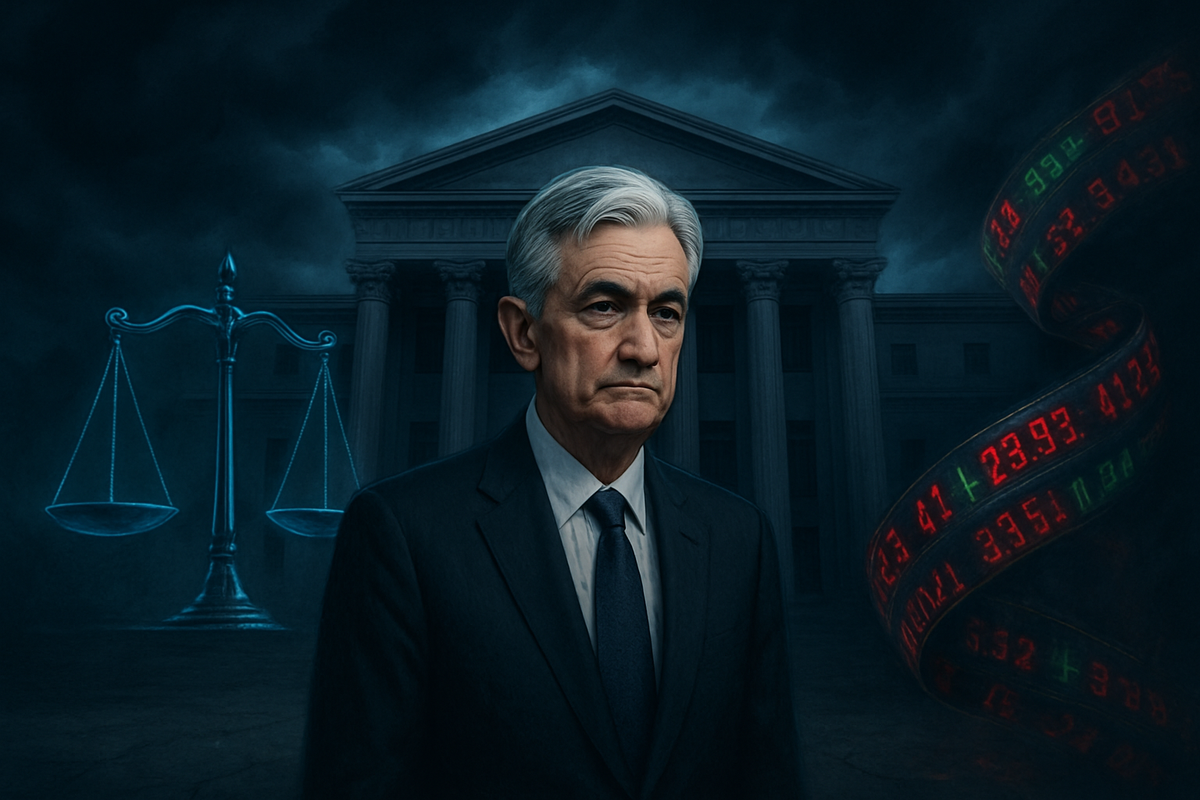
The financial world is reeling following the unprecedented disclosure that the U.S. Department of Justice (DOJ) has launched a formal criminal investigation into Federal Reserve Chair Jerome Powell. The probe, which centers on allegations of false statements regarding a multi-billion dollar renovation project at the Federal Reserve’s headquarters, marks a historic nadir in the relationship between the executive branch and the nation's central bank. As of January 20, 2026, the investigation has moved beyond mere political rhetoric, with grand jury subpoenas already served, raising urgent questions about the future of central bank independence and the stability of the U.S. dollar.
The immediate implications are profound: markets are now pricing in a "politicization discount" for U.S. assets as investors weigh the possibility of a Fed Chair being indicted while in office. While Powell has vowed to remain in his post until his term expires in May 2026, the specter of a criminal trial has triggered a flight to safety. Gold prices have shattered previous records, and international central banks are reportedly reassessing their holdings of U.S. Treasuries. The situation has shifted from a policy disagreement over interest rates into a full-blown constitutional crisis that threatens the foundational "dual mandate" of the Federal Reserve.
The Escalation of Hostilities: From Rates to Renovation
The criminal investigation stems from testimony Powell gave in June 2025 before the Senate Banking Committee regarding the $2.5 billion renovation of the Eccles Building and the Frances Perkins Building. DOJ officials, under the direction of Attorney General Pam Bondi, are investigating whether Powell intentionally misled Congress about the scope and costs of the project. The administration has categorized the renovations as "ostentatious," citing high-end features like rooftop gardens and specialized elevators as evidence of fiscal malfeasance. This investigation follows a weekend of high drama: on January 9, 2026, the Federal Reserve was served with subpoenas, and by January 11, Powell took the extraordinary step of releasing a video statement on social media to defend his integrity and the Fed’s autonomy.
Powell has framed the investigation as a "pretext" designed to force his resignation. Throughout late 2025, the White House had grown increasingly frustrated with Powell’s refusal to slash interest rates to the 1% level demanded by the President to spur economic growth and reduce the cost of servicing the national debt. Currently, the federal funds rate sits between 3.5% and 3.75%. The administration’s aggressive posture is seen by many legal scholars as an attempt to establish "for cause" removal—a legal requirement to fire a Fed governor—by proving neglect of duty or malfeasance through the lens of the building project.
The timeline leading to this crisis is a sequence of deteriorating norms. Following the August 2025 attempted firing of Fed Governor Lisa Cook over personal mortgage allegations—a case now before the Supreme Court in Trump v. Cook—the White House pivoted to a broader assault on the Fed’s leadership. The tension reached a boiling point last week when Powell announced he would personally attend the Supreme Court oral arguments for the Cook case, signaling a unified front by the Board of Governors against executive overreach. The market reaction has been swift, with safe-haven demand surging even as equities show high intraday volatility.
Market Winners and Losers in a Period of Instability
The primary winners in this environment have been traditional safe-haven assets and commodities. The SPDR Gold Shares (NYSE:GLD) has seen record inflows as gold prices surged past $4,600 per ounce following the news of the subpoenas. Investors are treating gold not just as an inflation hedge, but as a hedge against the institutional decay of the U.S. financial system. Similarly, miners like Newmont Corporation (NYSE:NEM) have seen their valuations jump as the "Sell America" trade gains momentum among international asset managers who fear the dollar's status as a reserve currency is being undermined by the DOJ’s tactics.
Conversely, the banking sector has been hit with a double-whammy of uncertainty. Major institutions like Citigroup Inc. (NYSE:C) and Capital One Financial Corp. (NYSE:COF) have seen their share prices sag as the standoff continues. Not only does the Fed investigation create a vacuum of regulatory clarity, but it coincides with the administration's separate calls for a 10% cap on credit card interest rates. The prospect of a politically compliant Federal Reserve—one that might prioritize short-term political wins over long-term price stability—threatens the net interest margins and risk-assessment models that these banks rely upon.
The Treasury market is perhaps the most significant loser in terms of stability. The 10-year Treasury yield rose above 4.2% as investors demanded a higher risk premium for holding U.S. debt. The uncertainty surrounding who will lead the Fed after Powell's term ends in May has led to a "wait-and-see" approach from primary dealers. If the DOJ's investigation succeeds in installing a "dovish" loyalist, the market fears a resurgence of long-term inflation, which would further devalue existing fixed-income portfolios held by major insurance companies and pension funds.
A Precarious Precedent for Central Bank Independence
This event fits into a broader global trend of "populist economics" challenging the technocratic independence of central banks. Historically, the U.S. Federal Reserve has maintained a degree of separation from the White House, even during the friction of the Nixon and Arthur Burns era. However, the use of a criminal probe into administrative expenses to potentially unseat a Fed Chair is entirely without precedent. If the DOJ successfully uses the Eccles Building renovation as "cause" for removal, it could fundamentally alter the Federal Reserve Act, making every future Fed Chair vulnerable to criminal investigation based on their policy decisions.
The ripple effects extend far beyond Washington. International partners and competitors are watching the Trump v. Cook case and the Powell investigation as barometers for the rule of law in the United States. A weakened Fed could lead to a less stable global financial system, as the dollar's role as a "neutral" reserve currency is predicated on the belief that its value is managed by an independent body. If the Fed is perceived as an arm of the executive branch, it may accelerate the "de-dollarization" efforts currently being pursued by the BRICS nations and other emerging economies.
Policy implications are already manifesting in the way the Fed communicates. For the first time in decades, the Federal Open Market Committee (FOMC) minutes are being scrutinized not just for economic data, but for signs of internal dissent or fear of prosecution. This "chilling effect" on central bank deliberations could lead to "groupthink" or a reluctance to take necessary but politically unpopular actions, such as raising rates during an inflationary spike, for fear of triggering further DOJ scrutiny.
The Path Forward: Scenarios and Strategic Pivots
In the short term, the market will be laser-focused on the Supreme Court. The ruling in Trump v. Cook is expected to be the "canary in the coal mine" for Chair Powell's fate. If the court rules that the President has broad authority to fire Fed officials for conduct outside their official duties, the DOJ may move to indict Powell shortly thereafter. Conversely, a ruling that reinforces the "for cause" protections would likely see the administration double down on the building renovation probe to find a smoking gun of financial misconduct that fits the legal definition of malfeasance.
Long-term, the Fed must prepare for a transition. Whether Powell finishes his term or is forced out, the search for a successor is already underway. Names like Kevin Warsh and Kevin Hassett are frequently mentioned as potential nominees. Investors will need to pivot their strategies toward "regime change" in the Fed, likely favoring assets that perform well in a lower-rate, higher-inflation environment. Strategic adaptations for corporations will include locking in long-term financing now, before the credibility of the Fed's inflation-fighting mandate potentially erodes under a more politically aligned leadership.
The potential for increased volatility remains the most likely scenario. We are entering a "new normal" where the Federal Reserve's interest rate decisions are no longer viewed through a purely economic lens but through a political one. Traders will increasingly have to monitor DOJ press releases as closely as they monitor the Consumer Price Index (CPI) and employment reports. The risk of a "policy error" is at its highest in decades, as the Fed Chair is forced to split his attention between managing the economy and managing a legal defense.
Summary: A Market in Uncharted Waters
The DOJ’s criminal investigation into Jerome Powell represents a watershed moment for the American economy. While the allegations focus on the costs of building renovations, the underlying conflict is a battle for the soul of the Federal Reserve. The markets have reacted with a mixture of resilience and deep-seated anxiety, buoyed by the hope that the institutional checks and balances of the U.S. government will hold, yet fearful of the volatility that a criminal trial of a sitting Fed Chair would unleash.
Moving forward, the market will likely remain in a state of high tension. The "Powell Premium" in gold and the "Politicization Discount" in the dollar are expected to persist until there is a clear resolution to the investigation or a definitive ruling from the Supreme Court. Investors should watch for any signs of a "coordinated exit" by other Fed governors, which would signal a total breakdown of the central bank's internal structure.
As we move toward May 2026, the focus will shift from the investigation to the confirmation of a successor. The identity of the next Chair will be the ultimate signal to the market: will the Fed return to its role as a neutral arbiter of the economy, or has the era of independent central banking in the United States come to a close? For now, the only certainty is that the historical shield protecting the Fed from the winds of partisan politics has been shattered.
This content is intended for informational purposes only and is not financial advice.