The Green Renaissance: Why ESG and Clean Energy are Defying the 2025 Slump
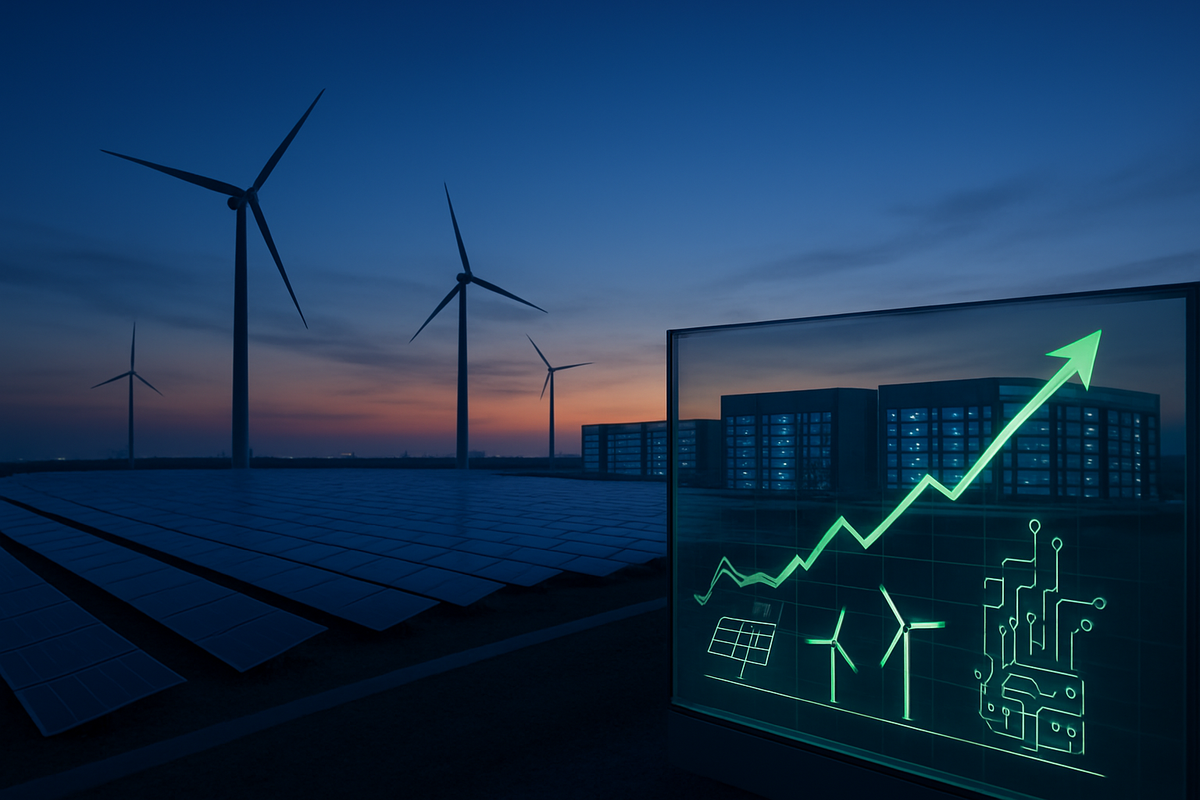
As the final trading days of 2025 approach, the financial markets are witnessing an unexpected and robust resurgence in Environmental, Social, and Governance (ESG) and clean energy sectors. After a grueling nine months defined by high interest rates and a shifting political landscape that many analysts dubbed the "ESG Winter," the sector has staged a dramatic late-year bounce. This recovery is not merely a technical correction but a fundamental shift driven by a "triple threat" of easing monetary policy, landmark international climate agreements, and an insatiable demand for power from the artificial intelligence sector.
The immediate implications are profound: capital that had fled to defensive "old economy" stocks in the first half of the year is now rotating back into renewables at a record pace. This shift, occurring as of December 22, 2025, has caught many short-sellers off guard, particularly as the Federal Reserve’s dovish pivot in the fourth quarter provided the long-awaited liquidity needed to green-light capital-intensive infrastructure projects. Investors are now recalibrating their portfolios for 2026, recognizing that the "green transition" is increasingly decoupled from political rhetoric and anchored in the hard reality of global energy needs.
The narrative of 2025 began under a cloud of uncertainty. On July 4, 2025, the political landscape shifted significantly when President Trump signed the "One Big Beautiful Bill Act" (OBBBA). This legislation drastically modified the 2022 Inflation Reduction Act, accelerating the sunsetting of consumer electric vehicle (EV) tax credits by September 30 and phasing out various solar and hydrogen production credits. The resulting "policy fog" led to a massive sell-off in the first three quarters, as utility-scale firms faced project delays and a sudden increase in the cost of capital. Throughout the spring and summer, the Federal Reserve maintained a hawkish stance, keeping the federal funds rate high to combat persistent 3% inflation, which further penalized the high-debt profiles typical of renewable energy developers.
However, the tide began to turn in late September. The Federal Reserve delivered the first of three consecutive rate cuts, ultimately lowering the federal funds rate to a range of 3.50%–3.75% by mid-December. This monetary easing coincided with the COP30 summit in Belém, Brazil, where the "Global Mutirão" decision was reached. This agreement mobilized $148 billion per year for renewables and grid storage, signaling to the markets that the global commitment to the energy transition remained ironclad despite domestic policy shifts in the United States. By the time the December Fed meeting concluded on the 11th, the market sentiment had shifted from fear of obsolescence to a scramble for "green" capacity.
The final catalyst arrived in the form of the "AI-Power" nexus. As tech giants realized that their massive data center expansions required 24/7 carbon-free energy to meet corporate sustainability goals, they began signing unprecedented direct-power purchase agreements. This surge in demand effectively "de-risked" the sector, as long-term contracts with high-credit-rating tech firms replaced the reliance on fluctuating government subsidies. The market reaction was swift, with clean energy indices jumping over 15% in the fourth quarter alone, erasing much of the year's earlier losses.
Among the primary beneficiaries of this late-year rally is NextEra Energy (NYSE: NEE), which has seen its stock return nearly 14% over the last 90 days. NextEra successfully navigated the OBBBA policy shifts by positioning itself as a "Power and Pipes" play for the AI boom, recently expanding a gigawatt-scale data center deal with Alphabet (NASDAQ: GOOGL). By announcing the restart of the Duane Arnold nuclear plant and leveraging its massive renewables portfolio, NextEra has proven that scale and reliability are the new currencies of the green energy market. Similarly, First Solar (NASDAQ: FSLR) emerged as a standout winner, with its stock surging over 25% since October. First Solar’s unique "CuRe" technology and its supply chain, which avoids reliance on Chinese polysilicon, allowed it to thrive under the OBBBA’s new trade rules while competitors struggled with import restrictions.
In the residential sector, Enphase Energy (NASDAQ: ENPH) provided one of the biggest surprises of December. Despite the challenges in the U.S. housing market, Enphase reported a 45% earnings-per-share (EPS) surprise in its late-year update. The company successfully pivoted to a lease and Power Purchase Agreement (PPA) model, securing "safe harbor" agreements that guaranteed significant revenue streams through 2026. Bloom Energy (NYSE: BE) also rode the wave, reporting a surge in orders for its fuel cell technology as AI campuses sought "behind-the-meter" power solutions to bypass aging and congested utility grids.
Conversely, the "losers" of 2025 remain those companies that were overly dependent on the now-defunct consumer EV tax credits or those with heavy exposure to Chinese supply chains that fell afoul of "material assistance" rules. Pure-play EV startups and smaller solar installers without diversified financing arms have found themselves in a liquidity crunch. These firms are now facing a wave of consolidation, as larger, better-capitalized players look to acquire distressed assets at a discount. The gap between the "quality" ESG names and the speculative "green-tech" firms has never been wider.
The resurgence of clean energy in late 2025 fits into a broader industry trend: the transition from "subsidy-driven" growth to "demand-driven" growth. For years, the sector was viewed as a ward of the state, reliant on tax credits and government mandates. The events of this year have demonstrated that the demand for clean energy—particularly from the technology and industrial sectors—is now a structural force that can withstand political volatility. This "decoupling" is a significant historical milestone, mirroring the way the internet sector matured after the dot-com bubble of the early 2000s, moving from speculation to essential infrastructure.
This shift has significant ripple effects on competitors in the traditional energy space. While oil and gas companies saw a brief resurgence during the mid-year policy shifts, the Q4 rally in renewables has forced a re-evaluation of long-term energy prices. Regulatory implications are also evolving; while federal support in the U.S. has become more targeted, state-level leadership has stepped into the vacuum. California, for instance, reported in mid-December that its grid ran on nearly 100% clean energy for parts of every day in 2025, providing a blueprint for other regions and maintaining downward pressure on carbon prices despite federal rollbacks.
Historically, the 2025 bounce resembles the 2019-2020 period when ESG first entered the mainstream, but with a crucial difference: profitability. In 2025, the winners are those with positive cash flows and proven technology, rather than those with merely "green" promises. The "Global Mutirão" decision from COP30 also suggests a new era of "climate pragmatism," where international finance is focused on grid stability and adaptation as much as carbon reduction. This holistic approach is drawing in a more diverse set of institutional investors who previously viewed ESG as too narrow or politically charged.
Looking ahead to 2026, the short-term focus will be on the execution of the massive data center contracts signed in late 2025. Investors should expect a period of "strategic pivots," as companies that previously focused on residential solar shift toward industrial and utility-scale projects to capture the AI-driven demand. The long-term possibility of a "secondary boom" in green hydrogen and long-duration energy storage remains high, especially as the $148 billion in global adaptation finance begins to hit the markets. However, the challenge will be the "wait-and-see" approach signaled by Fed Chair Jerome Powell, which suggests that while the era of peak rates is over, the era of "free money" is not returning.
Market opportunities will likely emerge in the "grid-tech" space—companies that provide the software and hardware necessary to manage a more complex and decentralized energy system. Potential scenarios include a wave of mergers and acquisitions in early 2026 as the "winners" of 2025 use their high stock currency to consolidate the market. The primary challenge will be navigating the remaining trade tensions with "foreign entities of concern," which will continue to pressure supply chains and necessitate a further "onshoring" of green technology manufacturing.
The key takeaway from the late 2025 resurgence is that the clean energy sector has reached a level of maturity where it can survive—and even thrive—amidst political and macroeconomic adversity. The "Green Renaissance" of December is a testament to the fundamental necessity of carbon-free power in a world increasingly dominated by energy-hungry technologies like AI. Moving forward, the market will likely reward companies that demonstrate "resilience and reliability" over those that rely on "hope and hype."
Investors should watch for the stabilization of the dollar and the continued rollout of state-level climate policies as indicators of the sector's health in the coming months. While the 2025 "winter" was cold, it served to prune the market of its weakest players, leaving behind a leaner, more robust group of companies ready to lead the next phase of the energy transition. As we enter 2026, the focus shifts from whether the world will go green to how quickly it can build the infrastructure to get there.
This content is intended for informational purposes only and is not financial advice.