The Great Memory Gold Rush: Why Micron and the Semiconductor Giants are Breaking Records in 2026
As of January 21, 2026, the global financial markets are witnessing a historic transformation in the semiconductor industry. What was once a notoriously cyclical and volatile sector has evolved into a high-margin, strategic pillar of the global artificial intelligence (AI) economy. Leading the charge is Micron Technology (NASDAQ: MU), which has seen its stock price surge to approximately $365.00—a staggering 250% gain from the start of 2025. This momentum is mirrored across the memory sector, as the "Memory Wall"—the bottleneck where processing power outpaces data transfer speeds—becomes the primary focus for AI infrastructure developers.
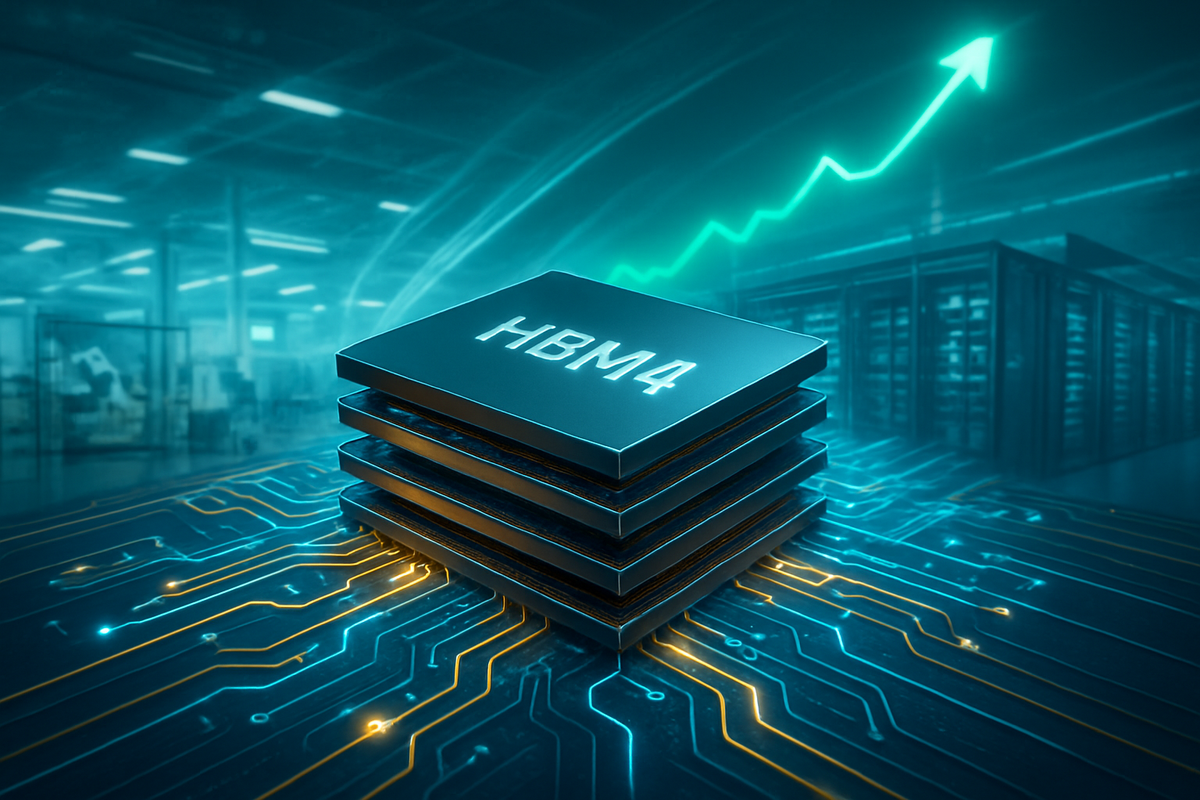
The surge is driven by an insatiable and unrelenting demand for High Bandwidth Memory (HBM), the specialized silicon required to feed data to advanced GPUs. With memory prices for some components jumping as much as 180% year-over-year, the industry has entered what analysts describe as a "scarcity regime." For the first time in history, major producers have announced that their entire production capacity for the calendar year 2026 is already pre-sold, effectively decoupling these stocks from traditional market fluctuations and anchoring them to the long-term build-out of AI data centers.
The current rally reached a fever pitch following Micron’s extraordinary FQ1 2026 earnings report on December 17, 2025, where the company posted record revenue of $13.64 billion. This financial performance was bolstered by the rapid transition to HBM3E and the initial sampling of HBM4, the next-generation memory architecture. By mid-January 2026, Micron officially crossed the $400 billion market capitalization threshold, solidifying its place among the elite "megacap" technology firms.
The timeline leading to this moment began in late 2024, as NVIDIA (NASDAQ: NVDA) accelerated its product roadmap. The unveiling of the "Vera Rubin" GPU platform at CES 2026 served as the most recent catalyst. These new chips require up to 288GB of HBM4 per unit—nearly triple the memory requirements of previous generations. This has forced a radical reallocation of manufacturing resources. Micron’s recent acquisition of the Powerchip (PSMC) P5 fab in Taiwan for $1.8 billion and the official groundbreaking of its $100 billion "megafab" in Onondaga County, New York, on January 16, 2026, illustrate the scale of the expansion required to meet this demand.
Initial market reactions have been overwhelmingly bullish, with major investment firms like Wells Fargo and TD Cowen raising price targets for memory stocks to the $450 range. The industry sentiment has shifted from "if" the demand will persist to "how" companies can possibly manufacture enough silicon to satisfy it. The scarcity is so acute that Micron announced in early January it would exit its "Crucial" consumer brand by February 2026, prioritizing high-margin enterprise and AI customers over the retail PC and gaming markets.
In this environment, the "Big Three" memory makers—Micron, SK Hynix (KRX: 000660), and Samsung Electronics (KRX: 005930)—are all emerging as clear winners, though their strategies differ. SK Hynix remains the market leader in the premium HBM space, controlling roughly 60% of the market through its specialized packaging partnership with Taiwan Semiconductor Manufacturing Company (NYSE: TSM). Samsung, after a period of trailing its rivals, reported a record operating profit of $14.8 billion in early January 2026, signaling that its aggressive push into HBM4 mass production is finally paying off.
Beyond the memory makers, the storage sector is seeing a massive ripple effect. Western Digital (NASDAQ: WDC), which recently spun off its flash business into SanDisk (NASDAQ: SNDK), is benefiting from the "Data Lake" phenomenon. As AI models require massive repositories of training data, demand for Seagate Technology (NASDAQ: STX) and Western Digital’s high-capacity 36TB+ hard drives has skyrocketed, with both companies reporting that their 2026 capacity is nearly sold out to cloud providers.
However, the surge has created a class of "losers" in the consumer electronics space. PC and smartphone manufacturers, such as Dell (NYSE: DELL) and Apple (NASDAQ: AAPL), are facing significantly higher bills of materials. Because HBM production consumes three times the wafer capacity of standard DRAM, there is a severe shortage of the memory used in everyday laptops and phones. Consequently, global PC shipments are forecasted to shrink by 9% in 2026 as manufacturers pass on 20% price hikes to consumers, potentially cooling the broader retail tech market.
The wider significance of this event lies in the structural shift of the semiconductor market. Historically, memory was a commodity business defined by "boom and bust" cycles. The 2026 surge is different because it is a "structural reallocation" rather than a temporary spike. We are seeing a move away from the 2017-2018 cloud boom or the 2021 pandemic shortage toward a permanent infrastructure layer for AI. Memory is no longer a peripheral component; it is the fundamental bottleneck of modern computing.
This shift is also deeply intertwined with geopolitics and national policy. The implementation of the US CHIPS and Science Act has reached a critical stage, with Micron’s New York project receiving over $6 billion in direct federal support. At the same time, new regulatory hurdles emerged in mid-January 2026, including a 25% tariff on advanced chips not contributing to domestic manufacturing. These policies are forcing a "reshoring" of the supply chain, which, while beneficial for long-term national security, adds significant cost and complexity to the production process in the short term.
Furthermore, a historic trade agreement signed between the US and Taiwan on January 15, 2026, has lowered barriers for Taiwanese firms but created tension with South Korean manufacturers. Companies like Samsung and SK Hynix now face pressure to meet high domestic production thresholds to maintain "Most Favored Nation" status in the US market. This regulatory landscape is effectively creating a "Sovereign AI" environment where memory production is as much about diplomacy as it is about engineering.
Looking ahead, the next 18 to 24 months will be defined by the transition to HBM4 and the scaling of "hybrid bonding" technology. While the short-term outlook remains exceptionally bright due to the sold-out status of 2026 production, the long-term challenge will be avoiding a "hangover" in 2027. If the AI infrastructure build-out stabilizes and new "megafabs" begin to come online simultaneously, the industry could face a sudden supply glut.
Strategic pivots are already underway. Companies are moving toward "custom memory," where the RAM is designed specifically for a particular AI chip rather than being a generic off-the-shelf part. This will likely lead to deeper vertical integration and long-term supply contracts that could last five to ten years, further stabilizing the industry's revenue. Investors should watch for potential consolidation or deeper alliances between memory makers and foundry giants like Intel (NASDAQ: INTC) or TSMC as the boundary between memory and logic continues to blur.
The surge in Micron and the broader memory sector marks the beginning of a new era in technology. The transition of memory from a cyclical commodity to an essential AI infrastructure component has rewritten the playbook for semiconductor investing. With record-breaking earnings, $400 billion valuations, and manufacturing capacity sold out a year in advance, the "Big Three" have solidified their role as the gatekeepers of the AI revolution.
Moving forward, the market will likely remain supply-constrained through at least the end of 2026. Investors should keep a close eye on the progress of HBM4 qualifications and any shifts in capital expenditure from the "Hyperscalers"—Amazon, Google, and Microsoft—as their demand remains the ultimate barometer for this cycle. While geopolitical tensions and consumer-side inflation pose risks, the structural importance of memory in the age of AI suggests that this "supercycle" has far more staying power than the booms of the past.
This content is intended for informational purposes only and is not financial advice