The Great Decoupling: Silver Hits $78 as Gold Plummets in '6-Sigma' Market Shock
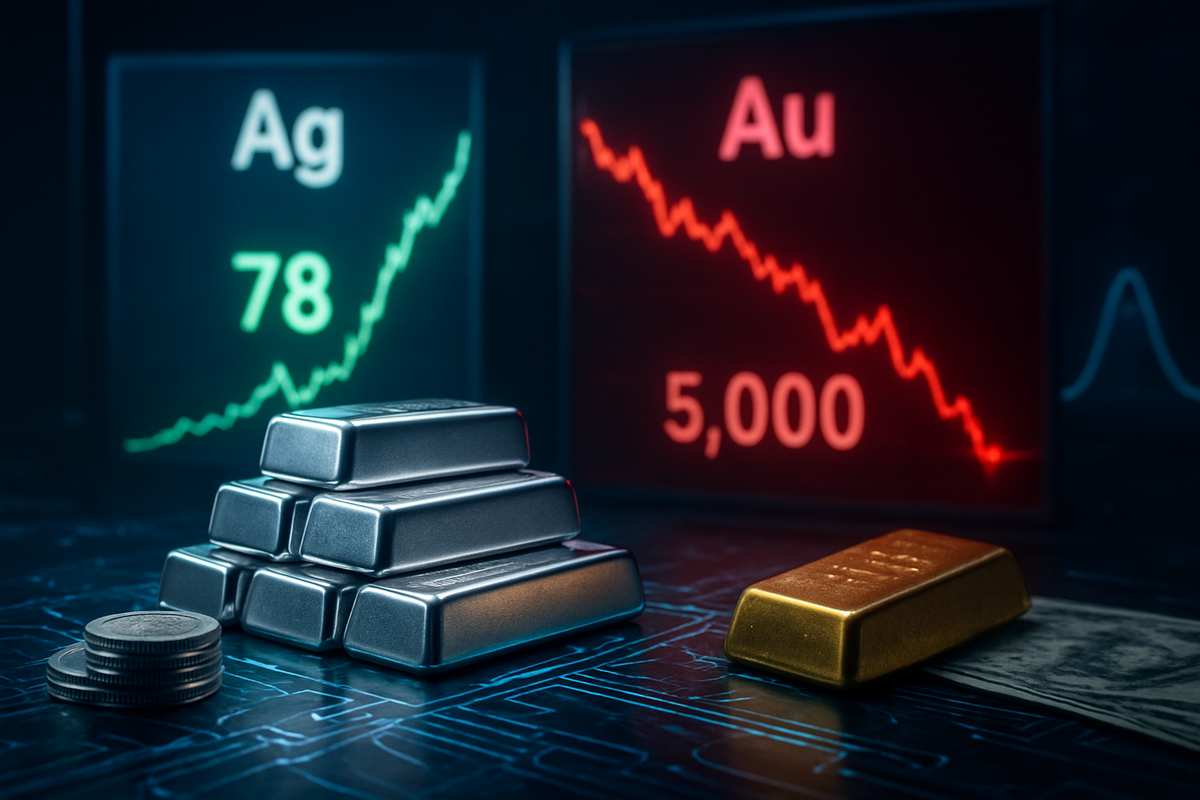
The global financial landscape was upended on February 6, 2026, as the precious metals market witnessed a "6-sigma" volatility event that defied centuries of historical correlation. In a session characterized by pure atmospheric chaos, silver prices skyrocketed to an unprecedented $78 per ounce, while gold, the traditional safe-haven anchor, suffered a violent liquidation that drove it below the critical $5,000 psychological floor. The divergence—the widest in recorded history—triggered a wave of margin calls and circuit breakers that halted trading across major commodities exchanges from London to Chicago.
The immediate implications of this move are staggering for global liquidity and monetary policy. The sudden "decoupling" of these two assets indicates a profound shift in how the market values industrial utility versus monetary protection. While gold investors are reeling from the collapse of the "inflation hedge" narrative amidst a surging U.S. dollar, silver’s parabolic rise suggests a desperate physical scramble for the metal required to power the global AI and solar infrastructure boom. By the closing bell, the gold-to-silver ratio had compressed to levels not seen in the modern era, signaling a fundamental realignment of the hard-asset hierarchy.
The Friday Flash: A Convergence of Geopolitics and Greed
The chaos began at 8:15 AM EST, shortly after a leaked report from the White House suggested that Kevin Warsh, a known monetary hawk, had secured the formal nomination to succeed Jerome Powell as Chair of the Federal Reserve (Federal Reserve System) when his term expires in May. The news sent the U.S. Dollar Index (DXY) to a three-year high, as traders immediately priced in a "higher-for-longer" interest rate regime designed to aggressively crush the remaining vestiges of 2025's sticky inflation. For gold, which pays no yield, the prospect of 6% real interest rates was a death knell. Massive sell orders from algorithmic trading desks flooded the SPDR Gold Shares (NYSE:GLD), sending the yellow metal into a $400-an-ounce freefall in less than two hours.
However, the silver market reacted with a paradoxical ferocity. As gold fell, news broke that two major Chinese photovoltaic manufacturers had declared force majeure on silver deliveries, citing an absolute exhaustion of physical inventories at the Shanghai Gold Exchange. This supply vacuum collided with a frenzied buy-order from a consortium of Silicon Valley data center developers, reportedly looking to secure silver-backed physical contracts to ensure the conductivity requirements for next-generation AI cooling systems. The result was a "short squeeze" of biblical proportions. The iShares Silver Trust (NYSE:SLV) saw record-shattering volume as silver blasted through its 2011 all-time highs of $50, touching $78 in a vertical line that left short-sellers completely wiped out.
By mid-day, the spread between the two metals had become a "6-sigma" event—a move so statistically improbable (roughly a 1-in-3.4 million chance under normal distribution models) that most risk-management software at major investment banks began to fail. JPMorgan Chase & Co. (NYSE:JPM) and other primary bullion dealers reportedly sought temporary "relief windows" from the Commodity Futures Trading Commission (CFTC) as they struggled to maintain orderly markets amidst the total breakdown of traditional pricing models.
Winners and Losers: Mining Titans and Metal Trusts
The fallout from the Feb. 6 "Great Decoupling" has created a stark divide among public companies in the materials and mining sectors. The biggest winners are pure-play silver producers, who are now sitting on margins that have effectively tripled overnight. First Majestic Silver Corp. (NYSE:AG) and Pan American Silver Corp. (NASDAQ:PAAS) saw their shares jump 35% and 28%, respectively, as investors scrambled for exposure to the skyrocketing white metal. These companies, which had been underperforming gold miners for much of 2025, are now the darlings of the resource sector, with analysts projecting a massive windfall in their Q1 2026 earnings.
On the other side of the ledger, gold-dominant giants are facing a crisis of confidence. Newmont Corporation (NYSE:NEM) and Barrick Gold (NYSE:GOLD) both saw their stock prices slide by double digits as the "gold is dead" narrative gained traction on social media and financial news networks. Despite gold still being priced near historic highs relative to the last decade, the loss of the $5,000 level—a milestone it had only recently conquered in late 2025—is being viewed as a technical catastrophe. Streaming and royalty companies like Wheaton Precious Metals (NYSE:WPM) provided a rare bit of stability, though even their shares were volatile as investors weighed their silver-heavy portfolios against their gold exposure.
Furthermore, the impact on exchange-traded funds (ETFs) has been profound. The Global X Silver Miners ETF (NYSEARCA:SIL) recorded its highest ever single-day inflow, while gold-backed ETFs saw massive outflows as retail investors fled the "safe haven" that no longer felt safe. For industrial consumers like Tesla, Inc. (NASDAQ:TSLA) and Samsung Electronics, the $78 silver price represents a massive spike in input costs for electronics and EVs, likely leading to a new round of price hikes for consumer goods by late 2026.
The Death of the Ratio: Analyzing the Wider Significance
The events of February 6 represent the culmination of a decade-long transition of silver from a "poor man's gold" into a "strategic industrial asset." Historically, gold and silver moved in tandem, but the explosive demand for silver in the green energy transition—specifically N-type TOPCon solar cells—has fundamentally altered its supply-demand mechanics. Unlike gold, 60% of silver demand is industrial, and in 2026, the market finally realized that silver is more essential to the modern economy than the yellow metal used primarily for jewelry and central bank vaults.
This "6-sigma" event also highlights the extreme sensitivity of the current market to Federal Reserve leadership. The market's violent reaction to a potential Warsh chairmanship underscores a deep-seated fear that the Fed will prioritize "Dollar Dominance" over the stability of the commodities market. By strengthening the dollar, the Fed is effectively exporting deflation to the gold market while ignoring the supply-side realities of industrial metals. This creates a dangerous "scissors effect" where monetary policy suppresses gold but cannot stop the scarcity-driven rise of silver, copper, and lithium.
Historically, moves of this magnitude—such as the 1980 Hunt Brothers silver corner or the 1987 "Black Monday"—have led to significant regulatory changes. The CFTC is already under pressure to investigate whether the $78 silver spike was exacerbated by algorithmic "spoofing" or if it was a genuine reflection of physical scarcity. There are also growing calls for the Fed to address the "Precious Metal Paradox" in its upcoming March meeting, as the volatility in these assets often precedes broader instability in the credit markets.
What Comes Next: A Pivot or a Panic?
In the short term, market participants should expect a period of extreme "price discovery." Silver is unlikely to stay at $78 indefinitely, but the old "floor" of $30 is likely gone forever. We may see a strategic pivot from major tech firms to secure direct "offtake agreements" with silver miners, bypassing the paper markets entirely to ensure they can continue manufacturing AI chips and solar panels. Companies like First Majestic Silver (NYSE:AG) are already hinting at holding back supply to sell directly to industrial end-users at a premium.
For gold, the path forward is more treacherous. To regain its luster, gold needs either a significant weakening of the U.S. dollar or a geopolitical shock that transcends interest rate expectations. If the Warsh nomination is confirmed by the Senate, the "Gold at $5,000" era may be viewed as a temporary peak. However, if the silver rally continues to drive up inflation expectations, the Fed may find itself in a "no-win" situation where raising rates to kill gold only further incentivizes the industrial hoarders to buy silver as a hedge against a failing fiat system.
The most likely long-term scenario is a "new normal" where the gold-to-silver ratio remains permanently lower, perhaps stabilizing between 40:1 and 50:1, compared to the 80:1 levels common in the early 2020s. This would require a complete re-weighting of commodity indices and a fundamental change in how "safe haven" portfolios are constructed.
The New Frontier for Hard Assets
The volatility of February 6, 2026, serves as a stark reminder that the "old rules" of finance are being rewritten by the twin forces of the energy transition and the AI revolution. The 6-sigma decoupling of gold and silver has shattered the belief that these metals are two sides of the same coin. Moving forward, silver must be viewed through the lens of a "strategic tech metal," while gold’s value will continue to be tied almost exclusively to the fate of the U.S. dollar and the perceived competence of the Federal Reserve.
For investors, the key takeaway is that diversification within the precious metals space is no longer enough; one must understand the specific industrial drivers of each metal. The days of "buying the dip" in gold while ignoring the supply-side fundamentals of silver are over. As we look toward the mid-point of 2026, all eyes will be on the Fed confirmation hearings and the physical silver inventories in London and Shanghai. The "Great Decoupling" wasn't just a one-day event; it was the birth of a new market paradigm.
This content is intended for informational purposes only and is not financial advice