The Great Decoupling: Meta Surges as AI Reckoning Fractures the 'Magnificent 7'
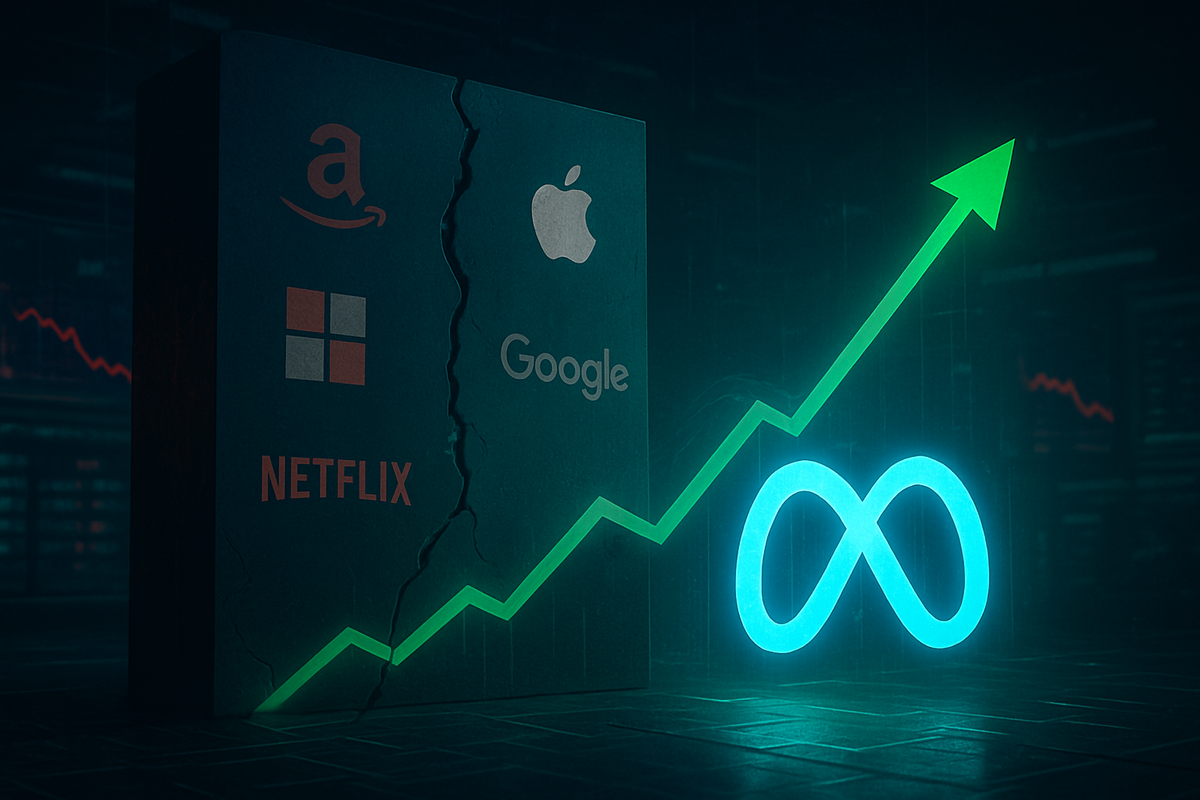
As the dawn of 2026 breaks over Wall Street, the era of the "Magnificent 7" moving as a monolithic force has officially come to an end. Once the collective engine of the global equity markets, this elite group of technology titans is now defined more by its internal divisions than its shared dominance. While the S&P 500 continues to navigate a landscape of high interest rates and moderating economic growth, a stark divergence has emerged: investors are no longer rewarding promise; they are demanding proof.
Nowhere is this shift more evident than in the meteoric rise of Meta Platforms, Inc. (NASDAQ:META), which has emerged as the clear standout in early 2026. While its peers grapple with the "AI Capex Trap"—spending billions on infrastructure with murky timelines for profitability—Meta has successfully bridged the gap between artificial intelligence investment and bottom-line revenue. This decoupling marks a fundamental turning point for the technology sector, signaling a transition from the speculative "build-it-and-they-will-come" phase of AI to a "show-me-the-money" reality that is reshaping institutional portfolios.
The Fracturing of a Titan: A Timeline of Divergence
The crack in the Magnificent 7’s armor began to appear in late 2024 but widened into a chasm throughout 2025. For years, these seven stocks moved with an 80% price correlation, essentially serving as a high-growth proxy for the entire market. However, by mid-January 2026, that correlation has plummeted to a mere 20%. The market’s infatuation with the group as a single trade has been replaced by a surgical approach, where companies are judged solely on their ability to monetize generative AI without sacrificing margins.
Meta's ascent to its current position was not a straight line. Throughout much of 2025, the stock trailed high-flyers like Alphabet Inc. (NASDAQ:GOOGL) and NVIDIA Corporation (NASDAQ:NVDA). However, as of January 20, 2026, the narrative has shifted. Meta’s third-quarter 2025 earnings report served as the catalyst, revealing a staggering $51.2 billion in revenue—a 26% year-over-year increase—fueled by its "Advantage+" AI advertising tools. Unlike its competitors, who are still installing server racks, Meta has turned its AI clusters into a $60 billion annual revenue engine for advertisers, effectively funding its own expansion through enhanced ad efficiency.
The market reaction has been swift and unforgiving for those left behind. Institutional investors have begun rotating out of "infrastructure" plays and into "platform" plays. While Nvidia remains the essential supplier of the "shovels and picks" for the AI gold rush, the rest of the group is being scrutinized for capital expenditure (capex) levels that are projected to hit a combined $527 billion in 2026. This massive spending spree has led to a "valuation reset" for several former market darlings, as the reality of slowing growth and compressed margins sets in.
Winners, Losers, and the 'Capex Trap'
In this new market regime, Meta and Alphabet have emerged as the primary victors. Alphabet’s successful integration of the Gemini AI model into its core search business and the rapid acceleration of Google Cloud allowed it to surge over 65% in 2025. Meta, while seeing a more modest 12.8% return in 2025, is now the top analyst pick for 2026 due to its attractive valuation. Trading at a forward P/E of roughly 21x—the lowest among the former Magnificent 7—Meta is being viewed as the ultimate "catch-up trade," offering high-growth fundamentals at a relative discount.
Conversely, Microsoft Corporation (NASDAQ:MSFT) and Amazon.com, Inc. (NASDAQ:AMZN) find themselves in a challenging middle ground. Despite being early leaders in the AI race, both companies are now facing intense ROI skepticism. Microsoft, trading at a steep 35x P/E, is under immense pressure to prove that its multi-billion dollar investment in OpenAI and Azure data centers will yield software profits that can outpace its soaring depreciation costs. Amazon has similarly struggled as its heavy investment in AI and robotics for its logistics network has dragged on margins, causing its stock to lag significantly behind the broader market index.
The most notable laggards in this new era are Apple Inc. (NASDAQ:AAPL) and Tesla, Inc. (NASDAQ:TSLA). Apple is increasingly viewed by analysts as a "growth-less utility," criticized for its late and cautious entry into the generative AI space. Its stock returned a lackluster 8.2% in 2025, leading to multiple contractions as investors seek more dynamic opportunities. Tesla faces a more existential crisis; as vehicle deliveries are projected to decline by 15% in early 2026, its astronomical 200x P/E ratio appears increasingly precarious, leaving the stock vulnerable to a massive correction if its "Robotaxi" and AI-driven autonomous dreams do not materialize quickly.
The Significance of the AI ROI Shift
The divergence within the Magnificent 7 is not merely a localized event; it reflects a broader industry trend toward fiscal discipline in the tech sector. After the "year of efficiency" in 2023 and the speculative boom of 2024, 2025 was the year of the "AI Reckoning." The ripple effects are being felt across the entire tech ecosystem. Smaller AI startups are finding it harder to secure funding unless they can demonstrate a clear path to revenue, as venture capitalists take their cues from the public market's pivot toward profitability.
Historically, this event mirrors the "post-hype" phase of the dot-com era, where the initial excitement over internet infrastructure gave way to a focus on the businesses that could actually build sustainable, profitable models on top of that infrastructure. The current regulatory environment adds another layer of complexity. With increased scrutiny on AI ethics and data privacy, companies like Meta and Alphabet—who already possess massive, proprietary data sets—have a distinct advantage over competitors who must navigate more complex licensing and acquisition hurdles to train their models.
Furthermore, the "Great Decoupling" signals the end of the passive investing era's reliance on a handful of stocks to carry the entire market. As these companies' paths diverge, the S&P 500's performance is becoming more broad-based, which could lead to a healthier, albeit more volatile, market environment. The concentration risk that haunted the index for the past three years is finally beginning to dissipate as capital flows toward companies based on individual merit rather than sector-wide momentum.
Looking Ahead: The 2026 Strategic Pivot
In the short term, the market will likely see a continued "valuation reset" for the high-multiple underperformers. Microsoft and Amazon will need to provide concrete evidence of AI-driven margin expansion in their upcoming quarterly reports to regain investor confidence. Strategic pivots are already underway; Apple is expected to make a significant acquisition in the AI software space to jumpstart its lagging roadmap, while Tesla may be forced to lower prices further or pivot more aggressively toward its energy storage business to offset declining vehicle margins.
For Meta, the challenge will be maintaining its current momentum. Having successfully monetized AI for its advertising business, the company must now look to its "Reality Labs" division to see if its long-term metaverse vision can finally find a similar path to profitability. If Meta can successfully integrate generative AI into its hardware products—such as the Ray-Ban Meta glasses—it could solidify its position as the undisputed leader of the post-mobile era.
Long-term, the divergence suggests that the "Magnificent 7" label may soon be retired in favor of more specific groupings. We are likely moving toward a market where the winners are defined by their "AI Utilization" rather than their "AI Ambition." Market opportunities will emerge for secondary and tertiary players who can provide specialized AI services to the enterprises that the hyperscalers are currently building infrastructure for.
Summary and Investor Takeaways
The fracturing of the Magnificent 7 represents a maturation of the AI era. The market has moved from a state of general euphoria to one of specific, data-driven conviction. Meta’s emergence as a leader highlights the value of tangible AI monetization, while the struggles of peers like Microsoft and Amazon underscore the risks associated with massive, unproven capital expenditures.
For investors, the key takeaway is that the "one-trade" basket approach to big tech is no longer viable. Success in 2026 and beyond will require a more nuanced understanding of individual company fundamentals and their specific AI integration strategies. The primary focus for the coming months will be the quarterly capex reports and the revenue-to-spending ratios of the cloud giants.
As we move deeper into 2026, the market will continue to reward those who can turn silicon into sales. The era of the monolithic tech giant is over; the era of the efficient AI operator has begun. Watch for signs of a "bottoming out" in Apple and Tesla, but keep a close eye on Meta’s ability to scale its AI tools across its entire ecosystem—this remains the benchmark for the modern tech bull market.
This content is intended for informational purposes only and is not financial advice