The Great American Rebound: Why 2026 is Set to See U.S. Stocks Retake the Global Throne
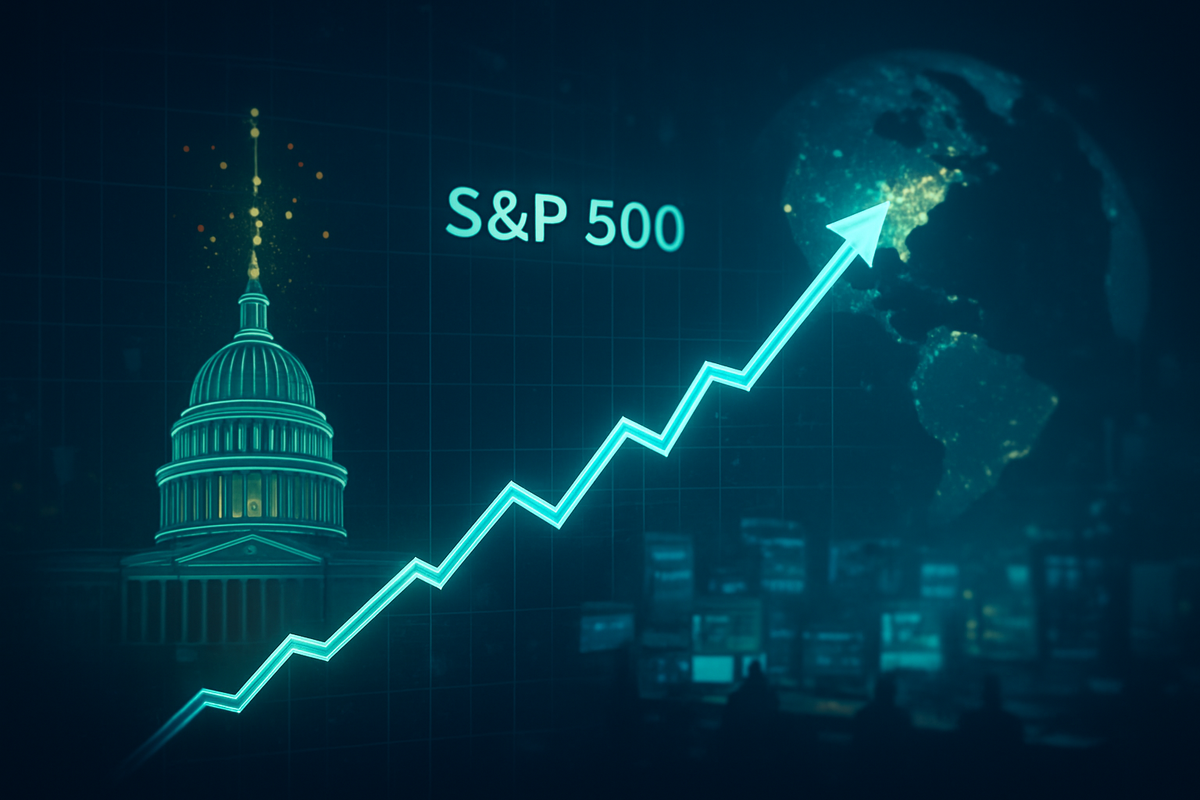
As the first month of 2026 unfolds, the narrative in global financial markets is shifting from the international outperformance seen last year back to the perceived safety and growth of the United States. Following a year where international equities surprisingly outperformed the S&P 500 (NYSE Arca: SPY) by roughly 15 percentage points, major analysts are now forecasting a "policy-driven divergence" that favors a return to American dominance. This shift is largely driven by a combination of permanent tax relief and a newly accommodative Federal Reserve, creating a favorable environment for large-cap growth.
Financial heavyweights like Fidelity and Morgan Stanley (NYSE: MS) have begun the year with a bullish outlook on U.S. equities, specifically targeting large-cap firms as the primary beneficiaries of current fiscal policies. Investors are watching closely as the market recalibrates for 2026, weighing the "trio of tailwinds"—tax cuts, falling interest rates, and lower energy costs—against the lingering valuation premiums of American stocks compared to their European and Asian counterparts.
Fiscal Tailwinds and the Policy-Driven Divergence
The current optimism for 2026 is rooted in the legislative and monetary shifts that defined the latter half of 2025. The centerpiece of this shift was the signing of the "One Big Beautiful Bill Act" (OBBBA) on July 4, 2025, which made the 2017 Tax Cuts and Jobs Act permanent and provided additional relief for capital-intensive industries. Morgan Stanley estimates this legislation will reduce corporate tax bills by a staggering $129 billion through the 2026–2027 cycle. This fiscal certainty has removed a major cloud of doubt for S&P 500 companies, allowing for more aggressive capital allocation and stock buybacks.
Timeline-wise, 2025 was a year of volatility that eventually paved the way for the current stability. After a brief "bear scare" in April 2025 triggered by the initial announcement of baseline reciprocal tariffs, negotiated trade deals with the UK and Japan by year-end helped stabilize global sentiment. Furthermore, the Federal Reserve’s decision to end Quantitative Tightening (QT) on December 1, 2025, has injected fresh liquidity into the system. As of January 19, 2026, the Fed’s target range sits at 3.5%–3.75%, with at least two more 25-basis-point cuts expected this year, according to consensus estimates.
Key players in this forecast include Fidelity’s Denise Chisholm, who has highlighted that median U.S. earnings growth is inflecting higher—a trend not yet mirrored in the Eurozone or emerging markets. While international markets had a banner year in 2025, returning approximately 30% to investors, analysts believe that the U.S. market’s higher concentration of Artificial Intelligence (AI) and technology leaders will drive a multi-year performance gap starting this quarter.
Sector Winners: Tech, Energy, and the Large-Cap Renaissance
The biggest winners in this 2026 forecast are expected to be the mega-cap technology and industrial firms that can leverage both lower interest rates and tax incentives. Nvidia (Nasdaq: NVDA) and Microsoft (Nasdaq: MSFT) remain at the forefront, as analysts now view AI not just as a technology sector theme but as a broader "macro force" that is driving efficiency gains across the entire S&P 500. Lower rates are expected to significantly reduce the "cost of carry" for the massive debt being issued by these tech giants to fund AI infrastructure.
Conversely, some caution remains for international-focused ETFs and value-centric funds. While the Vanguard Value ETF (NYSE Arca: VTV) may benefit from a broader market "catch-up" play, the sheer momentum of U.S. growth stocks is expected to overshadow international value plays for much of the year. Energy and industrial companies are also positioned to win; the OBBBA’s provisions for accelerated depreciation have significantly boosted cash flows for capital-heavy firms like ExxonMobil (NYSE: XOM) and Caterpillar (NYSE: CAT), which are now reinvesting those savings into automation and green-tech transitions.
Financial institutions like Goldman Sachs (NYSE: GS) and BlackRock (NYSE: BLK) are also poised to benefit from the increased deal-making activity that typically accompanies falling rates and a stable tax environment. However, firms with heavy exposure to Chinese markets may face continued headwinds as the U.S. remains focused on domestic manufacturing and "near-shoring," a trend that further supports the case for U.S. outperformance in 2026.
Broader Significance and Historical Precedents
The forecast for 2026 fits into a larger historical cycle where U.S. markets tend to lead during periods of rapid technological innovation and domestic fiscal stimulus. This era is being compared to the mid-1990s, where a combination of productivity gains and a supportive Fed led to a prolonged bull run. The broader industry trend is now moving toward "American Exceptionalism" in corporate earnings, where the U.S. GDP growth (projected at 2.6%) is expected to outpace the global average of 2.0%.
The ripple effects of these U.S. policies are significant for global competitors. As American companies enjoy lower effective tax rates and cheaper capital, European and Asian firms may find it difficult to compete on price and innovation speed. This has prompted some discussion in Brussels and Tokyo about potential retaliatory fiscal measures, though no concrete policies have emerged as of early 2026. The end of QT in late 2025 remains a critical historical marker, as it signaled the definitive end of the post-pandemic monetary tightening cycle, providing a structural tailwind for risk assets globally, but most notably in the U.S.
Regulatory implications also loom large. With the permanent extension of tax cuts, the focus in Washington has shifted toward deregulation in the energy and tech sectors. This "market-friendly" stance is a cornerstone of the 2026 bull case, as it reduces the compliance costs for large-cap firms. However, historical precedents suggest that such rapid expansion can lead to valuation bubbles, a risk that Vanguard and other conservative analysts are watching closely as the S&P 500 approaches the 7,800 mark.
What Comes Next: The Road to 8,000
In the short term, the market is awaiting the next Federal Reserve meeting to confirm the path of rate cuts. If the Fed remains on its current trajectory, we could see a "broadening" of the market where small-cap and mid-cap stocks join the large-cap rally. Strategic pivots are already occurring, with many multinational corporations shifting their supply chains further away from volatile regions to capitalize on the new U.S. tax incentives for domestic production.
The long-term challenge will be managing the national debt, which has grown alongside the tax cuts. While the market is currently ignoring fiscal deficit concerns in favor of growth, any resurgence in inflation could force the Fed to halt its rate-cut cycle, potentially derailing the 2026 forecast. Investors should also monitor the "AI productivity paradox"; if the massive investments made by companies like Alphabet (Nasdaq: GOOGL) do not result in tangible earnings growth by the end of 2026, the market could face a significant correction.
Summary: A Confluence of Growth Drivers
The outlook for 2026 is one of cautious optimism centered on the United States. The combination of the "One Big Beautiful Bill Act," a pivot toward monetary easing, and the continued maturation of AI technology creates a compelling case for U.S. large-cap outperformance. While 2025 belonged to the international markets, the structural advantages now enjoyed by American firms suggest a return to the mean where the U.S. leads the global pack.
Moving forward, investors should watch for the sustainability of earnings growth and any shifts in Fed rhetoric. The market is currently priced for a "soft landing" followed by an "acceleration phase," and the coming months will be critical in determining if reality matches these lofty expectations. With the S&P 500 eyeing new heights, 2026 stands to be a definitive year for the American economic engine.
This content is intended for informational purposes only and is not financial advice.