The Gilded Fortress: Global Central Banks Defy Dollar Hegemony as Fed Independence Wavers
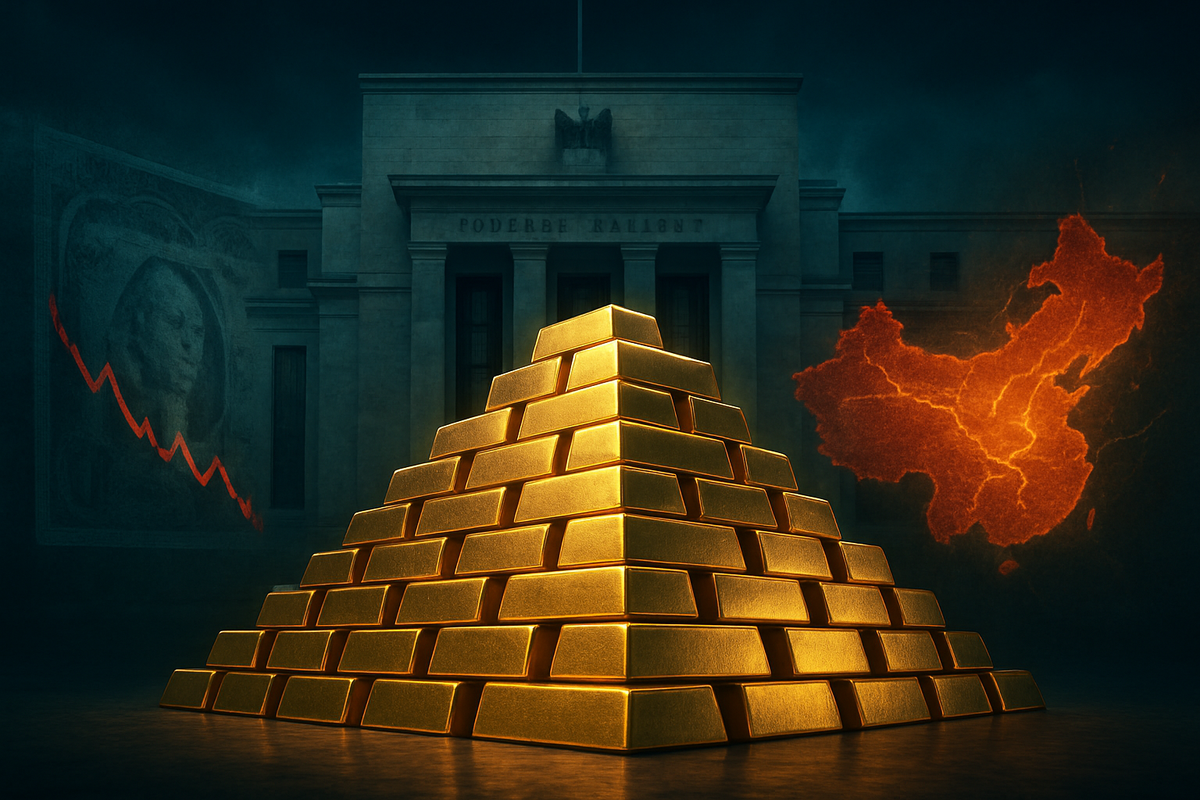
As of January 20, 2026, the global financial landscape is undergoing a tectonic shift, marked by a migration into bullion. Led by the People’s Bank of China (PBOC) and a cohort of emerging market sovereigns, central bank gold accumulation has reached a fever pitch, with China alone estimated to be absorbing over 900 tonnes annually through both official and strategic "covert" channels. This gold rush comes at a pivotal moment for the United States, where a simmering "crisis of confidence" regarding the Federal Reserve’s autonomy has reached a boiling point, sending institutional investors scurrying for hard assets.
The immediate implications are stark: gold prices have shattered historical resistance levels to trade near $4,700 per ounce, while the U.S. dollar’s share of global reserves has dwindled to a two-decade low of 56%. Market participants are now grappling with the reality of "credit easing by decree"—a new era where political mandates increasingly dictate monetary policy. As the traditional wall between the Treasury and the Fed begins to crumble, the resulting volatility is fundamentally reshaping the risk profile of the world’s most liquid markets.
A Perfect Storm: China’s 900-Tonne Pivot and the Fed Under Siege
The road to this unprecedented accumulation began in earnest during the 2024-2025 period, when global central banks maintained a net buying pace exceeding 1,000 metric tons for three consecutive years. However, by early 2026, the focus has shifted entirely to the sheer scale of China’s appetite. While official reports from the PBOC frequently downplayed their monthly additions, physical flow data and domestic mine retention analysis reveal a much more aggressive strategy. Experts suggest that China has surpassed an annual accumulation rate of 900 tonnes, a move designed to insulate the world’s second-largest economy from potential U.S. sanctions and to provide a tangible "floor" for the yuan’s international credibility.
This massive rotation into gold is not occurring in a vacuum. It is being fueled by a perceived erosion of the Federal Reserve’s independence. In late 2025, the U.S. Department of Justice launched a controversial criminal investigation into Fed Chair Jerome Powell, ostensibly over cost overruns in the $2.5 billion renovation of the central bank's headquarters. However, market analysts and constitutional scholars have largely dismissed the probe as a "political pretext" intended to force Powell’s resignation before his term expires in May 2026. This administrative pressure has coincided with proposals for "credit easing by decree," including executive-level suggestions to cap credit card interest rates at 10% and direct mandates for the Fed to lower borrowing costs regardless of prevailing inflation data.
The initial reaction from the bond market has been one of alarm. Yields on the 10-year Treasury note have broken above 4.2%, not due to growth expectations, but because investors are demanding a higher "political risk premium." For institutional players, the blurring of lines between fiscal and monetary policy represents a fundamental threat to the dollar's status as a neutral reserve asset.
The Winners and Losers of the New Golden Era
In this climate of monetary uncertainty, the precious metals sector has been transformed into a high-octane engine for capital. Newmont (NYSE:NEM) has emerged as a primary beneficiary, reporting record free cash flow of $4.5 billion for fiscal 2025. With its focus on "Tier-1" assets and a fortified balance sheet, Newmont is currently positioned as the industry's blue-chip haven. Similarly, Barrick Gold (NYSE:GOLD) has leveraged the price surge to retire significant debt while targeting a 30% production growth by 2030, making it a favorite for institutional investors seeking leveraged exposure to bullion.
However, the gains are not universal across the sector. Agnico Eagle (NYSE:AEM), while seeing its earnings nearly double over the past year, is facing scrutiny over stretched valuations. Analysts warn that Agnico Eagle is currently trading at 24 times 2025 earnings, a multiple that may be difficult to sustain if capital expenditures continue to climb. On the more speculative end of the spectrum, Hecla Mining (NYSE:HL) has been one of the top performers of 2025 and early 2026. As silver prices surged to $94 per ounce in tandem with gold, Hecla’s high leverage to the white metal has seen its stock price nearly quadruple.
The clear "losers" in this scenario are holders of long-duration U.S. debt and traditional fiat-heavy portfolios. As the "credit easing by decree" narrative gains traction, the real yield on Treasuries is being eaten away by expectations of long-term currency debasement. Banking institutions that rely on stable net interest margins are also under pressure as political interference in interest rate pricing threatens to squeeze profitability.
Credit Easing and the Death of Neutrality
The concept of "credit easing by decree" marks a significant departure from the post-Volcker era of central banking. Historically, the Fed maintained its credibility by remaining "data-dependent" and politically insulated. The current shift toward executive mandates represents what some historians call a "return to the 1940s," a period when the Fed was essentially an arm of the Treasury, tasked with keeping borrowing costs low to finance government spending. The wider significance of this shift cannot be overstated; it signals the end of the "neutral dollar" and the beginning of a fragmented global financial system.
This trend is rippling through the international community. Nations in the "Global South" are increasingly looking at gold not just as a hedge against inflation, but as a hedge against the U.S. legal and political system. The "weaponization" of the dollar—through sanctions and political maneuvering—has turned gold into the only asset that carries no counterparty risk. This is a historical precedent that mirrors the 1971 "Nixon Shock," though this time it is the central banks, rather than the U.S. government, that are initiating the decoupling.
Furthermore, the policy implications are profound. If the Fed's independence is fully compromised by mid-2026, the market may lose its most effective anchor for inflation expectations. This could lead to a permanent shift in how institutional portfolios are constructed, with a "60/40" portfolio potentially evolving into a "50/30/20" split, with the final 20% allocated to commodities and hard assets.
The Road to May 2026: Scenarios for the Transition
What comes next depends heavily on the transition of power at the Federal Reserve in May 2026. If a new, more "politically aligned" Chair is appointed, we could see an immediate acceleration of the "credit easing by decree" strategy. This would likely involve a series of aggressive rate cuts and potentially the implementation of yield curve control, aimed at capping the cost of servicing the massive U.S. national debt. Such a move would be a "rocket fuel" scenario for gold and silver, but a potential death knell for the dollar’s relative strength.
Conversely, if the institutional framework of the Fed manages to withstand the current DOJ probe and political pressure, we might see a "mean-reversion" event. Analysts at Morningstar have cautioned that if political stability returns, gold could eventually retreat toward its mid-cycle fundamental price of approximately $2,050 per ounce. However, this scenario currently seems remote given the momentum of de-dollarization and the entrenched nature of the current political divide. Strategic pivots are already underway at major hedge funds, which are increasingly replacing Treasury allocations with "digital gold" (Bitcoin) and physical bullion.
Final Thoughts: The Golden Shield
The current record-level gold accumulation is more than just a market trend; it is a vote of no confidence in the future of the dollar-centric financial system. The combination of China’s 900-tonne annual appetite and the internal crisis at the Federal Reserve has created a "perfect storm" that has pushed precious metals into a new valuation regime. For investors, the takeaway is clear: the era of the Fed as a predictable, independent arbiter of value is, at least for now, over.
Moving forward, the market will be characterized by heightened volatility and a constant watch for "decrees" from Washington that bypass traditional monetary channels. The lasting impact of this period will likely be a permanently higher floor for gold and a permanently lower ceiling for the dollar's global dominance. In the coming months, investors should keep a close eye on the 10-year Treasury yield and the official appointment of the next Fed Chair. These will be the ultimate signals of whether the U.S. intends to defend the dollar’s independence or surrender it to the whims of political decree.
This content is intended for informational purposes only and is not financial advice.