The End of an Era: Court Approves Luminar Technologies’ Final Wind-Down Plan
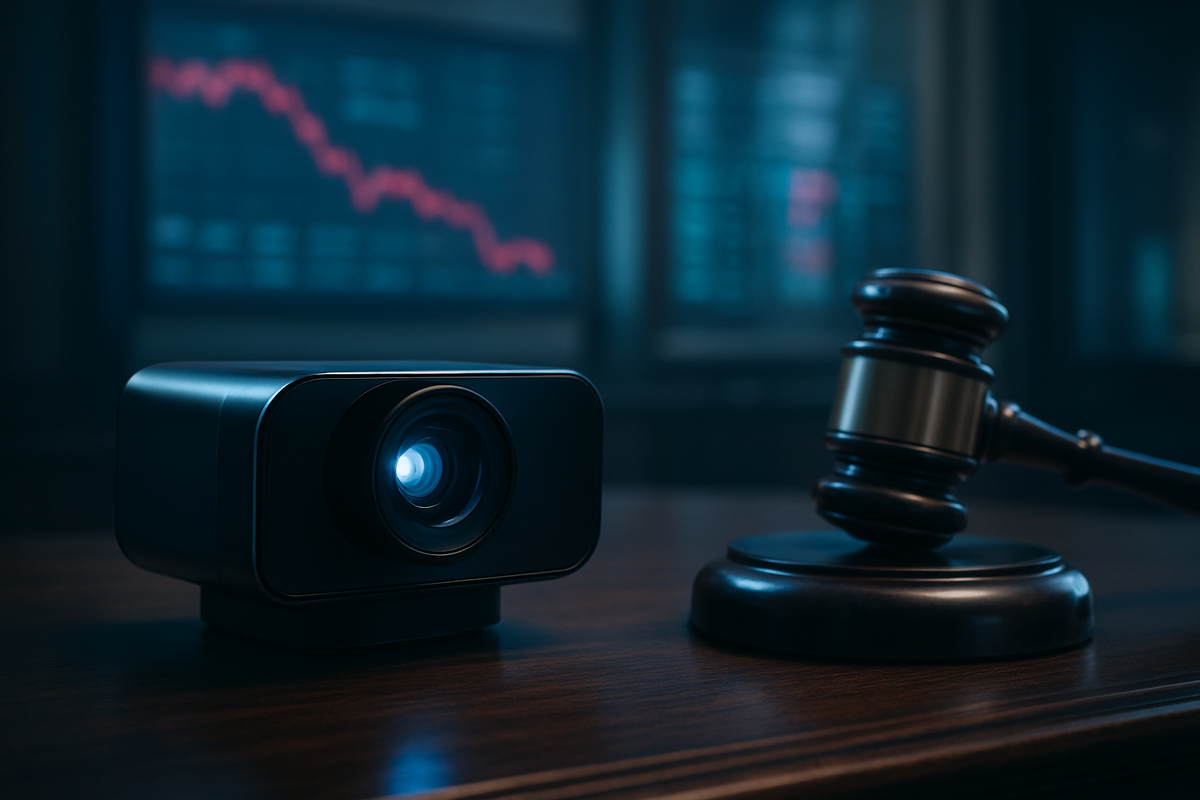
In a definitive conclusion to one of the most dramatic rises and falls in the automotive technology sector, the United States Bankruptcy Court for the Southern District of Texas has officially confirmed the Third Amended Plan of Liquidation for Luminar Technologies (OTC: LAZRQ). The court’s decision on April 1, 2026, marks the final chapter for the lidar pioneer, which once boasted a multi-billion-dollar valuation and the promise of revolutionizing autonomous driving.
The approved wind-down plan codifies the total wipeout of common equity, leaving retail and institutional investors with no recovery as the company’s remaining assets are carved up to satisfy nearly half a billion dollars in debt. For the broader market, the dissolution of Luminar serves as a sobering reminder of the "capital-intensity trap" that has claimed several high-profile sensor and autonomy startups over the last 24 months, signaling a massive consolidation in the lidar industry.
From Market Darling to Liquidation: The Timeline of a Collapse
The court’s approval follows a frantic four-month period that began with Luminar’s Chapter 11 filing on December 15, 2025. The collapse was precipitated by a series of catastrophic events throughout late 2024 and 2025. The primary catalyst was the departure of founder Austin Russell in May 2025, following an internal inquiry into business conduct. Under the interim leadership of Paul Ricci, the company attempted a desperate pivot to stabilize its balance sheet, but the momentum had already shifted.
By the third quarter of 2025, the automotive industry’s enthusiasm for high-performance, high-cost lidar units began to evaporate. Volvo (OTC: VLVLY), Luminar’s anchor customer, slashed its volume projections for the Iris sensor by 90%, citing the need for lower-cost solutions for consumer-grade ADAS. This was quickly followed by Mercedes-Benz (OTC: MBGYY) and Polestar (NASDAQ: PSNY) reducing their exposure. With revenue for 2025 plummeting to just $66 million against a net loss of $366.3 million, Luminar’s liquidity evaporated, leading to a default on $488 million in funded debt.
The final liquidation plan establishes a trust to oversee the distribution of the $143 million generated from asset sales. A last-minute "insider" bid from Russell’s newly formed venture, Russell AI Labs, was rejected by the board and the court in early 2026 due to legal infirmities, clearing the way for the piecemeal sale of the company's revolutionary intellectual property.
Winners and Losers in the Lidar Fallout
The biggest winner in the wreckage is MicroVision, Inc. (NASDAQ: MVIS), which secured Luminar’s core lidar intellectual property—including the Iris and Halo sensor designs—for a mere $33 million in January 2026. This acquisition provides MicroVision with a massive patent portfolio and advanced engineering talent at a fraction of the cost it would take to develop such technologies from scratch. Similarly, Quantum Computing Inc. (NASDAQ: QUBT) emerged as a strategic victor, acquiring the Luminar Semiconductor (LSI) unit for $110 million. QCi intends to integrate Luminar’s photonics capabilities into its quantum processing hardware, pivoting the tech away from the struggling automotive sector.
Conversely, the losers are numerous. Luminar’s equity holders have been completely extinguished, a bitter pill for those who bought into the company’s $13 billion peak valuation in 2020. The exit of Luminar also creates a power vacuum that is rapidly being filled by Chinese competitors like Hesai Group (NASDAQ: HSAI) and RoboSense. These firms have benefited from state-backed subsidies and a faster-moving domestic EV market, allowing them to scale hardware at costs that North American firms have found impossible to match.
The automotive OEMs, including Volvo and Mercedes, also face short-term challenges. While they have distanced themselves from Luminar’s financial instability, the bankruptcy forces a redesign of sensor suites for upcoming 2027 and 2028 models. This "lidar crunch" has delayed the rollout of certain Level 3 autonomous features, as manufacturers are forced to wait for next-generation, lower-cost solid-state sensors from surviving vendors.
A Systemic Shift: The Trough of Disillusionment
The fall of Luminar is not an isolated event but a milestone in what analysts call the "Trough of Disillusionment" for autonomous vehicle (AV) technology. The 2024-2026 period has seen a broader industry retreat from full Level 4 autonomy toward more practical, cost-effective Level 2+ and Level 3 systems. Luminar’s high-fidelity, long-range sensors were designed for a future that arrived slower than the capital markets expected.
Furthermore, the event highlights the regulatory and economic headwinds facing capital-intensive tech. Rising interest rates throughout 2024 and 2025 made the "burn now, profit later" model untenable. For the lidar industry, this has triggered a wave of consolidation similar to the early days of the smartphone market, where dozens of hardware vendors were eventually whittled down to a handful of giants. The market is now prioritizing companies that can offer "good enough" performance at a price point that doesn't add $1,000 to the MSRP of a vehicle.
Historical precedents, such as the 2022 collapse of Argo AI, foreshadowed this moment. However, Luminar’s failure is more significant due to its status as a public entity with deep ties to the global supply chain. Its dissolution signals that the era of "pure-play" lidar startups may be over, as the remaining intellectual property is likely to be absorbed into the ecosystems of Tier 1 suppliers like Bosch or Continental.
What Lies Ahead: The Future of Laser Sensing
In the short term, the lidar market will remain fragmented as MicroVision and other survivors attempt to integrate Luminar’s IP into their own stacks. We are likely to see a pivot away from the automotive sector toward industrial automation, mapping, and defense applications. These sectors are less price-sensitive and more focused on the precision that Luminar’s technology offers. For MicroVision, the challenge will be whether they can successfully commercialize the "Halo" sensor under a leaner operating model than its predecessor.
Strategically, the industry is moving toward 4D Lidar (FMCW) and solid-state sensors. These technologies promise to solve the reliability and cost issues that plagued Luminar’s mechanical and hybrid units. Investors should watch for the emergence of a "Lidar 2.0" generation of companies that focus on software-defined sensing and silicon-level integration rather than just raw hardware specs.
Final Assessment and Investor Outlook
The court’s finalization of the Luminar wind-down plan marks the end of a speculative era. The key takeaway is the importance of scalability over technical superiority. While Luminar arguably possessed the most advanced lidar technology on the planet, its inability to reach mass-production economics before its cash reserves were depleted proved fatal.
Moving forward, the automotive tech market will be defined by pragmatic partnerships and vertical integration. For investors, the lesson is clear: in the race to autonomy, the winners are rarely the first to cross the technical finish line, but rather those with the balance sheets to survive the journey. In the coming months, focus should remain on the survivors of the lidar consolidation—such as Ouster or MicroVision—and how they manage the integration of distressed assets into profitable business units.
This content is intended for informational purposes only and is not financial advice.