The Blue Flame Chokepoint: Strait of Hormuz Disruption Sends Global LNG Markets into Turmoil
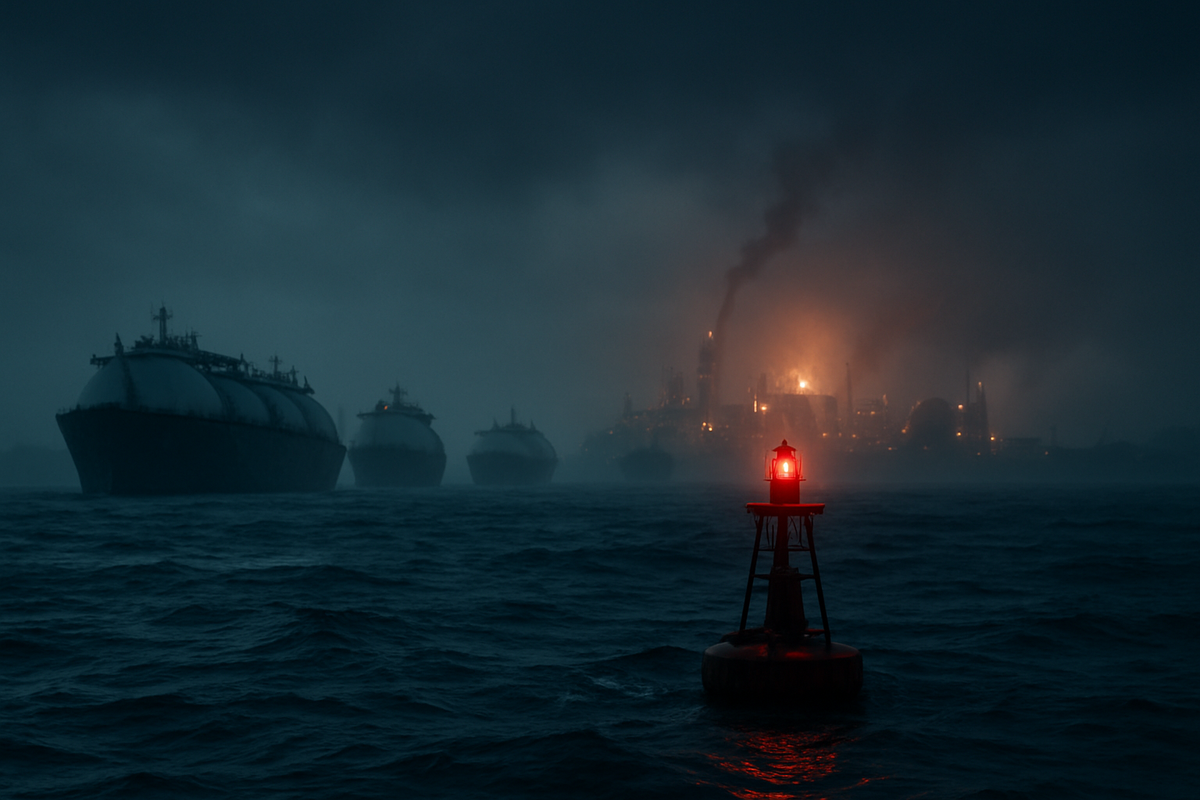
The global energy landscape has been plunged into a state of unprecedented volatility as the effective closure of the Strait of Hormuz enters its second month. Following a series of military escalations that began in late February 2026, the world’s most critical maritime chokepoint for energy has been rendered impassable for commercial Liquefied Natural Gas (LNG) tankers. As of April 9, 2026, nearly 20% of the world’s LNG supply—roughly 110 billion cubic meters of gas primarily originating from Qatar—is effectively stranded, causing energy prices to skyrocket from Tokyo to Berlin.
The immediate implications are dire. Spot prices for LNG in Asia (JKM) have surged by over 140% since the conflict erupted, while European benchmarks (TTF) have climbed past €50/MWh, a level not seen since the height of the 2022 energy crisis. With QatarEnergy declaring force majeure on its global shipments and key export infrastructure at Ras Laffan sustaining significant damage, the global market is grappling with a supply deficit that cannot be easily bridged by existing producers. Governments are already dusting off emergency rationing protocols, and the industrial sector is bracing for a prolonged period of high-cost energy that threatens to derail the fragile global economic recovery.
The Chokehold: A Timeline of Escalation and Impact
The current crisis is the culmination of a "perfect storm" of diplomatic failure and military kinetic action. On February 28, 2026, a coalition led by the United States and Israel launched "Operation Epic Fury," a massive pre-emptive strike targeting Iranian nuclear and military infrastructure. In the chaotic 48 hours that followed, Iran retaliated with "Truth Promise 4," deploying a swarm of drones and sea mines that effectively shuttered the Strait of Hormuz. Crucially, the conflict saw direct hits on the Ras Laffan Industrial City in Qatar, the world’s largest LNG export hub. The March 2nd attack on Ras Laffan reportedly knocked out 17% of the nation’s export capacity, with damage so extensive that repairs are projected to take three to five years.
The timeline of the disruption has been relentless. By March 4, QatarEnergy, the state-owned giant, officially notified its global partners that it could no longer fulfill delivery obligations. Since then, no loaded LNG tankers have successfully exited the Persian Gulf. High-profile attempts by vessels such as the Al Daayen and the Rasheeda to run the blockade in early April ended in abrupt "U-turns" as naval intelligence warned of active mining and missile threats. The psychological impact on the market was immediate; what was initially viewed as a temporary geopolitical flare-up has transformed into a structural supply catastrophe.
Key stakeholders, including the International Energy Agency (IEA) and various G7 energy ministries, have held emergency summits in Paris and Washington to coordinate a response. However, the physical reality remains unchanged: there is no immediate pipeline or alternative maritime route capable of replacing the 112 billion cubic meters of gas that transits the Strait annually. The crisis has exposed the extreme vulnerability of the "just-in-time" global LNG market, which had only just begun to find its footing after the shocks of the early 2020s.
Corporate Impact: Navigating the Supply Void
The disruption has created a bifurcated reality for public companies, rewarding those with North American and Australian assets while punishing major buyers and regional players. Cheniere Energy (NYSE: LNG) has emerged as the primary beneficiary of the crisis. Shares of the Houston-based exporter hit a record high of $300.89 in late March, as the company fast-tracked the commissioning of its Corpus Christi Stage 3 expansion. With Qatari molecules absent, Cheniere has become the global "lender of last resort" for gas, capturing massive premiums on spot market cargoes. Similarly, Sempra (NYSE: SRE) has seen its stock price surge toward the $100 mark, buoyed by its geographically insulated export projects on the US Gulf Coast.
In the Pacific, Woodside Energy (NYSE: WDS) has seen its valuation jump by approximately 20% in the last 30 days. As Australia’s leading producer, Woodside is 40% closer to the desperate Asian markets than the now-blocked Middle Eastern suppliers. Global majors with diversified portfolios, such as Shell (NYSE: SHEL) and TotalEnergies (NYSE: TTE), have managed to mitigate some losses through "portfolio flexibility"—rerouting US and African cargoes to high-bidding utilities in Japan and South Korea—though their significant equity stakes in Qatari projects remain a heavy drag on their long-term production outlook.
Conversely, the "losers" list is dominated by Asian utilities and national champions. Korea Gas Corporation (KRX: 036460), commonly known as KOGAS, is facing a procurement nightmare. South Korea is arguably the nation most dependent on the Hormuz transit route, and KOGAS has been forced to divert all its Australian and Canadian equity gas to domestic use just to keep the lights on, eroding its profit margins. In Japan, Tokyo Electric Power Company (TSE: 9501), or TEPCO, has seen its earnings outlook slashed as it restarts dormant coal-fired plants to compensate for the missing gas, facing astronomical fuel costs that analysts expect will lead to a collapse in year-end earnings.
The Strategic Shift: Global Energy Fragility
This event fits into a broader trend of "energy regionalization" that has been accelerating since 2022. While the Russian invasion of Ukraine taught Europe the danger of pipeline dependency on a single hostile neighbor, the 2026 Hormuz crisis has taught the world the danger of maritime chokepoints. Historically, the 2022 crisis was viewed as a regional European issue, but the current disruption is truly global. Because LNG is a seaborne commodity, a closure in the Middle East has an immediate "ripple effect" on prices in the Atlantic, as Asian buyers outbid Europeans for the limited supply of American and West African cargoes.
Regulatory and policy implications are shifting rapidly. In the United States, the 2026 crisis has definitively ended the debate over the "LNG export pause" of 2024. The Department of Energy has pivoted to an "Energy Dominance" agenda, issuing blanket authorizations for export projects to bolster global security. In Europe, the REPowerEU mandates have been revised to accelerate the total decoupling from all fossil fuel dependencies, as the continent realizes that even "friendly" LNG sources are subject to physical blockades. The crisis has essentially killed the narrative that LNG is a "safe" bridge fuel, forcing a more aggressive tilt toward homegrown renewables and nuclear power.
The Road Ahead: Scenarios and Strategic Pivots
In the short term, market participants should expect continued extreme volatility. Even if a permanent ceasefire were announced tomorrow, the clearing of mines in the Strait of Hormuz and the repair of the Ras Laffan infrastructure would take months, if not years. We are likely entering a multi-year period of "scarcity pricing" where energy-intensive industries—such as petrochemicals and fertilizer production—may be forced to relocate or shutter operations permanently in regions without domestic gas.
Looking long-term, the strategic pivot will likely involve a massive build-out of "bypass" infrastructure. We may see renewed interest in trans-continental pipelines and a surge in investment for US and Canadian East Coast export terminals that avoid both the Suez Canal and the Strait of Hormuz. Furthermore, the 2026 crisis is acting as a catalyst for a "storage revolution." Just as the 1970s oil shocks led to the creation of Strategic Petroleum Reserves, we are now seeing the emergence of mandated, large-scale LNG storage requirements in Asia, which will require significant capital expenditure from public utilities over the next decade.
Summary of the New Energy Reality
The events of early 2026 have rewritten the rules of the energy market. The closure of the Strait of Hormuz has proven that the global LNG supply chain is far more fragile than previously assumed, and the resulting price spikes are fundamentally altering the cost of living and the cost of doing business globally. For investors, the takeaway is clear: the "peace dividend" of the early 2010s is gone, replaced by a "security premium" that favors producers in politically stable, geographically accessible regions.
Moving forward, the market will be defined by its ability to adapt to a world where 20% of its energy supply can vanish overnight. Investors should watch for the pace of repairs in Qatar, the speed of new US capacity coming online, and the regulatory response from the EU and Japan. The "Blue Flame" of LNG remains essential for now, but its reputation as a reliable pillar of global energy security has been permanently scorched.
This content is intended for informational purposes only and is not financial advice.