The Battle for Acres: Grain Markets Bracing for USDA’s High-Stakes Plantings Report
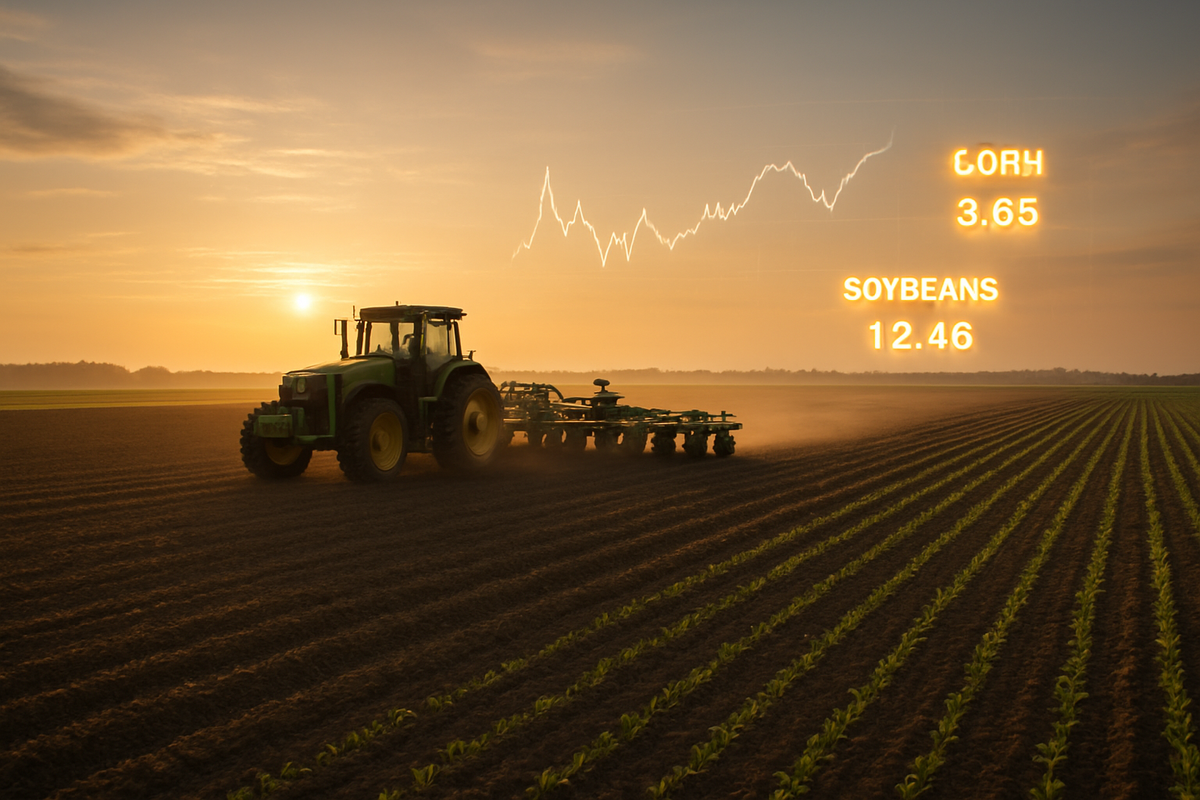
As the clock ticks toward noon on March 31, 2026, the global agricultural community has collectively held its breath. The U.S. Department of Agriculture (USDA) is set to release its annual Prospective Plantings report, a document that serves as the definitive opening salvo for the North American growing season. For grain traders, the stakes are rarely higher; this survey-based report provides the first hard evidence of how millions of acres will be divided between the world’s most critical commodities.
Initial analyst consensus suggests a pivotal shift is underway. After a record-breaking 2025 that saw corn acreage swell to nearly 95.3 million acres, industry experts are forecasting a strategic retreat. Current expectations place 2026 corn plantings at 94.5 million acres—a slight but significant contraction that could recalibrate global supply chains, influence inflation figures, and dictate the profit margins for the largest agribusinesses on the planet.
A Forecasted Retreat from the Corn Surplus
The journey to this year’s March 31 report has been defined by a complex "battle for acres" between corn and soybeans. Following the massive harvest of 2025, which saw corn stocks reach multi-year highs and pressured prices, farmers are facing a different economic reality this spring. The lead-up to today’s release has been characterized by a shifting Soybean/Corn price ratio, which recently climbed above the 2.5 threshold, historically a signal for farmers to favor oilseeds over the more nitrogen-intensive corn.
This report is the result of an exhaustive survey of approximately 80,000 farm operators conducted during the first two weeks of March. Unlike the "Outlook Forum" projections released earlier in February, the Prospective Plantings report reflects actual farmer intentions influenced by current input costs and local weather conditions. For months, the market has traded on speculation; today, those theories meet reality. If the USDA confirms the expected drop to 94.5 million acres, it would mark a deliberate pivot away from the oversupply of 2025, potentially floor-setting corn prices for the remainder of the year.
Agribusiness Giants in the Crosshairs
The shift in acreage creates a distinct landscape of winners and losers across the public markets. CF Industries Holdings, Inc. (NYSE: CF) and The Mosaic Company (NYSE: MOS) are among the most sensitive to these figures. Corn requires significantly more nitrogen and phosphate fertilizer than soybeans; therefore, a reduction in corn acreage—even a modest one—represents a direct hit to the potential volume of domestic fertilizer sales. Shares of these companies often trade in high correlation with the "corn-heavy" bias of the USDA’s data.
Equipment manufacturers and seed providers are also bracing for the impact. Deere & Co (NYSE: DE), the titan of agricultural machinery, views corn as its primary demand driver. Because corn is more equipment-intensive to plant, treat, and harvest than soybeans, high corn acreage typically translates to stronger sales for high-horsepower tractors and advanced planters. Similarly, Corteva, Inc. (NYSE: CTVA) relies on corn for its highest-margin "triple-stack" seed products. A shift toward soybeans could see a temporary contraction in seed revenue as farmers opt for lower-cost oilseed varieties.
Meanwhile, the "ABCD" grain majors, led by Archer-Daniels-Midland (NYSE: ADM) and Bunge Global SA (NYSE: BG), are navigating a double-edged sword. While ADM benefits from massive corn volumes to feed its sprawling ethanol and sweetener divisions, Bunge thrives on the "crush margin" of soybeans. A move away from corn into soybeans could bolster Bunge’s processing volumes while tightening the supply of feedstock for ADM’s biofuels. For these diversified giants, the volatility following the 12:00 PM release is not just about price, but about the long-term logistical planning of their global processing networks.
The Global Ripple Effect and Historical Context
The expected drop to 94.5 million acres fits into a broader trend of agricultural recalibration. Historically, whenever corn acreage nears the 95-million-acre mark, as it did in 2025 and 2023, the subsequent market saturation inevitably leads to a "correction year" where soybeans regain ground. This cyclicality is being compounded in 2026 by increasing competition from Brazil and Argentina, where expanded double-cropping of corn (Safrinha) has made the U.S. corn export market more price-sensitive than ever before.
Regulatory pressures are also playing a quiet but persistent role. As the U.S. continues to debate the future of the Renewable Fuel Standard (RFS) and the expansion of Sustainable Aviation Fuel (SAF), the demand for corn-based ethanol vs. soybean-based biodiesel is under the microscope. A shift toward more soybean acres would align with the growing domestic demand for vegetable oils in the green energy sector, signaling a long-term policy shift that may outlast any single growing season.
Navigating the Growing Season: What Lies Ahead
In the short term, the market's reaction to the 94.5 million-acre figure will likely be one of "buying the rumor, selling the news" if the number hits exactly as expected. However, any surprise—such as corn acreage holding higher than 95 million or dropping below 93 million—could trigger limit-moves in the Chicago Board of Trade (CBOT) futures. For grain traders, the next 48 hours will be a frantic scramble to adjust positions before the focus shifts from "intended acres" to "weather-driven yields."
Looking further ahead, the successful execution of these planting intentions will depend entirely on the April-May weather window across the I-States (Iowa, Illinois, Indiana). If the spring is wet and cold, we may see an even further shift toward soybeans, as they have a shorter growing season and can be planted later than corn. Strategic pivots by the major agribusinesses are already underway, with companies like Corteva and ADM focusing heavily on digital agronomy and precision planting to maximize the efficiency of whichever acres the farmers ultimately choose to plant.
Summary and Market Outlook
The USDA Prospective Plantings report is far more than a collection of numbers; it is the fundamental blueprint for the global food and fuel supply for the coming year. A retreat to 94.5 million acres of corn suggests a market attempting to find equilibrium after a year of record supply. For investors, the takeaway is clear: the era of "easy" volume growth for input providers like CF Industries and Deere may be hitting a plateau, requiring a shift in focus toward pricing power and technological efficiency.
Moving forward, the primary metric to watch will be the "prevent plant" figures that will emerge later this summer, as well as the June 30 Acreage Report which will confirm what actually made it into the ground. As of March 31, 2026, the agricultural sector has its roadmap. Whether the weather and the economy allow farmers to follow it remains the multi-billion dollar question that will dominate the financial markets through the harvest season.
This content is intended for informational purposes only and is not financial advice.