The $98 Anchor: Global Markets Breathe as Oil Stabilizes Amid Middle East Ceasefire
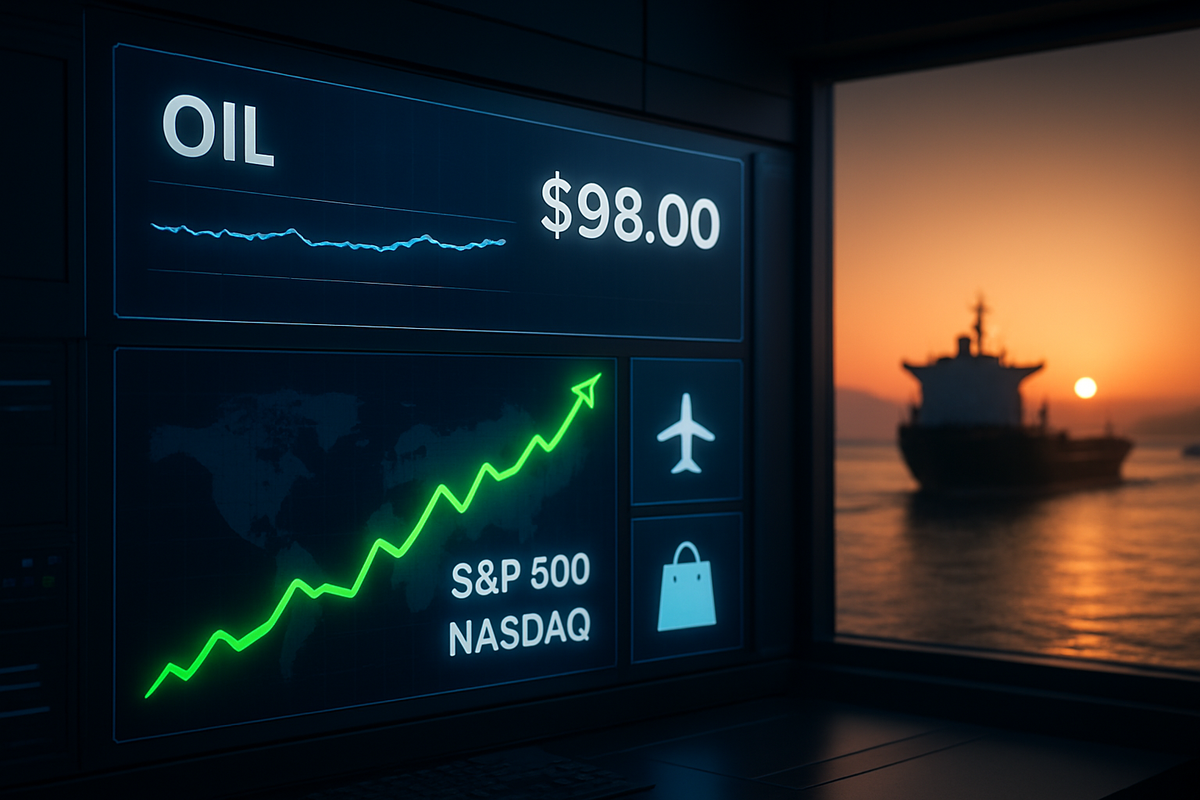
As of April 10, 2026, the global energy landscape has reached a precarious but welcome plateau. After a harrowing six-week surge that saw West Texas Intermediate (WTI) crude skyrocket toward $125 per barrel, prices have retreated and stabilized near the $98 mark. This normalization follows a breakthrough ceasefire agreement that has temporarily de-escalated a looming conflict between the United States and Iran, providing a crucial "relief valve" for a global economy that was beginning to buckle under the weight of triple-digit energy costs.
The stabilization at $98 is being hailed by Wall Street as the "Goldilocks" pivot—high enough to maintain the profitability of domestic energy producers, yet low enough to prevent a full-scale inflationary spiral. This price anchor has acted as a primary catalyst for a broad-based equity rally, with the S&P 500 and Nasdaq Composite recording their strongest weekly gains of 2026. For investors, the move represents more than just a lower number at the pump; it signifies a return to a market driven by fundamentals rather than the immediate threat of a catastrophic disruption in the Strait of Hormuz.
The Path to $98: A Timeline of Tension and Truce
The volatility that defined the first quarter of 2026 reached a fever pitch in late February, following "Operation Epic Fury," a series of targeted strikes by U.S. and Israeli forces on Iranian military assets. In retaliation, the Islamic Revolutionary Guard Corps (IRGC) effectively weaponized the Strait of Hormuz—the world’s most vital oil artery—implementing a de facto "toll regime." By mid-March, tankers were reportedly being charged upwards of $1 million in Chinese yuan for safe passage, while physical crude premiums for North Sea blends reached record highs of $50 over futures prices.
The turning point arrived on the evening of April 7, 2026. Just hours before a scheduled escalation of U.S. air operations, a two-week conditional ceasefire was brokered by Pakistani diplomats in Islamabad. The agreement necessitated a pause in hostilities and a partial reopening of the Strait, leading to a "violent reversal" in paper oil markets. WTI crude, which had been trading at a fear-induced premium near $120, plummeted nearly 18% in a single session to settle in the high 90s.
Industry reactions were instantaneous. While energy traders liquidated long positions, equity desks saw a massive influx of capital into sectors that had been previously paralyzed by fuel costs. The "Iran War Premium" did not evaporate entirely—lingering infrastructure damage to Saudi Arabia’s East-West Pipeline and the fragility of the Islamabad talks have kept prices from falling back to 2025 levels—but the move to $98 has established a new psychological floor that the market currently views as sustainable.
Winners and Losers: From Big Oil to the Big Skies
The stabilization of oil has created a stark divergence in corporate fortunes. The primary beneficiaries have been the fuel-sensitive transportation and retail sectors. United Airlines (NASDAQ: UAL) and Delta Air Lines (NYSE: DAL) saw their stock prices surge by 14% and 10.6% respectively following the April 7 announcement. For these carriers, the drop from $125 to $98 translates into billions of dollars in saved operational expenses for the upcoming summer travel season. Similarly, retail giants like Amazon (NASDAQ: AMZN) and Home Depot (NYSE: HD) have rallied on expectations that lower gasoline prices will boost discretionary consumer spending.
Conversely, the "Great Rotation" that saw energy stocks dominate the early part of the year has slowed. While ExxonMobil (NYSE: XOM) remains up roughly 42% year-to-date, its momentum has cooled as the immediate supply-crunch panic subsides. Exxon and Chevron (NYSE: CVX) are now being evaluated not as speculative war plays, but on their ability to maintain high dividends in a "stable high-price" environment. Chevron, in particular, has seen its stock consolidate as investors weigh its 3.7% yield against the risk of further price erosion if the ceasefire becomes permanent.
Technology leaders, often sensitive to the inflationary pressures of high energy costs, have also joined the relief rally. Nvidia (NASDAQ: NVDA) and Meta Platforms (NASDAQ: META) posted gains of over 3% as the "SaaSpocalypse"—a term coined by analysts to describe the tech sell-off in early 2026—appears to have bottomed out. The stabilization of oil has allowed these high-growth companies to move past the "macro-gloom" and back toward earnings-driven valuations.
Broader Trends and the "New Normal" for Energy Policy
The current price of $98 a barrel fits into a wider 2026 trend of "Resource Realism." The energy shock of early 2026 has forced a regulatory pivot in both the U.S. and Europe, where aggressive green energy timelines are being balanced against the immediate need for energy security. This event echoes the 1970s oil crises but with a modern twist: the integration of strategic reserves and advanced shale production has allowed the U.S. to respond more dynamically to the Strait of Hormuz blockade than in decades past.
The ripple effects are also being felt in the semiconductor and AI industries. As Microsoft (NASDAQ: MSFT) and other cloud providers manage massive data centers, the stabilization of energy costs is a critical factor in their 2026 capital expenditure plans. Furthermore, the reliance on the Islamabad peace talks highlights the increasing role of "middle-power" nations in mediating energy-security conflicts, a shift away from the traditional U.S.-Saudi hegemony that dominated oil politics for the last fifty years.
Historically, periods of extreme volatility followed by a plateau often lead to a "re-basing" of the economy. The $98 anchor suggests that the era of $70 oil may be a relic of the past, as the "War Premium" is replaced by a "Security Premium." This shift is prompting competitors in the EV space to accelerate production, as the cost-benefit analysis for consumers remains tilted in favor of electrification even at slightly lower-than-peak oil prices.
Looking Ahead: The Islamabad Deadline
The short-term fate of the market now rests on the high-stakes peace talks scheduled for April 11–12 in Pakistan. If a permanent resolution regarding the Strait of Hormuz is reached, some analysts predict oil could slide further toward $85, potentially sparking a massive secondary rally in the broader S&P 500. However, if the talks fail and the ceasefire expires without a transition plan, the $98 floor could quickly become a launchpad for a return to $150.
Strategic pivots are already underway. Companies are diversifying their supply chains to bypass the Middle East, with increased investment flowing into Guyanese and Brazilian offshore projects. Market opportunities are emerging in "energy logistics" and infrastructure protection, as firms realize that the Strait of Hormuz remains a single point of failure for the global economy. In the coming months, the ability of companies to hedge against renewed volatility will separate the winners from the losers.
Summary: A Tense Stability
The stabilization of oil at $98 a barrel represents a critical moment of respite for the global markets in 2026. It has successfully decoupled the equity markets from the immediate panic of a Middle Eastern war, allowing for a significant recovery in tech, retail, and transportation stocks. Key takeaways for the week of April 10 include the resilience of the U.S. consumer in the face of energy shocks and the rapid "Great Rotation" back into growth assets as oil volatility subsided.
Moving forward, the market remains in a state of "cautious optimism." Investors should keep a close watch on the outcome of the Islamabad summit and the weekly inventory reports from the Department of Energy. While $98 oil has provided the foundation for the current rally, the structural issues in the Middle East remain unresolved. For now, the "Goldilocks" price is holding, but in the volatile world of 2026, stability is a commodity as precious—and as fleeting—as the oil itself.
This content is intended for informational purposes only and is not financial advice