The $7 Trillion Storm: Why Volatility is the New Permanent Resident of Wall Street
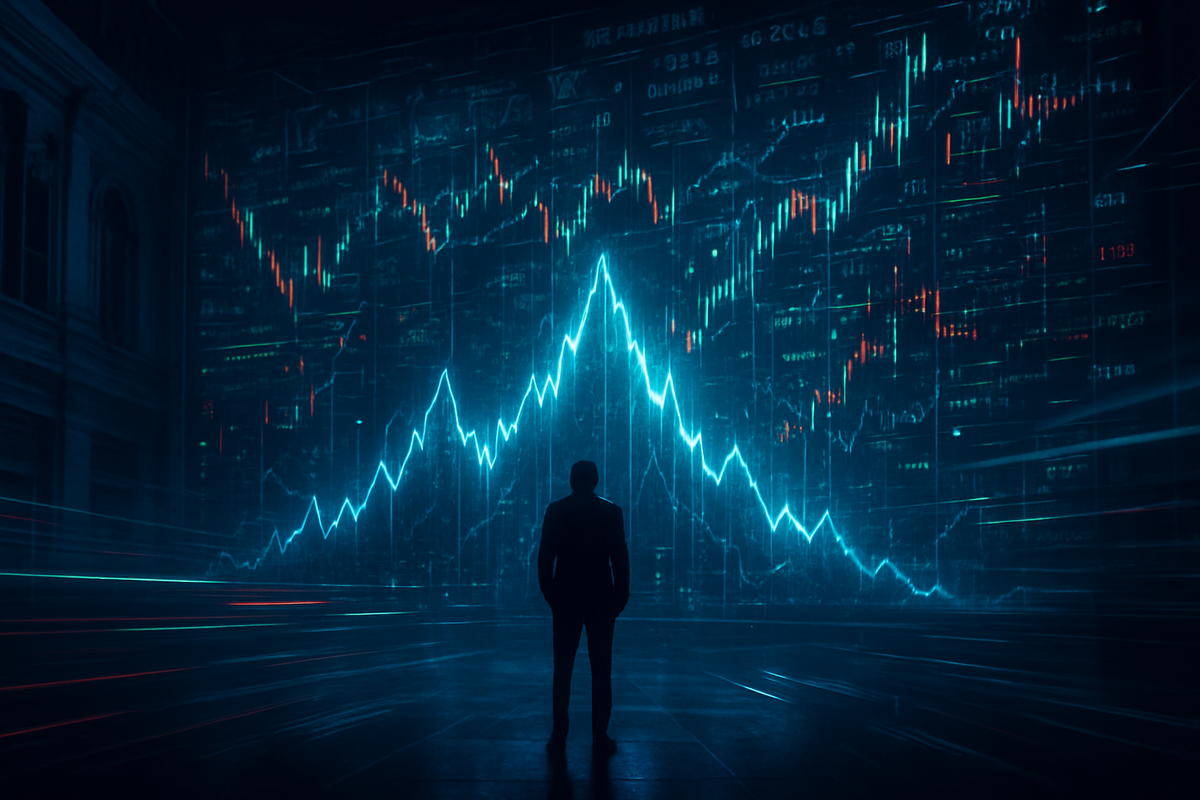
As the closing bell approaches on this Friday, December 19, 2025, Wall Street is grappling with a staggering $7.1 trillion "Triple Witching" event—the simultaneous expiration of stock options, index futures, and index options. This massive derivatives expiration, the largest in financial history, has sent shockwaves through the market, with the S&P 500 experiencing intraday swings of nearly 2% in mere minutes. The event marks a chaotic climax to a year defined by the "Great Data Gap," a 43-day federal government shutdown that paralyzed economic reporting and left investors flying blind for much of the fourth quarter.
The immediate implications of today's volatility are profound. High-frequency trading (HFT) algorithms, now the primary architects of market liquidity, are struggling to reconcile two months of delayed economic data that only began hitting the tapes earlier this week. For the retail investor, the message is clear: the era of "buy and hold" in a calm sea has been replaced by a permanent state of high-frequency turbulence. As AI-driven platforms react instantaneously to every scrap of information, price "gapping"—where a stock jumps over price levels without trading—has become a standard feature of the modern trading landscape.
The Road to the Storm
The road to today’s $7.1 trillion derivatives storm began in early October 2025, when the longest government shutdown in U.S. history commenced. For 43 days, essential data points like the Consumer Price Index (CPI) and Non-Farm Payrolls were suspended, creating an information vacuum. During this "Great Data Gap," the market relied on "alternative data"—AI-generated sentiment analysis and satellite imagery of retail hubs—to guess at the health of the economy. When the government finally reopened in mid-November, the backlog of official data released this week revealed a labor market cooling faster than anticipated, triggering a frantic repricing of assets.
Key players in this drama include the Federal Reserve, which was forced to execute a preemptive 25-basis-point rate cut on December 10 without the benefit of full Q4 data, and the Bank of Japan, whose hawkish shift to a 0.50% interest rate earlier this year continues to unravel global "carry trades." These macro shifts have been amplified by Nvidia Corporation (NASDAQ:NVDA), which saw its own volatility spike in August 2025 after AI-driven sentiment analysis flagged emerging export risks. The intersection of these geopolitical tensions and the sudden dump of "catch-up" data has turned today’s Triple Witching into a pressure cooker for institutional and retail traders alike.
Initial market reactions have been polarized. While the VIX—Wall Street’s "fear gauge"—has settled near 16.87, the SKEW index remains at a historic high of 155.4, indicating that institutional players are paying massive premiums for protection against a sudden "black swan" crash. The sheer volume of automated trades today has narrowed bid-ask spreads to fractions of a penny, yet this efficiency has removed the human "buffers" that once slowed down market panics, leading to the violent intraday reversals seen in the final hour of trading.
Winners and Losers in the Chaos
In this environment of permanent volatility, a clear divide has emerged between the companies that monetize chaos and those that are vulnerable to it. Virtu Financial (NASDAQ:VIRT) stands as a primary beneficiary; as a leading market maker, it thrives on the wider spreads and increased transaction volumes that accompany market stress. In 2025, Virtu reported a 50% year-over-year increase in trading income, capitalizing on the fragmented and unstable global markets. Similarly, CBOE Global Markets (BATS:CBOE) has reached record revenues through its proprietary VIX and SPX options products, which have become essential tools for traders looking to hedge against the very swings CBOE helps facilitate.
CME Group (NASDAQ:CME) has also emerged as a winner, benefiting from a record-breaking average of 26 million daily contracts as institutions rush to hedge interest-rate and commodity risks. On the retail front, Robinhood Markets, Inc. (NASDAQ:HOOD) has seen its stock rally over 150% in the first half of 2025, fueled by an explosion in "event contract" trading and speculative crypto activity. However, Robinhood remains a high-beta play, susceptible to sudden shifts in retail sentiment and regulatory scrutiny over its gamified features during high-volatility windows.
Conversely, traditional asset managers and banks like The Charles Schwab Corporation (NYSE:SCHW) have faced a more complex path. While high trading volume generates commissions, extreme volatility often scares retail clients into "wait-and-see" modes, rotating capital out of equities and into fixed-income or safe-haven assets. In April 2025, Schwab reported a significant dip in client activity during a major tariff-related volatility spike, highlighting how traditional brokerages can suffer when market turbulence turns from an opportunity into a deterrent for the average investor.
A New Era of Algorithmic Dominance
The current state of the market is not a temporary aberration but a reflection of broader industry trends. The dominance of AI and HFT has "sterilized" the market, making it more efficient but also more prone to cascading sell-offs. When algorithms "herd" in the same direction based on the same AI-flagged news, the result is a liquidity vacuum that can cause 10% drops in a matter of days, as seen during the "April 2 Tariff Announcement" earlier this year. This event, dubbed "Liberation Day" by critics, saw the S&P 500 plunge 10% in 72 hours, a move that would have taken weeks in previous decades.
Regulatory and policy implications are looming large. The "Great Data Gap" of 2025 has sparked a debate in Washington about the decentralization of economic reporting, with calls for the government to adopt the very "alternative data" methods that AI firms used during the shutdown. Furthermore, the rise of 0DTE (zero days to expiration) options—now a staple of the retail diet on platforms like Robinhood—has drawn the eye of the SEC, as these instruments are blamed for exacerbating intraday "gamma squeezes" that force market makers to buy or sell shares rapidly to hedge their positions.
Historical precedents, such as the 1987 Black Monday or the 2010 Flash Crash, offer some comparison, but 2025 is unique in its integration of machine learning. Unlike 1987, where human floor traders could physically halt the chaos, today’s "circuit breakers" are often triggered by the same algorithms that caused the slide. The ripple effect extends to global partners; as the U.S. market swings, it drags down European and Asian indices through cross-border algorithmic triggers, creating a truly globalized, high-frequency contagion.
Navigating the Future
Looking ahead, the market is likely to remain in this "event-driven" state for the foreseeable future. In the short term, the resolution of the December data backlog will dictate whether the Fed continues its easing cycle into 2026. If the "Great Data Gap" hid a deeper economic malaise, we could see a strategic pivot toward defensive sectors and a sustained rise in the VIX. However, if the economy proves resilient, the current volatility may simply be the "new noise" that investors must learn to tune out.
For retail investors, surviving this environment requires a fundamental adaptation of strategy. The traditional stop-loss order is increasingly dangerous in "gapping" markets; an investor who sets a stop at $95 might see their stock open at $80 after a bad news cycle, resulting in a far worse exit than planned. Instead, sophisticated retail traders are moving toward "stop-limit" orders with wide cushions to prevent being "stopped out" at the bottom of a flash crash. Furthermore, the use of "tail-risk" ETFs, such as the Cambria Tail Risk ETF (BATS:TAIL) or the Simplify Tail Risk Strategy ETF (NYSE:CYA), is becoming a standard portfolio insurance policy, providing a convex payoff when the market takes a double-digit dive.
Final Thoughts
The events of December 19, 2025, serve as a stark reminder that volatility is no longer an occasional visitor to the New York Stock Exchange—it is a permanent resident. The combination of a $7.1 trillion derivatives expiration and the chaotic end to the "Great Data Gap" has demonstrated that the market's internal plumbing has changed. Efficiency has come at the cost of stability, and the speed of information has outpaced the human capacity to process it.
Moving forward, investors should watch for the Fed’s 2026 outlook and any potential regulatory shifts regarding HFT and 0DTE options. The key takeaway is that "buying the dip" now requires more than just courage; it requires a technical understanding of how algorithms move prices. In the coming months, the ability to manage risk through hedging and disciplined order execution will separate the winners from those swept away by the high-frequency tide. The market has entered a new era where the only certainty is uncertainty itself.
This content is intended for informational purposes only and is not financial advice.