The $240 Steak: Livestock Markets Hit Record Highs as 'Beef Super-Cycle' Grips Wall Street
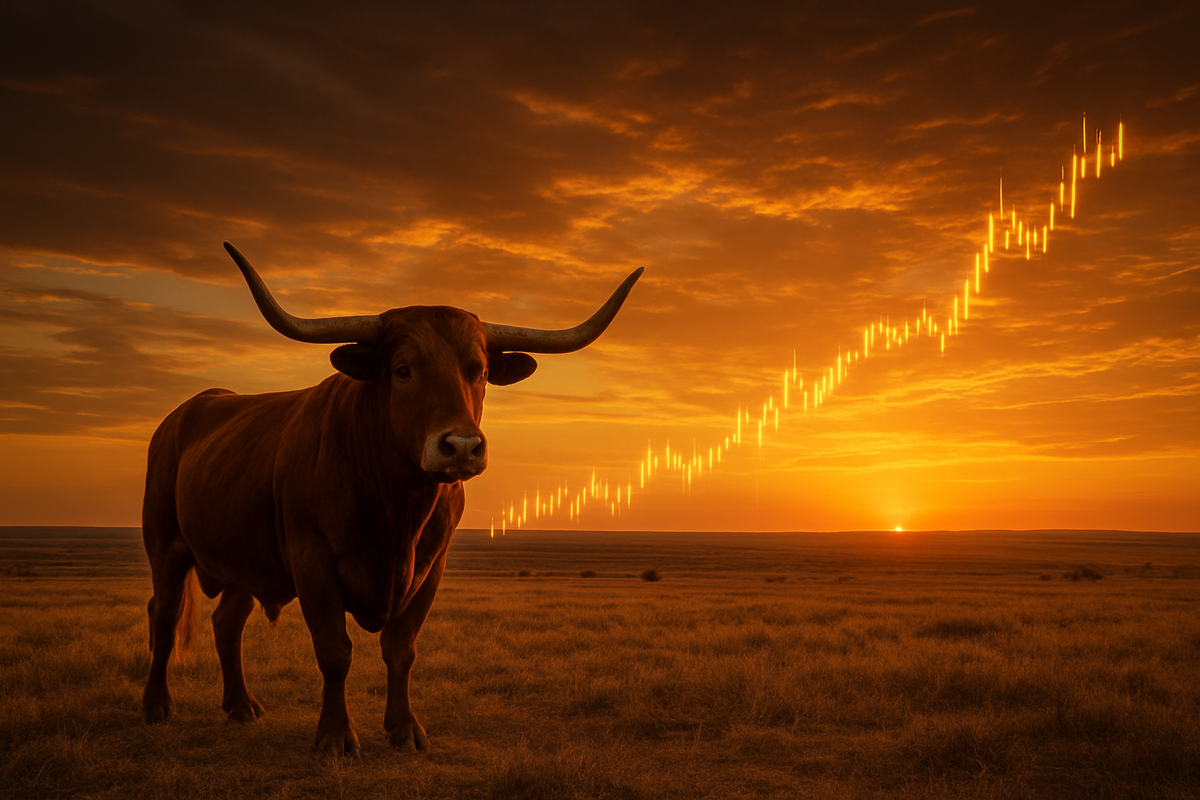
The American livestock sector has entered unchartered territory as March 2026 draws to a close, with live cattle futures surging to a historic $240.20 per hundredweight (cwt). This rally, which market analysts are now officially labeling a "Beef Super-Cycle," has been fueled by a perfect storm of structural supply shortages and a consumer base that refuses to quit beef, even as retail prices push toward $10 per pound. The bullish favor returning to the pits in Chicago is not merely a seasonal fluctuation but a profound realignment of the protein market that is sending shockwaves from the ranch to the restaurant table.
The immediate implications are stark: cattle producers are seeing generational profit margins while the "Big Four" meatpackers are struggling to maintain processing volumes. As of March 31, 2026, the CME Feeder Cattle Index has climbed to a staggering $365.12, reflecting an intense scramble among feedlots to secure a dwindling supply of young animals. This price action suggests that the era of "cheap beef" is over for the foreseeable future, as the industry grapples with the smallest national cattle herd in more than seven decades.
Structural Scarcity: The Road to $240 Cattle
The surge to $240.20 per cwt is the culmination of a multi-year contraction that began during the severe droughts of 2020–2025. According to the USDA’s Cattle on Feed report released on March 20, 2026, the total U.S. herd has fallen to 86.2 million head—the lowest level since 1951. More critically, the beef cow herd, the engine of future production, stands at just 27.6 million head, a nadir not seen since 1961. Ranchers, hammered by high interest rates and years of poor grazing conditions, spent the last half-decade liquidating breeding stock rather than retaining heifers, creating a supply hole that cannot be quickly filled.
The timeline of this month's rally was further accelerated by a high-stakes labor strike at the JBS S.A. (OTCMKTS: JBSAY) flagship processing plant in Greeley, Colorado, which began on March 16. The work stoppage temporarily froze nearly 7% of the nation’s daily slaughter capacity. While this bottleneck locally depressed cash prices for some ranchers in the Mountain West who couldn't move their animals, it sent futures skyrocketing as buyers feared a widening retail shortage. Simultaneously, the March USDA report showed that marketings—the flow of cattle out of feedlots to packers—fell 7% year-over-year to 1.52 million head, the slowest pace in over a decade.
The market reaction has been one of "aggressive bullishness" among commodity traders. The June 2026 Live Cattle contract’s climb to $240.20 represents a 15% year-over-year increase, signaling that the market does not expect relief anytime soon. Despite higher carcass weights—up 11.5% since 2015 due to better genetics and feeding efficiency—the sheer drop in the number of head has created a deficit that weight alone cannot bridge.
Winners and Losers in the Protein Pivot
The financial fallout of this rally is creating a stark divide between different segments of the industry. On the losing end, major meatpackers like Tyson Foods (NYSE: TSN) are facing a severe margin squeeze. Tyson recently reported a $319 million operating loss in its beef segment for the first quarter of 2026, as the cost of live animals outpaced the price the company could fetch for boxed beef. In a bid to streamline operations, Tyson has already shuttered its facility in Lexington, Nebraska, a move that highlights the pain of underutilized processing capacity.
Conversely, diversified giants like JBS S.A. and Pilgrim's Pride (NASDAQ: PPC) are attempting to weather the storm by leaning into their pork and poultry segments. Poultry, in particular, has become a vital hedge as consumers begin to "trade down" from expensive ribeyes to chicken breasts. Meanwhile, Hormel Foods (NYSE: HRL) has pivoted toward "blended proteins" and value-added prepared foods, a strategic move to maintain its price points without alienating middle-class shoppers who are increasingly priced out of the premium steak aisle.
The restaurant sector is perhaps the most visible casualty of $240 cattle. McDonald's (NYSE: MCD) recently faced a "value perception crisis" following the launch of its "Big Arch" burger, which carried a price tag as high as $12.99 in some markets. The backlash has forced the fast-food giant to announce a total revamp of its value menu, set to debut in April 2026. Steakhouse chains like Texas Roadhouse (NASDAQ: TXRH) have also been forced to act, implementing a 1.9% price hike at the start of Q2 to defend margins, noting that beef now constitutes over 50% of their total food basket.
The 'Beef Super-Cycle' and Macro Implications
This event fits into a broader trend of "protein inflation" that is reshaping global food security. The current rally is not just a American phenomenon; it is a structural shift known as the "Beef Super-Cycle." Historically, cattle cycles last 8 to 12 years, but the combination of extreme climate volatility and high capital costs has elongated the current contraction phase. The precedent for this was the 2014-2015 rally, but the 2026 peak has far surpassed those levels in both nominal and inflation-adjusted terms.
The ripple effects are extending to competitors in the "fake meat" or alternative protein space. While companies like Beyond Meat have struggled in recent years, the $9.50 per pound retail price for ground beef is creating a new opening for plant-based and cultivated meat products to achieve price parity. Regulatory bodies are also taking notice; the USDA is under increasing pressure to investigate the price spread between what ranchers receive and what consumers pay, though the current data suggests the "Big Four" packers are currently losing money on every head they process, complicating the political narrative of "greedflation."
Furthermore, the $365.12 Feeder Cattle Index suggests that the cost of rebuilding the herd will be astronomical. Ranchers wishing to buy young steers or heifers to expand their operations must now pay record premiums, which may ironically delay the herd recovery as producers opt to sell their heifers for immediate high profits rather than keeping them for breeding.
The Outlook: A Long Climb Back
In the short term, the livestock market is expected to remain highly volatile. The scramble for supply will likely keep Live Cattle futures above the $220 mark for the remainder of 2026. Investors should watch for the "heifer retention" signal in the next several USDA reports; until ranchers stop sending female cattle to slaughter and start keeping them for breeding, the supply of beef will continue to shrink. This process typically takes two to three years to result in more beef on the shelf, suggesting that high prices will persist through at least 2028.
Strategic pivots will be required across the board. We may see more restaurant chains like Burger King (NYSE: QSR) and Shake Shack (NYSE: SHAK) permanently shift their marketing focus toward chicken and pork products. For the meatpackers, the challenge will be "right-sizing" their footprint. If the national herd remains below 90 million head, the U.S. simply has too many slaughterhouses, leading to more facility closures and potential industry consolidation.
A potential scenario for late 2026 involves a "consumer cliff," where the cumulative effect of food inflation finally breaks the resilience of the American shopper. If demand for beef drops significantly, prices could retreat, but the low supply floor provided by the 75-year herd low will likely prevent a total market collapse.
Summary and Investor Takeaways
The record-breaking rally to $240.20 per cwt in the live cattle market is a watershed moment for the financial and agricultural sectors. It signifies a move into a period of structural scarcity that will test the margins of some of the world’s largest food companies and the budgets of millions of households. The key takeaway for investors is the divergence between producers, who are in a "golden age" of pricing, and processors and retailers, who are caught in a brutal margin squeeze.
Moving forward, the market will be defined by the pace of herd rebuilding and the durability of consumer demand. Investors should keep a close eye on the monthly USDA Cattle on Feed reports and quarterly earnings from the major meatpackers for signs of operational stabilization. While the "bullish favor" is currently the dominant force, the ultimate limit of this rally will be determined at the grocery store checkout line. For now, the "Beef Super-Cycle" remains the most powerful narrative in the commodities complex, and its lasting impact on the American diet and the balance sheets of the food industry is only just beginning to be felt.
This content is intended for informational purposes only and is not financial advice