The 2026 Outlook: Wall Street Prepares for a "Quadruple Engine" Rally
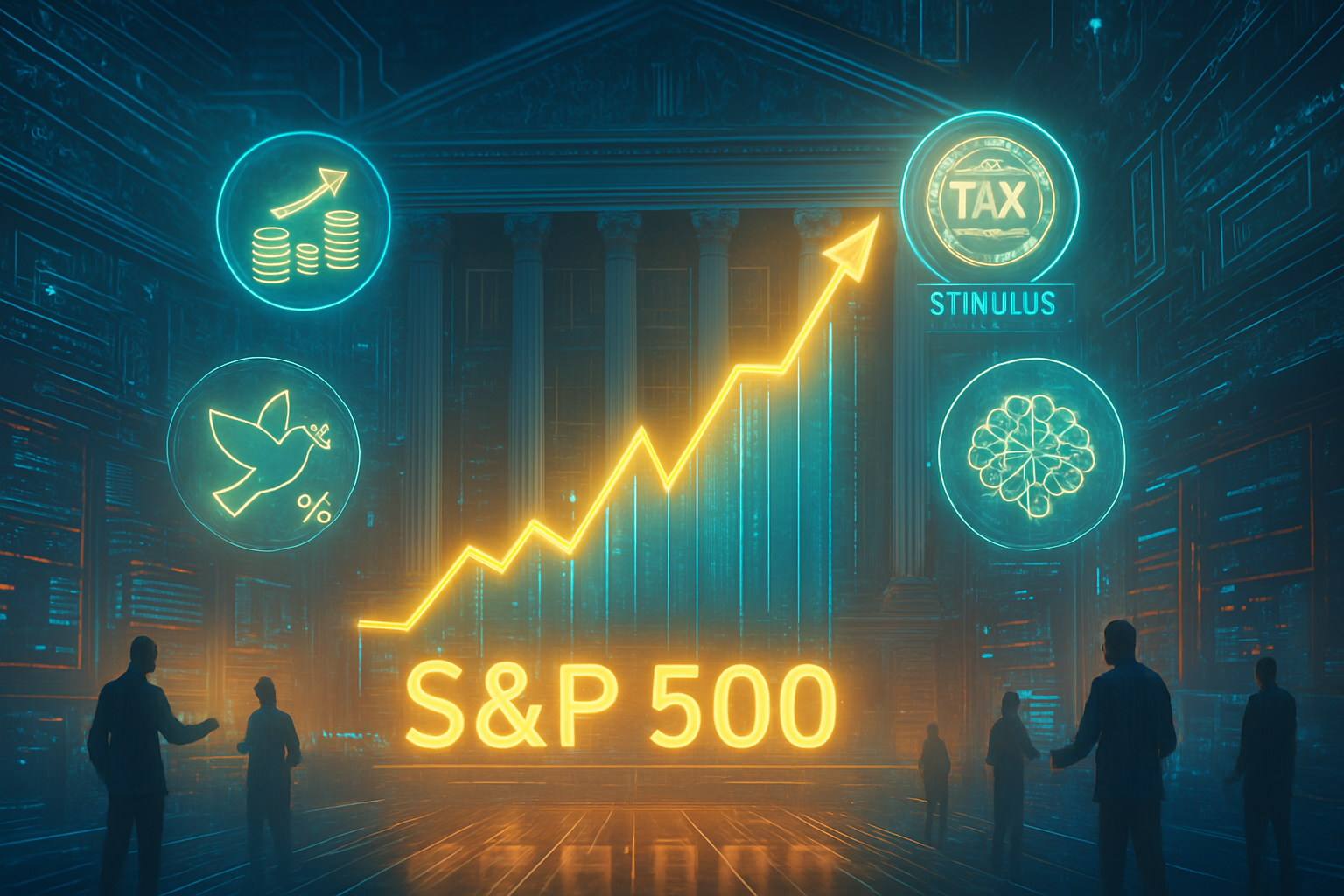
As the sun sets on 2025, investors are looking toward 2026 with a level of optimism not seen in years. With the S&P 500 closing out December near record highs, market strategists are coalescing around a "Quadruple Engine" theory that could propel the benchmark index toward the 8,000 level. This forecast is built on a foundation of four critical pillars: a surge in corporate earnings, a massive wave of tax stimulus, a pivot toward a dovish Federal Reserve, and the transition of Artificial Intelligence from a speculative buzzword into a tangible profit machine.
The immediate implications are clear: the "higher for longer" era of interest rates is firmly in the rearview mirror, and the focus has shifted to fiscal expansion and productivity gains. While 2025 was a year of stabilization and cooling inflation, 2026 is being framed as the year of the "Great Acceleration," where the structural shifts of the early 2020s finally begin to pay off in the form of double-digit margin expansion and robust consumer spending.
A Perfect Storm of Growth: The Four Pillars of 2026
The primary catalyst for the 2026 bull case is a projected 12% to 14% year-over-year increase in S&P 500 earnings per share (EPS). Analysts at major firms like Morgan Stanley (NYSE:MS) and Goldman Sachs (NYSE:GS) are targeting a collective EPS of over $315, driven by a rare combination of cost-cutting efficiencies and top-line growth. This profit surge is expected to be led by the tech sector, but broaden out to industrials and financials as the "productivity multiplier" of AI begins to affect non-tech sectors.
Simultaneously, the legislative landscape is shifting toward aggressive fiscal stimulus. The anticipated "One Big Beautiful Bill Act" (OBBA) is set to dominate the 2026 calendar, effectively making permanent the core provisions of the 2017 Tax Cuts and Jobs Act. Beyond simple extensions, the 2026 fiscal package is expected to introduce new deductions for car loan interest and a significant increase in the State and Local Tax (SALT) deduction cap to $40,000. This influx of disposable income is designed to bolster a consumer base that has been weary of inflation, providing a "tax cliff" insurance policy that markets have been craving.
On the monetary side, the Federal Reserve is entering a new chapter. With inflation stabilized near the 2% target, the Fed is expected to maintain a "dovish" stance throughout 2026, with the fed funds rate projected to settle between 3.0% and 3.25%. A critical milestone will occur in May 2026, when Jerome Powell’s term as Chair expires. Markets are already pricing in a "market-friendly" successor who will likely oversee a final series of rate cuts to reach a neutral equilibrium, further lowering the cost of capital for businesses and homebuilders.
Finally, the AI investment cycle is entering its "implementation phase." Hyperscale capital expenditure is projected to top $500 billion in 2026. Unlike the initial hardware land grab of 2023 and 2024, the 2026 cycle will focus on the monetization of software and the deployment of specialized chips. NVIDIA (NASDAQ:NVDA) is expected to dominate this era with its new Rubin architecture, while cloud giants shift their focus toward delivering proprietary AI agents that can perform complex, multi-step tasks for enterprise clients.
The Winners and Losers of the 2026 Acceleration
The clear beneficiaries of this environment are the "Hyperscalers" and the semiconductor elite. NVIDIA (NASDAQ:NVDA) remains the primary winner, with revenue visibility extending through 2026 as data centers transition to HBM4 memory and the Rubin platform. Microsoft (NASDAQ:MSFT) is also poised for a banner year, with a scheduled price increase for its AI-integrated 365 suites and the full-scale rollout of GPT-5 across its Azure ecosystem. Alphabet (NASDAQ:GOOGL) is expected to see a significant boost not just from search, but from the external sale of its Tensor Processing Units (TPUs) to other tech giants like Meta (NASDAQ:META), creating a secondary revenue stream that rivals its advertising business.
Financial institutions like JPMorgan Chase & Co. (NYSE:JPM) and Bank of America (NYSE:BAC) are also expected to thrive. A dovish Fed combined with a steeper yield curve typically improves net interest margins, while the 2026 push for "Financial Innovation"—including blockchain-based settlement systems—is expected to slash back-office costs. Furthermore, the industrial sector, represented by giants like Caterpillar (NYSE:CAT), will likely benefit from the continued onshoring of manufacturing and the massive energy infrastructure buildout required to power the nation's burgeoning data center fleet.
However, the 2026 rally will not lift all boats. Companies that failed to integrate AI or those burdened by high debt loads that were not refinanced during the 2025 window may find themselves marginalized. Traditional retail sectors that lack a sophisticated digital-first strategy could face "AI disruption," where automated personal shoppers steer consumers toward more efficient, direct-to-consumer competitors. Additionally, the energy sector may see volatility as the shift toward high-efficiency data center power sources clashes with traditional fossil fuel demand.
Broader Significance and Historical Precedents
The 2026 forecast draws striking parallels to the late 1990s, specifically the 1995-1998 period where productivity gains from the early internet began to show up in corporate bottom lines. However, unlike the "Dot-com" era, the 2026 surge is backed by massive cash flows and high-margin software businesses rather than speculative valuations. The "Four Pillars" represent a rare alignment of both fiscal (tax cuts) and monetary (lower rates) policy working in tandem with a technological revolution.
This event signifies a shift in the global economic order. The "Onshoring" trend, supported by 2026 industrial policies, suggests that the U.S. is moving away from the globalization model of the early 2000s toward a "Fortress America" economic strategy. This has profound implications for international trade and suggests that domestic-focused mid-cap stocks, represented by the Russell 2000, could see their strongest performance in over a decade as they benefit from local tax incentives and lower domestic borrowing costs.
What Comes Next: Navigating the 2026 Landscape
In the short term, investors should prepare for a "buy the rumor, sell the news" reaction around the May 2026 Fed leadership transition. While the market expects a dovish successor, any hawkish surprise or political friction during the confirmation process could spark temporary volatility. Strategically, the "pivot" for 2026 will be moving from pure-play hardware stocks to "AI-enabled" service providers—companies that use AI to generate new revenue rather than just those that build the chips.
Long-term, the sustainability of the 2026 rally will depend on the actual ROI of AI. If the projected $500 billion in capex does not translate into meaningful productivity gains by the end of the year, the market could face a "valuation reckoning" in 2027. However, the current trajectory suggests that the integration of GPT-5 and similar models will be deep enough to justify the spend, potentially creating a new "floor" for equity valuations.
Summary and Investor Outlook
The 2026 stock market is shaping up to be a historic period of growth, fueled by the quadruple engines of rising profits, tax stimulus, a dovish Fed, and relentless AI investment. With the S&P 500 eyeing the 8,000 mark, the narrative has shifted from "avoiding a recession" to "maximizing an expansion."
Key Takeaways for Investors:
- Watch the EPS: Double-digit earnings growth is the primary driver; any miss in the Q1 2026 earnings season could signal a shift in the bull case.
- The Fed Transition: The May 2026 leadership change at the Federal Reserve is the most significant macro event of the year.
- Tax Policy: Monitor the progress of the OBBA in Congress, as the car loan and SALT deductions are critical for consumer-facing stocks.
- AI Monetization: Shift focus from chipmakers to software companies that are successfully raising prices for AI-integrated services.
While the "Four Pillars of Hope" provide a strong foundation, the coming months will require a disciplined approach to sector selection as the market differentiates between the true innovators and those being left behind in the Great Acceleration.
This content is intended for informational purposes only and is not financial advice.