The 2.5% Pivot: How January’s PCE Cooling Reshaped the Federal Reserve’s Long Game
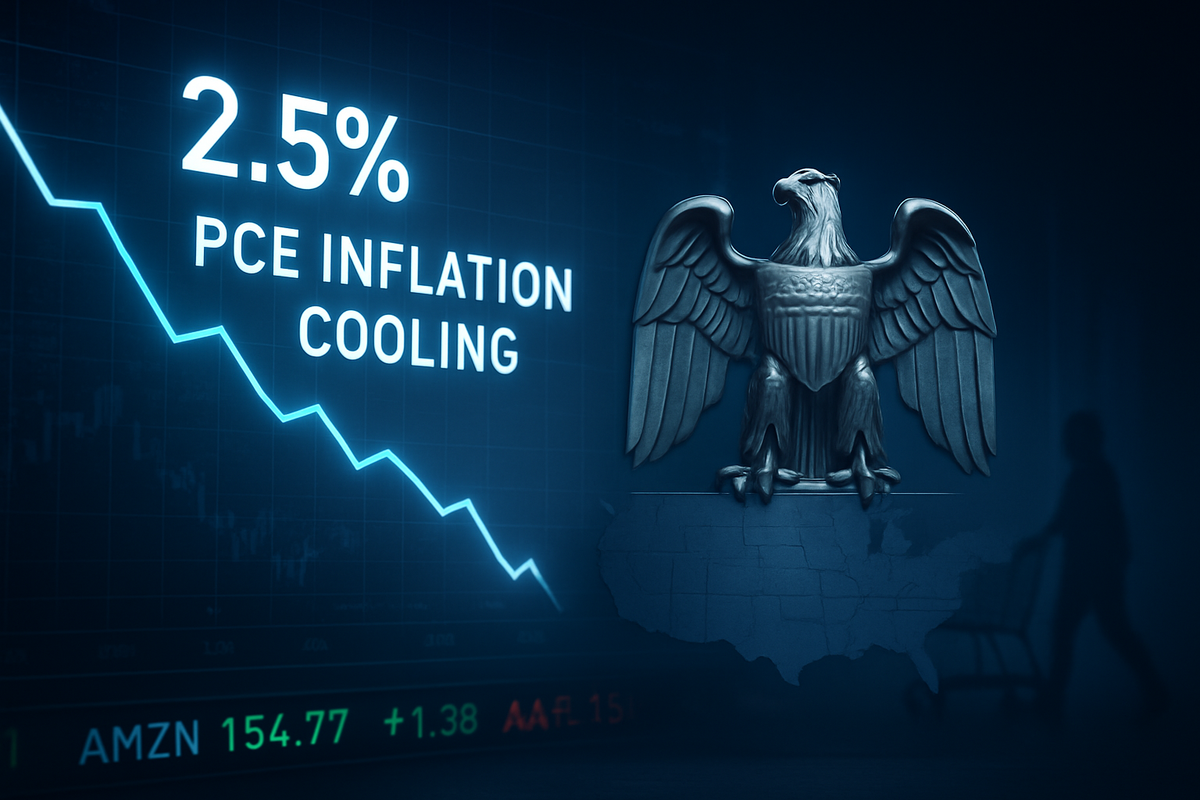
As the financial world reflects on the economic milestones of the past year, few data points stand out as vividly as the January PCE inflation report. Released in late February 2025, the report revealed a headline year-over-year cooling to 2.5%—marking the first significant deceleration in price pressures in four months. For a market that had grown weary of "sticky" inflation readings throughout the final quarter of 2024, the news provided a momentary boost to investor sentiment, fueling hope that the Federal Reserve’s restrictive policy was finally reaching its intended destination.
However, the relief was short-lived as the underlying details of the report began to surface. While the headline figure offered a psychological victory, the simultaneous contraction in consumer spending suggested that the cooling was less a "soft landing" and more of a "forced slowing" of the American consumer. Today, on January 20, 2026, as markets brace for the next cycle of inflation data, the legacy of that 2025 report remains a central pillar in the Federal Reserve's current "hold" strategy, defining the delicate balance between price stability and economic growth.
The Numbers Behind the Calm: A Timeline of the 2025 Cooling
The January 2025 Personal Consumption Expenditures (PCE) report, released by the U.S. Bureau of Economic Analysis (BEA), arrived at a critical juncture for the U.S. economy. Following a turbulent end to 2024, where inflation had plateaued between 2.6% and 2.7%, the drop to 2.5% represented a crucial break in the trend. This was the first downward tick in four months, a statistical shift that Jerome Powell and the Federal Open Market Committee (FOMC) had been searching for to justify their prolonged pause in interest rate hikes.
The road to this 2.5% print began in the autumn of 2024, when cooling progress seemingly stalled. Investors were increasingly concerned that the final mile to the Fed’s 2% target would be the hardest, characterized by stubborn services inflation and rising energy costs. When the January data hit the tapes, it initially triggered a relief rally. Treasury yields saw a slight decline, and the U.S. Dollar Index (DXY) stabilized as the "in-line" reading suggested that the inflation dragon, while not yet slain, was at least being contained.
However, the excitement was tempered by the release of personal spending figures. Consumer spending contracted by 0.2% in January 2025 (0.5% when adjusted for inflation), the sharpest drop in nearly a year. This indicated that the cooling inflation was not merely a result of improved supply chains, but also a direct consequence of high interest rates curbing the appetite of the American shopper. The reaction from stakeholders was a mix of relief and growing recessionary anxiety, setting the stage for a year where "bad news is good news" regarding inflation, but "bad news is bad news" regarding growth.
Winners, Losers, and the Tech Sector Tumble
The immediate market reaction to the 2.5% PCE cooling was a case study in sectoral divergence. While the headline was positive, the broader economic implications hit high-growth and consumer-facing companies the hardest. Amazon.com, Inc. (NASDAQ: AMZN) became the face of this volatility, with its stock price facing significant pressure as investors digested the 0.2% spending contraction. For a retail giant dependent on the discretionary spending of the American middle class, the "cooling" inflation looked more like a "cooling" business model.
Similarly, Apple Inc. (NASDAQ: AAPL) saw its initial gains erased, falling more than 2.6% on the day of the release. The tech sector, often sensitive to the "higher-for-longer" interest rate narrative, struggled as core services inflation remained stickier than the headline figure. While companies like Nvidia Corp. (NASDAQ: NVDA) continued to find support from the artificial intelligence boom, the broader tech indices were weighed down by the realization that the Federal Reserve would not be rushing to slash rates despite the 2.5% print.
In the banking sector, the results were equally nuanced. Regional banks, represented by the KBW Regional Banking Index, saw mixed performance. While larger regional players like PNC Financial Services Group, Inc. (NYSE: PNC) managed to hold ground due to strong credit trends, smaller entities like Regions Financial Corp. (NYSE: RF) faced sell-offs. The fear among investors was that a cooling economy would lead to higher loan defaults, even if the interest rate environment began to stabilize. Conversely, defensive assets and hard commodities emerged as the clear winners, with gold reaching record highs in early 2025 as a hedge against the geopolitical and trade uncertainties that loomed over the horizon.
Analyzing the Significance: A Shift in Fed Mandate
The significance of the January 2025 PCE report extended far beyond the ticker tape. It represented a fundamental shift in the Federal Reserve’s "dual mandate" focus. For years, the fight against inflation had been the primary, if not sole, driver of FOMC policy. The 2.5% figure, however, signaled that the inflation fight was entering its final stages, forcing Chair Jerome Powell to pivot his rhetoric toward the second half of the mandate: maximum employment and economic stability.
Historically, this moment drew comparisons to the mid-1990s "soft landing" attempts, where the Fed successfully navigated a cooling economy without triggering a deep recession. However, the 2025 context was complicated by the introduction of new trade policies and tariffs, which analysts warned could reignite inflation just as it reached the 2% doorstep. Powell’s testimony in February 2025 emphasized that the Fed was "well-positioned to wait," a phrase that has since become the hallmark of the 2025–2026 economic era.
This "wait-and-see" approach served as a regulatory buffer. It prevented the Fed from over-reacting to the 2.5% cooling with premature rate cuts, which could have triggered a second wave of inflation. Instead, it paved the way for a series of gradual, 25-basis-point cuts that did not begin until the fourth quarter of 2025. This cautious path has shaped the competitive landscape for public companies, favoring those with strong balance sheets and "moats" that could withstand a prolonged period of high, albeit stabilizing, borrowing costs.
Looking Ahead: The 2026 Outlook and Market Evolution
As we stand in January 2026, the market is currently navigating a "post-pivot" world. The Federal Reserve, having executed 75 basis points of cuts in late 2025, now holds the federal funds rate in the 3.50%–3.75% range. The question for the coming months is whether the cooling trend that started with that 2.5% print in early 2025 can be maintained in the face of new trade-related inflationary pressures.
Current projections for the January 2026 PCE data, expected in late February, suggest a slight uptick to the 2.7%–2.8% range. This potential "re-heating" of inflation presents a new challenge for the market. Public companies that adapted to the cooling environment of 2025 by tightening operations and focusing on efficiency—such as Walmart Inc. (NYSE: WMT)—may be better positioned to handle a secondary inflation wave than those that relied on a rapid return to near-zero interest rates.
Strategic pivots are already underway. Many firms are diversifying supply chains to mitigate the impact of tariffs, while the banking sector is bracing for a "prolonged hold" throughout most of 2026. The scenarios for the year ahead range from a continued, slow descent toward 2% to a "no-landing" situation where inflation remains trapped in the high 2s, forcing the Fed to keep rates restrictive through the expiration of Jerome Powell’s term in May 2026.
Summary and Investor Takeaways
The January 2025 PCE report was more than just a data point; it was the catalyst for the "Great Stabilization" of the past year. By delivering the first cooling in four months, it provided the Fed with the breathing room to transition from an aggressive tightening cycle to a data-dependent holding pattern. While it initially boosted markets, the underlying message of consumer fatigue served as a warning that the path to a healthy economy would be "lumpy" and protracted.
Moving forward, investors should remain vigilant regarding the upcoming January 2026 data. The key takeaway from the previous year is that headline inflation is only half the story; consumer spending and services stickiness will continue to dictate the Federal Reserve's next move. As the market enters this new phase of uncertainty, the ability of companies to maintain margins in a 3%+ interest rate environment will be the primary differentiator between the winners and losers of the 2026 fiscal year.
This content is intended for informational purposes only and is not financial advice.