The 10% Gambit: How the White House’s War on Credit Card Interest is Rattling Wall Street
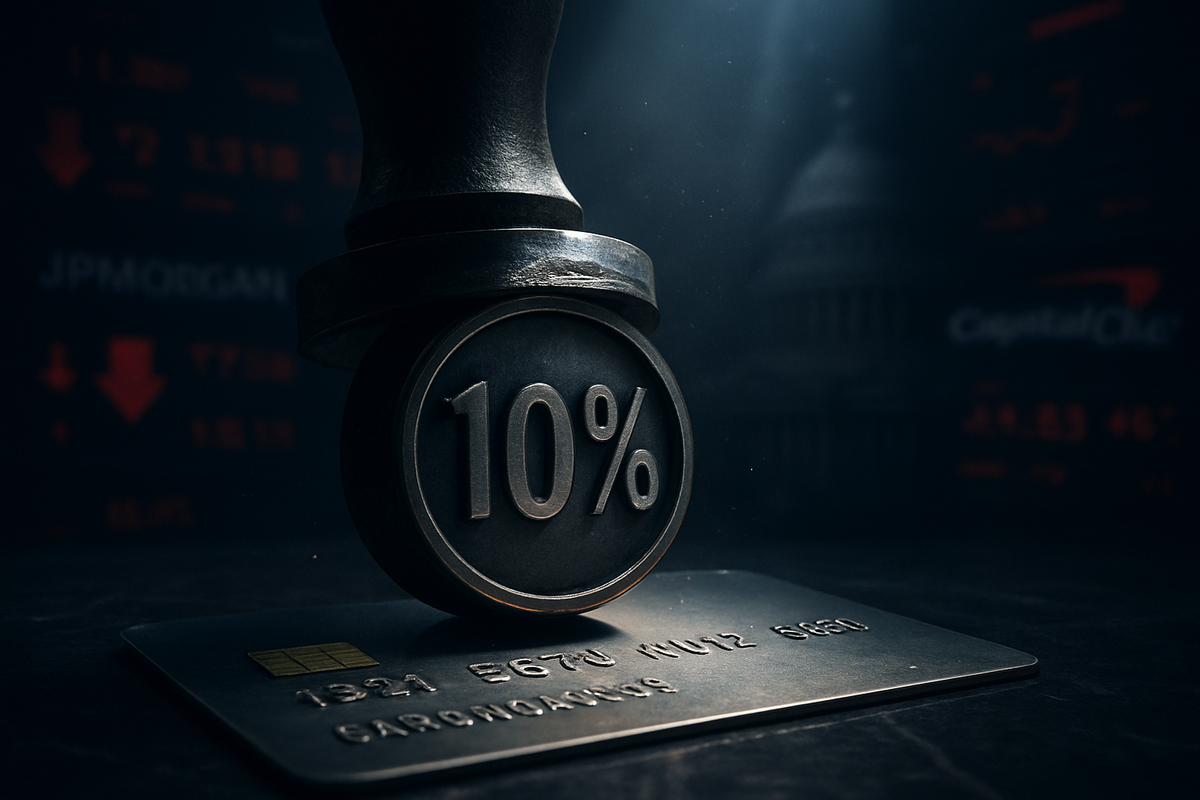
As of late January 2026, the financial sector is grappling with a resurgence of one of the most disruptive populist economic proposals in recent memory. President Donald Trump, entering the second year of his term, has intensified his push for a federal 10% cap on credit card interest rates—a move that has sent shockwaves through the boardrooms of the nation's largest lenders. What began as a campaign-trail firebrand promise in September 2024 has evolved into a persistent legislative and executive threat, forcing investors to re-evaluate the long-term profitability of the consumer credit business.
The immediate implications are visible on the trading floors of the New York Stock Exchange. Shares of major credit card issuers have been trading with a distinct "regulatory risk premium," as analysts struggle to model a world where risk-based pricing is effectively outlawed for millions of borrowers. While the White House frames the cap as a necessary relief for American families struggling with persistent inflation, the banking industry warns of a "credit cliff" that could see nearly 50 million Americans lose access to mainstream revolving credit entirely.
The current tension reached a boiling point on January 12, 2026, when President Trump used a high-profile speech at the World Economic Forum in Davos to reiterate his demand for a one-year, 10% interest rate ceiling. This announcement followed a turbulent 2025, during which a bipartisan coalition—led by the unlikely duo of Rep. Anna Paulina Luna and Rep. Alexandria Ocasio-Cortez—introduced the "10 Percent Credit Card Interest Rate Cap Act" (H.R. 1944). While the bill has been stalled in the House Financial Services Committee for months due to intense lobbying, the President’s renewed focus has revitalized the legislative effort and forced a defensive crouch from the American Bankers Association.
The timeline leading to this moment is marked by a series of political maneuvers and economic warnings. In late 2024, the initial proposal was largely dismissed by Wall Street as campaign rhetoric. However, following the 2024 election and the subsequent administrative transition, the tone shifted. By mid-2025, the Consumer Financial Protection Bureau (CFPB) began laying the groundwork for more aggressive oversight of "junk fees" and interest margins, aligning with the President's affordability agenda. This regulatory environment has created a climate where even the threat of a cap is enough to influence stock prices and lending standards across the country.
Initial market reactions to the Davos speech were swift. Major card-heavy banks saw immediate intraday drops, as the prospect of executive action—however legally questionable—loomed large. JPMorgan Chase (NYSE: JPM) and Capital One Financial Corp. (NYSE: COF) both experienced sharp volatility, reflecting investor fears that the administration might attempt to bypass a gridlocked Congress through emergency executive orders or Department of the Treasury directives.
The impact of a 10% interest rate cap is not distributed equally across the financial landscape. Capital One Financial Corp. (NYSE: COF) stands out as the most exposed institution in the current environment. Following its successful $35.3 billion acquisition of Discover Financial Services (NYSE: DFS) in May 2025, Capital One became the largest credit card issuer in the United States by outstanding balances. Because a significant portion of its portfolio serves subprime and near-prime borrowers—whose interest rates frequently exceed 30% to compensate for default risk—a 10% cap would fundamentally break its revenue model. On the day of the Davos announcement, Capital One shares plummeted 6.5%, as analysts at Goldman Sachs warned that a 10% cap would render 40% of its card portfolio unprofitable.
Conversely, JPMorgan Chase (NYSE: JPM) has shown more resilience, though it remains a vocal critic of the policy. CEO Jamie Dimon has labeled the proposal an "economic disaster," arguing that it would force the bank to significantly cut back on card availability. While JPMorgan's massive scale and diversified revenue streams—including investment banking and asset management—provide a cushion, its card business is a major growth engine. The bank added over 10 million new card accounts in 2025, many of which would become unsustainable under the proposed cap. For JPMorgan, the risk is less about survival and more about the erosion of a high-margin business segment that currently helps fund its multi-billion dollar technology and expansion budgets.
Other players like Synchrony Financial (NYSE: SYF) and Citigroup Inc. (NYSE: C) are also in the crosshairs. Synchrony, which handles private-label credit cards for retailers, is particularly vulnerable as its business model relies on high-interest revolving credit to offset the costs of retail partnership rewards. If the 10% cap were to manifest, these retailers could see a dramatic drop in consumer spending power, potentially leading to a broader retail slowdown.
The wider significance of this proposal goes beyond bank earnings; it threatens to reshape the very structure of American consumer finance. Historically, credit card interest rates have been exempt from federal usury caps since the 1978 Supreme Court ruling in Marquette National Bank of Minneapolis v. First of Omaha Service Corp. Reversing this precedent would be a seismic shift in U.S. financial policy. Industry experts warn of a "credit rationing" event, where banks simply stop lending to anyone without a near-perfect credit score. A January 2026 report from the New York Fed suggested that up to 47 million subprime borrowers could be "unbanked" overnight, losing the safety net of credit cards during financial emergencies.
This policy push fits into a broader global trend of populist economic intervention. From the UK’s energy price caps to rent controls in various European capitals, governments are increasingly willing to interfere with market pricing to appease voter concerns over the cost of living. In the U.S., this has manifested as a "War on Fees," where the 10% interest cap is the ultimate weapon. If enacted, the ripple effects would be profound: the disappearance of "cash back" and travel reward programs (which are funded by interest and interchange fees) and a surge in demand for unregulated "shadow banking" products and payday lenders.
The precedent for such a move is sparse. The 2009 CARD Act introduced significant protections for consumers, but it notably stopped short of capping interest rates, recognizing the risk to credit availability. By pushing for a hard cap, the current administration is venturing into uncharted economic territory that risks turning the "democratization of credit" on its head.
As we look toward the remainder of 2026, two primary paths emerge for the 10% cap proposal. The first is a protracted legislative battle. Even with the President's backing, the 10% cap faces a steep climb in the Senate, where more moderate members of both parties remain skeptical of its economic fallout. Strategic pivots are already underway; some lawmakers are proposing a "compromise" cap of 18% or 20%, which would still be a significant reduction from current averages but might prevent a total collapse of the subprime credit market.
The second, and more volatile, path is executive action. Should the White House attempt to implement the cap via the Treasury or the CFPB, the result would be an immediate and massive legal challenge from the banking industry. This would likely end up before the Supreme Court, creating a period of extreme market uncertainty that could last for years. In the short term, banks are expected to preemptively tighten credit standards and increase annual fees to offset the anticipated loss of interest income, a move that could ironically make credit more expensive for the very people the cap is intended to help.
Market opportunities may emerge for "Buy Now, Pay Later" (BNPL) firms and fintechs that operate outside traditional credit card frameworks. If traditional cards become unavailable, these alternative lenders may see a massive influx of users, though they too may eventually face similar regulatory scrutiny.
The battle over credit card interest rate caps has become the defining financial news story of early 2026. For investors, the takeaway is clear: the era of high-margin, risk-priced consumer credit is under its most serious political threat in decades. While the 10% cap remains a proposal rather than a law, its presence as a "Sword of Damocles" hanging over the sector has fundamentally changed the valuation of companies like Capital One Financial Corp. (NYSE: COF) and JPMorgan Chase (NYSE: JPM).
Moving forward, the market will be hypersensitive to any movement on H.R. 1944 and any executive rhetoric coming from the White House. Investors should watch for the quarterly earnings calls of major card issuers in April 2026, where management teams will likely provide more detailed "stress test" scenarios regarding a capped-interest environment. The ultimate irony of the 10% cap may be that in the government’s attempt to make credit cheaper, it inadvertently makes it extinct for the millions of Americans who need it most.
This content is intended for informational purposes only and is not financial advice