Tariff Wall vs. Corporate Fortress: Why U.S. Profit Margins Refuse to Crumble
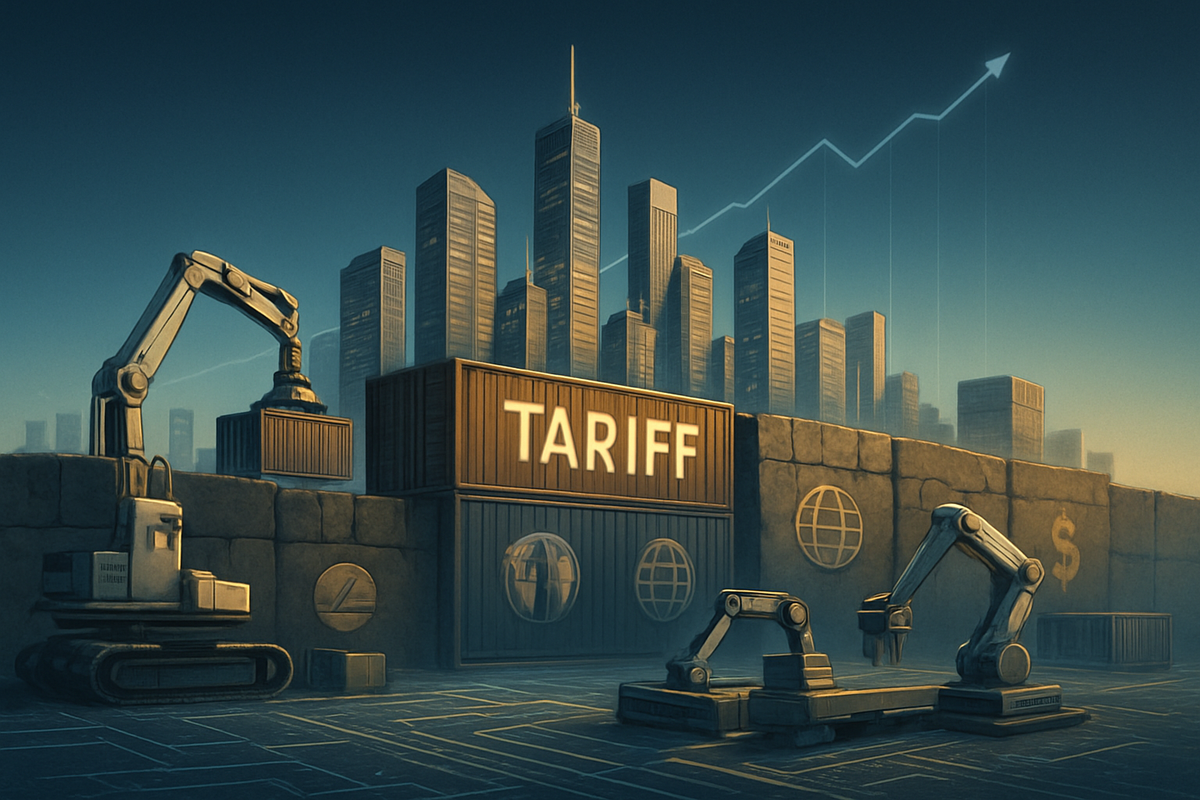
NEW YORK — As the first major earnings season of 2026 gets underway, a startling reality has emerged across trading floors: the widely predicted "margin collapse" from the 2025 trade escalations has failed to materialize. Despite an effective U.S. tariff rate that peaked at a staggering 17% in late 2025, S&P 500 profit margins have remained historically resilient, hovering at a blended 13.9%. This defiance of gravity suggests that large-cap American companies have successfully built a "corporate fortress" through a combination of aggressive supply chain relocation, AI-driven efficiency, and a massive fiscal safety net.
The immediate implication for the market is a "K-shaped" resilience that favors the giants. While small-to-mid-cap firms are reeling from an estimated $700 million per day in additional import costs, the heavyweights of the S&P 500 are reporting a blended earnings growth rate of 8.2% for Q4 2025. This divergence has stabilized the broader market, with the forward P/E ratio sitting at a confident 22.2, as investors bet that corporate adaptability will continue to outpace geopolitical friction.
The resilience witnessed in January 2026 is the result of a frantic and highly strategic 18-month pivot. Following a series of reciprocal trade measures in late 2024 and throughout 2025, the U.S. effective tariff rate climbed from a mere 2.3% to its current 17% baseline. This "tariff shock" was expected to gut corporate earnings, yet many companies used 2025 to "frontload" inventory—importing billions in goods before the highest rates took effect. By the time the full weight of the tariffs hit in Q4 2025, many large-cap balance sheets were already shielded by pre-positioned stock.
Crucially, the corporate sector was bolstered by the passage of the "One Big Beautiful Bill Act" (OBBBA) in July 2025. This landmark legislation provided the fiscal "off-ramp" that many analysts say prevented a full-scale recession. By making the 2017 tax cuts permanent and introducing retroactive capital expense credits, the OBBBA injected fresh liquidity into the system just as trade costs were rising. This legislative maneuver allowed companies to write off the costs of domestic manufacturing investments immediately, incentivizing a massive wave of "reshoring" that is only now beginning to show up in production data.
Market reactions have been cautiously optimistic. While the "beat magnitude" of earnings is slightly lower than the five-year average, the fact that 79% of companies have exceeded estimates in the face of a 17% trade tax is being hailed as a triumph of American management. The primary stakeholders—from institutional investors to supply chain logisticians—are now focused on whether this margin strength is a temporary byproduct of tax breaks or a permanent shift in operational efficiency.
The current environment has created a sharp divide between those with the scale to navigate the "Tariff Wall" and those without. Apple Inc. (NASDAQ: AAPL) has emerged as a primary example of legislative and operational agility. Despite facing a potential $1.1 billion hit in Q4 2025 due to hardware tariffs, the tech giant negotiated a broad-based exemption by pledging a $600 billion domestic investment. By pivoting iPhone production toward India and announcing an AI server manufacturing hub in Houston, Apple has effectively diversified its risk while leveraging the OBBBA's tax provisions.
In the retail sector, Walmart Inc. (NYSE: WMT) has widened its lead over competitors. With less than 35% exposure to high-tariff foreign products and a massive private-label ecosystem, Walmart has been able to maintain its "rollback" pricing strategy while smaller retailers saw their operating margins drop into negative territory. Similarly, General Motors Company (NYSE: GM) has successfully mitigated a projected $5 billion tariff hit by relocating production of its Equinox and Blazer models from Mexico back to U.S. plants in Michigan and Tennessee. GM is also capitalizing on the new 3.75% "MSRP offset" tax credit for U.S.-assembled vehicles, effectively neutralizing the cost of imported components.
Conversely, the "losers" in this new regime are primarily concentrated in the mid-market. Smaller apparel brands and hardware importers, lacking the capital to onshore or the leverage to negotiate exemptions, are facing a "margin squeeze" of over 500 basis points. For these firms, the 17% tariff is a direct hit to the bottom line that cannot be easily passed on to a price-sensitive consumer, leading to a wave of consolidation as larger firms like Nike, Inc. (NYSE: NKE) use their automation-driven logistics to capture market share.
The broader significance of this moment lies in the convergence of trade policy and the AI revolution. Many analysts believe that the 13.9% profit margins are not just a result of tax credits, but a reflection of a massive "productivity jump" powered by generative AI. Companies have spent the last two years integrating AI into supply chain forecasting and customer service, allowing them to trim overhead and absorb the 17% tariff costs without raising prices to levels that would kill demand. This suggests that the U.S. economy may be entering a period where technological gains can act as a permanent hedge against geopolitical volatility.
Historically, this era is being compared to the supply chain reorganizations of the 1970s, though at a much faster pace. The move toward "nearshoring" in Mexico and "friend-shoring" in Vietnam and India has fundamentally altered global trade routes. The ripple effect is already being felt by competitors in Europe and Asia, who are now forced to consider similar "reciprocal" measures or face a permanent disadvantage in the U.S. market. Policy-wise, the success of the OBBBA in shielding margins may lead to a permanent shift in how Washington uses fiscal policy to offset trade-related pain.
Looking into the remainder of 2026, the primary challenge will be the "cliff" that occurs once pre-tariff inventory is fully depleted. Most large-cap firms have enough stock to last through Q2 2026, but the real test of margin resilience will come in the second half of the year. If companies are forced to replenish stock at the full 17% rate without a significant drop in logistics costs, the current optimism could face a reality check.
Strategic pivots are already underway. NVIDIA Corporation (NASDAQ: NVDA) is leading the charge in "advanced packaging onshoring," moving critical chip certifications to Arizona to bypass the new 25% "Silicon Surcharge" implemented in early January 2026. If other tech firms follow suit, we could see a total decoupling of high-end hardware manufacturing from traditional offshore hubs. The long-term scenario is one of "Fortress America"—a more self-contained, high-margin economy, but one with higher baseline costs for the average consumer.
The key takeaway from the early 2026 earnings season is that the U.S. corporate sector is far more adaptable than the "doomsday" models of 2024 predicted. By leveraging the OBBBA's fiscal relief and doubling down on AI-driven efficiency, the S&P 500 has managed to turn a trade war into a catalyst for domestic investment and operational restructuring. The market is moving forward with a "wait and see" attitude, focusing less on the tariffs themselves and more on a company’s ability to onshore its supply chain.
For investors, the next few months will be critical. Watch for inventory turnover rates and any signs of "margin fatigue" in the mid-cap space. While the giants like Apple and Walmart appear safe within their fortresses, the broader health of the economy will depend on whether the "K-shaped" recovery can eventually pull the rest of the market upward. For now, the "Tariff Wall" has met its match in the resilient American balance sheet.
This content is intended for informational purposes only and is not financial advice.