Target Hospitality (TH) Secures Landmark $550M Contract for AI Data Center Workforce Hub
In a move that signals a tectonic shift in the workforce housing sector, Target Hospitality (NASDAQ: TH) announced yesterday, April 1, 2026, that it has secured a massive multi-year contract exceeding $550 million with a "top-five hyperscaler." The deal focuses on the construction and operation of a flagship workforce community in North Texas, designed to support the explosive growth of AI-driven data center infrastructure. The news sent shares of the company soaring over 24% in early trading today, as investors cheered the company’s successful diversification away from its historical reliance on the volatile energy and government sectors.
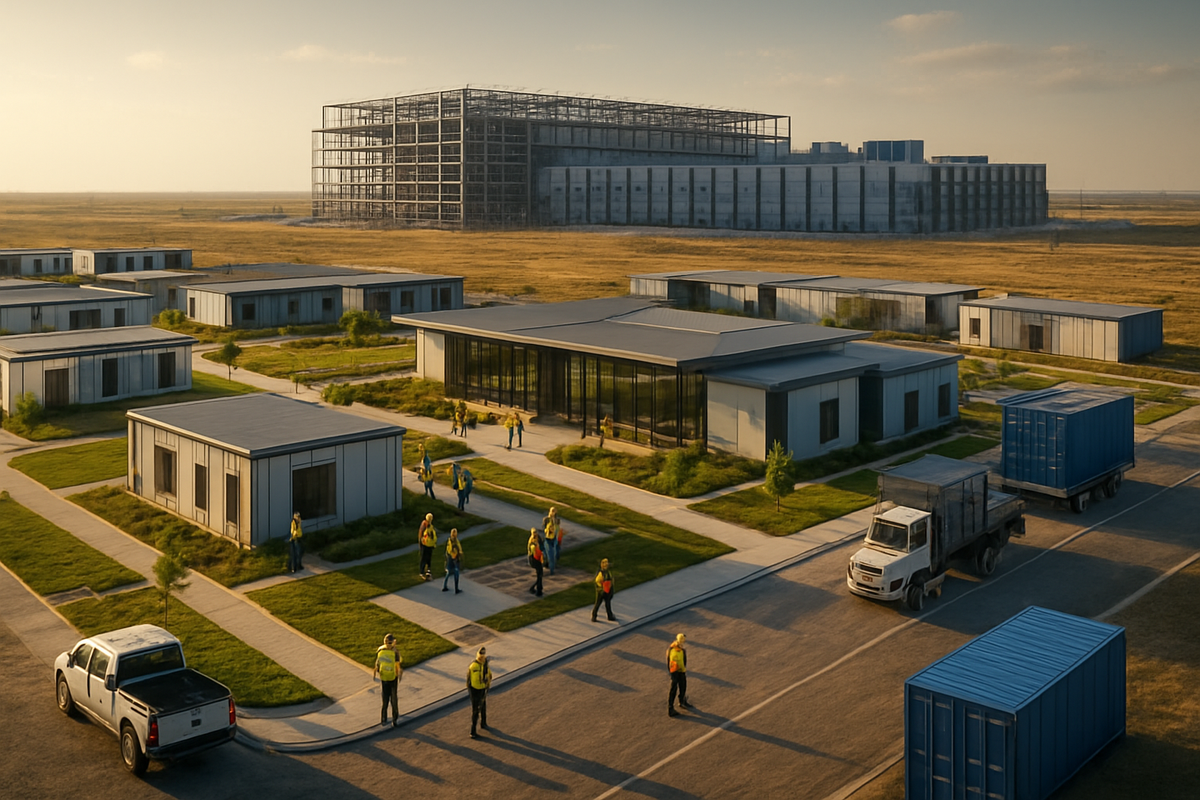
The contract, dubbed the "Data Center Hub Contract," represents the largest single award in Target Hospitality's history within the technology vertical. Under the agreement, Target will provide a full-turnkey hospitality solution for approximately 4,000 specialized workers involved in the massive buildout of a next-generation "AI Factory" campus. This "closed-loop" community will go beyond basic housing, offering high-end dining, fitness facilities, and specialized logistics—amenities now deemed essential by tech giants to attract and retain the highly skilled labor force required for modern megascale data centers.
A New Blueprint for the Digital Frontier
The $550 million agreement is structured as a five-year initial term with multiple extension options that could see the partnership last through 2035. According to company filings, the contract guarantees a minimum of $550 million in committed revenue, with the potential for an additional $20 million to $40 million annually based on occupancy and service utilization. Target Hospitality expects to invest between $115 million and $125 million in net capital to build out the site, leveraging its proprietary modular assets alongside new, purpose-built facilities specifically designed for the tech workforce.
The timeline for the project is aggressive, reflecting the urgent global demand for AI processing power. Construction on the workforce hub has already commenced in the North Texas "Digital Corridor," with the first phase of occupancy expected by the third quarter of 2026. This region, encompassing areas like Red Oak and Midlothian, has become a global epicenter for data center development, with tech titans like Google (NASDAQ: GOOGL) and Microsoft (NASDAQ: MSFT) having already committed over $40 billion to infrastructure in the state through 2027.
Industry analysts point to this moment as a validation of Target Hospitality’s "Hyper/Scale" brand, which was launched in late 2024 to target the technology sector. The company's ability to provide a comprehensive, hospitality-driven environment was reportedly a key factor in winning the bid against more traditional modular providers. By integrating housing with 24/7 catering, security, and "recovery-optimized" amenities, Target is solving a critical pain point for hyperscalers who are struggling with labor shortages in semi-rural areas where local housing cannot meet the sudden demand of 5,000-person construction crews.
Market Winners and Losers in the Workforce Shift
The immediate winner of this announcement is undoubtedly Target Hospitality, which has struggled for years with the "lumpy" nature of its government contracts and the cyclicality of the Permian Basin oil fields. By securing a high-credit customer like a top-five hyperscaler, the company has effectively "de-risked" its revenue profile for the next decade. Following the announcement, Target raised its 2026 revenue guidance to a range of $360 million to $370 million, prompting several Wall Street analysts to raise their price targets toward the $11.00 mark.
However, the ripple effects extend to competitors like Civeo Corp (NYSE: CVEO) and WillScot (NASDAQ: WSC). While Civeo is also pivoting toward infrastructure housing, Target’s massive "first-mover" advantage in the North Texas data center cluster may leave competitors scrambling for smaller, tertiary contracts. WillScot, the industry leader in modular space by sheer volume, remains a beneficiary of the general buildout, as it provides the critical storage and office units for the same sites. Yet, the high-margin "hospitality-as-a-service" component is where Target is currently outmaneuvering its peers.
On the losing side of this deal are the local midscale and extended-stay hotel chains in the North Texas area. Brands owned by Choice Hotels International (NYSE: CHH), such as WoodSpring Suites and MainStay Suites, have historically relied on long-term contractor stays during construction booms. The emergence of self-contained, 4,000-person workforce hubs directly cannibalizes this demand. Analysts suggest that local hotel occupancy in rural Texas "data center boomtowns" could see a significant drop as these dedicated hubs provide a more integrated and cost-effective solution for large-scale developers than traditional lodging.
The Broader AI Infrastructure Phenomenon
This event highlights a fundamental shift in the scale of industrial labor. Historically, a large data center might have required 500 to 750 workers. Today, the "AI Factories" being built by the likes of Amazon (NASDAQ: AMZN) and Meta Platforms (NASDAQ: META) require thousands of specialized electricians, fiber technicians, and HVAC engineers. The sheer density of labor needed for these builds has outstripped the capacity of any single municipality to house them, making modular workforce communities a critical pillar of the global AI supply chain.
Target’s success also points to the "Amenity War" within the skilled trades. To secure the 5,000+ workers needed for a single campus, developers are no longer offering just a bed and a meal; they are offering "lifestyle hubs" that reduce worker burnout and absenteeism. This move toward luxury-adjacent workforce housing mirrors historical precedents seen during the massive rail and mining booms of the late 19th century, but with a modern, high-tech twist that prioritizes connectivity and wellness.
Furthermore, this pivot represents a significant "recession-resistant" hedge for the modular housing industry. While consumer spending or energy prices may fluctuate, the capital expenditure budgets for AI and cloud computing from the "Magnificent Seven" remain robust. By hitching its wagon to the hyperscale buildout, Target Hospitality is positioning itself as a vital service provider to the infrastructure that will power the next era of global computing.
What Lies Ahead for Target and the Tech Vertical
In the short term, the primary challenge for Target Hospitality will be execution. Managing a $125 million capital investment and a rapid construction schedule in a tight labor market carries inherent risks. However, if the North Texas hub meets its Q3 2026 occupancy goals, it will serve as a powerful proof-of-concept for similar hubs across the United States and potentially international markets. The company’s strategic pivot may necessitate a restructuring of its sales and operations teams to focus more on "tech-sector hospitality" rather than its legacy "man-camp" origins.
Longer-term, the market will be watching to see if other hyperscalers follow suit. With Microsoft and Oracle (NYSE: ORCL) reportedly scouting sites for even larger "Stargate" class data centers in the Midwest and South, the total addressable market for dedicated workforce communities is expanding rapidly. Target's ability to replicate this $550 million model in other states like Ohio, Indiana, and Arizona—where data center clusters are also forming—will determine whether the company can sustain its recent stock price momentum and transition into a specialized "Infrastructure REIT" style valuation.
Final Assessment: A Significant Market Evolution
The $550 million contract between Target Hospitality and a top-five hyperscaler is more than just a large order; it is a signal that the AI boom has matured to a point where physical logistics and labor management are now the primary bottlenecks. For Target Hospitality, this is a transformative moment that fundamentally changes the company's investment thesis from a volatile energy play to a stable, tech-infrastructure support provider.
As the market moves forward, investors should closely monitor the company's quarterly execution reports through 2026 to ensure construction timelines are being met. The key indicator of success will be whether Target can maintain its high-margin service levels while scaling to 4,000 residents. For the broader market, this deal confirms that the "bricks and mortar" of the AI revolution—the housing and feeding of the people who build the cloud—is a massive, and until now, undervalued investment opportunity.
This content is intended for informational purposes only and is not financial advice