Stagflation Shadows Loom as US GDP Revised Downward Amidst Persistent Inflation Shock

The narrative of a "soft landing" for the United States economy faced its most rigorous challenge yet on April 10, 2026, as a convergence of disappointing growth data and a revitalized inflation threat rocked the financial markets. The Bureau of Economic Analysis (BEA) finalized its revision of the fourth quarter 2025 Gross Domestic Product (GDP) growth to a mere 0.5%, down from the previous 0.7% estimate. This stalling growth has collided head-on with a March Consumer Price Index (CPI) report that showed headline inflation surging to 3.3% year-over-year, leaving the Federal Reserve in a precarious "strategic paralysis."
This "twin-engine failure" of the economy—stalling growth paired with accelerating prices—has shifted the market conversation from a smooth descent to the dreaded specter of "Stagflation Lite." For investors, the data represents a sharp departure from the optimism of early 2025, as the residual effects of a late-2025 government shutdown and a sudden geopolitical energy shock in the Middle East begin to choke the post-pandemic expansion.
The final revision of the Q4 2025 GDP to 0.5% marks a significant deceleration from the 1.4% "advance" estimate initially reported. This downward trend was primarily fueled by a sharp 6.5% contraction in structures investment and a notable reduction in private inventory investment. While consumer spending remained a lone bright spot, it too was revised downward to 1.9%, indicating that the American consumer is finally feeling the weight of prolonged high interest rates. A critical factor in this slump was the 43-day federal government shutdown during October and November of 2025, which analysts estimate stripped approximately 1.0 percentage point from the quarterly growth figure.
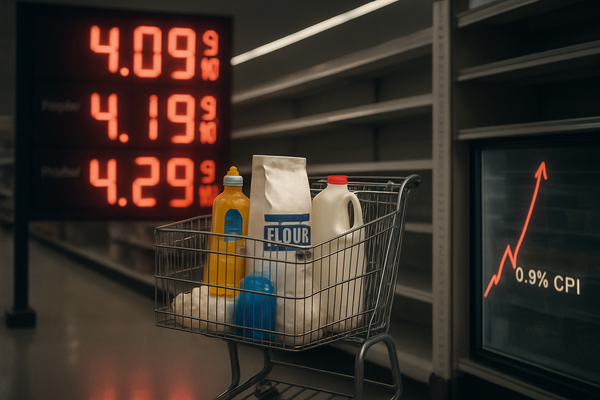
Simultaneously, the March 2026 CPI report released today has sent shockwaves through the bond market. Headline inflation jumped to 3.3% year-over-year, largely driven by a 10.9% monthly spike in energy prices following the "Iran War Shock" and the subsequent disruption of the Strait of Hormuz. Core CPI, which excludes volatile food and energy, remained more resilient at 2.6%, but the headline figure has already unanchored market expectations. The Federal Reserve, led by Chair Jerome Powell, maintained the federal funds rate at 3.5% to 3.75% during the March FOMC meeting, but the new data suggests that the window for any planned rate cuts in 2026 may be slamming shut.
The current economic climate has created a stark divide between sectors, with energy giants emerging as the primary beneficiaries of the inflationary spike. Companies like Exxon Mobil Corp. (NYSE: XOM) and Chevron Corp. (NYSE: CVX) have seen their stock prices surge as oil prices crested above $110 per barrel, providing a natural hedge for portfolios against rising costs. Similarly, the automotive sector has seen a renewed focus on fuel efficiency, benefiting Toyota Motor Corp (NYSE: TM) and Tesla, Inc. (NASDAQ: TSLA), as consumers seek an "exit ramp" from volatile gasoline prices that spiked 21.2% in March alone.
Conversely, the housing and retail sectors are bearing the brunt of the downturn. Lennar Corp. (NYSE: LEN) and Masco Corp. (NYSE: MAS) have faced a "double-whammy" of mortgage rates remaining stubbornly above 6.5% and skyrocketing construction costs. In the retail space, Walmart Inc. (NYSE: WMT) and other goods-heavy retailers are struggling with a "K-shaped" consumer pullback, where low-income shoppers are significantly reducing discretionary spending as real earnings fell 0.6% this month. Even the high-flying tech sector has seen turbulence; while Microsoft Corp. (NASDAQ: MSFT) remains a favorite due to its asset-light SaaS model, NVIDIA Corporation (NASDAQ: NVDA) has seen its valuation multiples compressed as the massive electricity demands of AI data centers face surging utility costs.
The significance of these data points lies in the potential death of the "Soft Landing" theory. For much of 2025, the Federal Reserve hoped to bring inflation down to its 2% target without triggering a recession. However, the Q4 2025 GDP revision suggests the "growth cushion" is far thinner than previously believed. This situation is reminiscent of the stagflationary periods of the 1970s, albeit on a smaller scale, where supply-side shocks—in this case, energy and the 2025 government shutdown—rendered traditional monetary policy less effective.
Financial institutions like JPMorgan Chase & Co. (NYSE: JPM) are now recalibrating their forecasts, with some analysts raising the probability of a formal recession within the next 12 months to nearly 50%. The policy implications are severe: the Fed cannot easily cut rates to stimulate the 0.5% growth without risking a further blowout in headline inflation. This "policy trap" means that any relief for the housing or manufacturing sectors may be months, if not years, away.
Looking ahead, the next several months will be defined by the Federal Reserve's ability to navigate this "strategic paralysis." The May FOMC meeting will be the most anticipated in years, as investors watch for any signs of a "hawkish hold"—a stance where the Fed maintains high rates despite low growth to combat energy-driven inflation. If the geopolitical situation in the Middle East stabilizes and the Strait of Hormuz reopens, a rapid cooling of energy prices could allow the Fed to pivot back to supporting growth.
However, a long-term strategic shift may be required for many public companies. We are likely to see an acceleration in "asset-light" business models and a defensive rotation into sectors with high pricing power, such as premium travel, exemplified by Delta Air Lines, Inc. (NYSE: DAL), which has so far managed to pass costs onto high-end consumers. Short-term volatility is expected to remain high as the market digests whether the 0.5% growth rate was a temporary blip caused by the shutdown or the start of a protracted secular decline.
The Q4 2025 GDP revision to 0.5% and the hot March CPI report have combined to create a "perfect storm" for the U.S. economy. The primary takeaway is that the "soft landing" is no longer a guaranteed outcome, and the risk of a "no landing" or "hard landing" has increased dramatically. The Federal Reserve's mandate to maintain price stability is now in direct conflict with the need to prevent a growth collapse, leaving little room for error.
Investors should move forward with a focus on quality and resilience. Moving into the middle of 2026, the key metrics to watch will be Core CPI stability and the Q1 2026 GDP "advance" estimate. If growth slips into negative territory while headline inflation remains above 3%, the "stagflation" label will become unavoidable. For now, the market remains in a defensive crouch, waiting for the Fed's next move in this high-stakes economic chess match.
This content is intended for informational purposes only and is not financial advice