Salesforce Insiders Signal Defiant Optimism with Massive Share Purchases Amidst 'SaaSpocalypse'
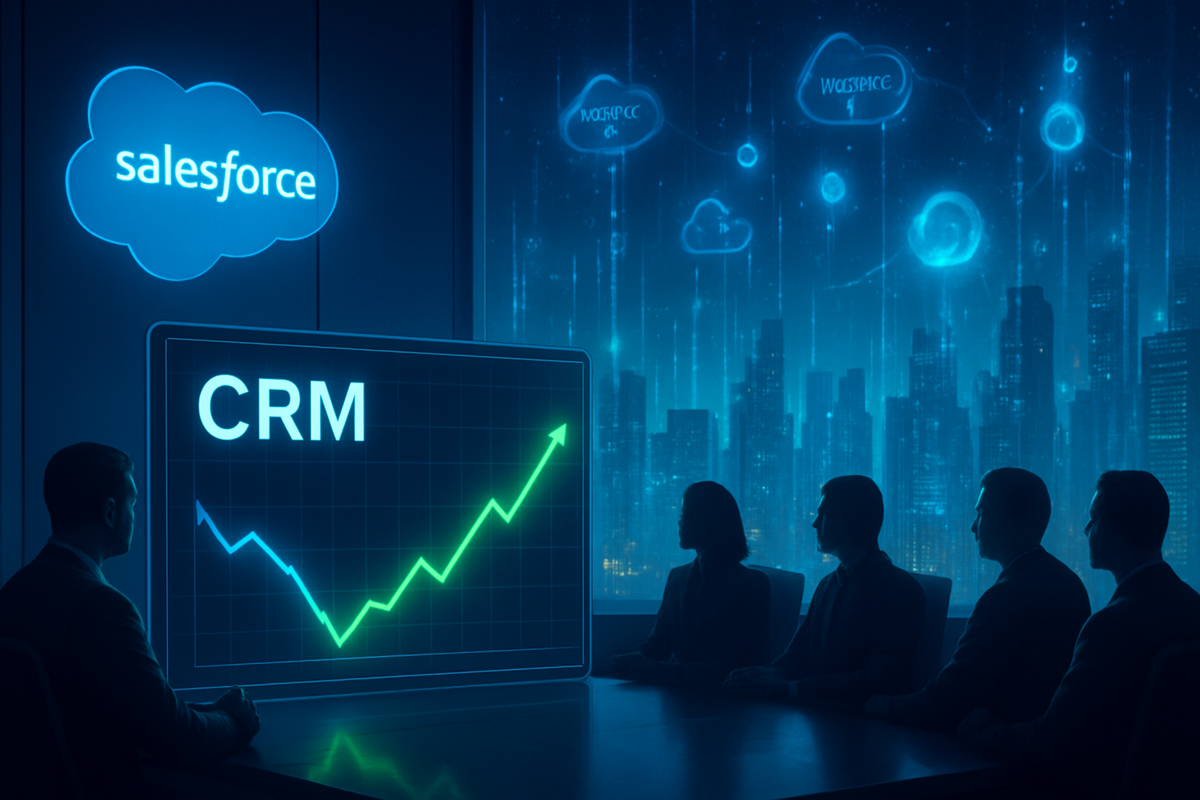
SAN FRANCISCO — In a bold display of corporate conviction, top executives and board members at Salesforce (NYSE:CRM) have launched a massive "buy the dip" campaign as of March 31, 2026, attempting to floor a stock price that has been in freefall for the better part of the first quarter. Following a punishing 30% pullback that saw shares plummet to their lowest levels in years, the company’s leadership has moved from defense to offense, utilizing both personal capital and a record-breaking $25 billion accelerated share repurchase program to signal that the market has fundamentally undervalued the enterprise software giant’s transition into the "Agentic AI" era.
The aggressive insider activity comes at a pivotal moment for the cloud pioneer. While the broader market remains gripped by "AI fatigue" and fears that autonomous agents might render traditional Software-as-a-Service (SaaS) models obsolete, the purchases by directors Kirk David Blair and Laura Alber, coupled with Marc Benioff’s strategic debt-funded buyback, suggest a decoupling between internal sentiment and external panic. Investors are now forced to weigh the skepticism of Wall Street analysts against the direct financial commitments of the people steering the ship, a tension that has historically preceded major market turning points.
The March Lows and the Board’s Counter-Strike
The timeline of the current crisis began in late February 2026, when Salesforce reported its Q4 fiscal 2026 earnings. Despite beating analysts' expectations on earnings per share ($3.81 versus the $3.05 estimate), the company’s forward-looking guidance for fiscal 2027 sent shockwaves through the market. Management projected a conservative revenue growth of just 10–11%, a figure that failed to satisfy a market hungry for the triple-digit "AI alpha" promised during the 2024–2025 hype cycle. By mid-March, CRM shares had cratered from their late-2025 highs to a range of $183 to $195, a level not seen since the early days of the post-pandemic recovery.
In response to this "SaaSpocalypse," as some commentators have dubbed the sector-wide downturn, Salesforce insiders stepped in with significant open-market purchases. On March 18, 2026, Director Kirk David Blair acquired 2,570 shares at an average price of $194.62. This was followed immediately on March 19 by Director Laura Alber, who purchased 2,571 shares at $194.58. While these individual buys totaled roughly $1 million, their symbolic value far outweighed the dollar amount. This was reinforced by CEO Marc Benioff’s decision to launch the largest share repurchase in the company's history—a $25 billion program funded by a massive issuance of senior notes maturing as far out as 2066.
The initial market reaction was one of cautious stabilization. After months of unrelenting selling pressure, the stock found a firm floor near the $185 mark as the volume of the buyback began to provide much-needed liquidity. "We are aggressively repurchasing shares because we are so confident in the future of Salesforce," Benioff told analysts in a special briefing. "The market sees a sunset for SaaS; we see the sunrise of the Agentic Enterprise." This high-stakes gamble aims to bridge the gap between the current slowing of core cloud services and the expected monetization of the new "Agentforce" AI platform.
Winners and Losers in the AI Agent Arms Race
The primary winner in this current reshuffling has undoubtedly been Microsoft (NASDAQ:MSFT). By March 2026, Microsoft’s Copilot integration had successfully penetrated over 60% of Fortune 500 companies, creating a "walled garden" that makes it increasingly difficult for specialized CRM tools to compete on pure workflow efficiency. Microsoft’s ability to unify CRM data with the ubiquitous Office 365 suite has allowed it to capture significant market share from Salesforce’s traditional Marketing and Commerce Cloud segments, which have shown uncharacteristic weakness this quarter.
On the other end of the spectrum, Oracle (NYSE:ORCL) has emerged as a dangerous "value" challenger. Leveraging its high-growth Cloud Infrastructure (OCI), Oracle has been undercutting Salesforce on price while offering its own AI Agent Platform that allows enterprises to query complex databases using natural language. For large-scale enterprise deployments, Oracle's "backend-first" approach to AI agents is attracting cost-conscious CTOs who are wary of Salesforce's premium pricing model. Salesforce (NYSE:CRM) itself remains in a state of transition; while its Agentforce platform reached a respectable $800 million in Annual Recurring Revenue (ARR) this month, it has yet to prove it can fully offset the slowing growth of its legacy subscription business.
Smaller, legacy SaaS players without a clear "Agentic" strategy are the clear losers in this environment. Companies that relied on simple "seat-based" pricing models are finding their valuations slashed as autonomous agents begin to do the work of dozens of human employees, potentially reducing the total "seat count" required by major corporations. Salesforce's aggressive buyback and insider buying are designed to prevent the company from being grouped into this "legacy" category by the market.
A Structural Shift in the Software Industry
The current events at Salesforce are a microcosm of a broader industry trend: the death of the "Human-in-the-loop" SaaS model. The pivot toward autonomous agents—software that doesn't just suggest actions but executes them—is the most significant architectural shift in software since the transition from on-premise to the cloud in the early 2000s. Historically, Salesforce has been the aggressor in these shifts, but the rise of Microsoft (NASDAQ:MSFT) as a dominant AI power has put the pioneer on its heels, forcing a defensive use of its balance sheet that mirrors the tactics of mature, "old-tech" companies like IBM (NYSE:IBM).
Regulatory implications are also beginning to surface. The use of a $25 billion debt issuance to fund buybacks during a stock pullback has drawn scrutiny from some policy circles, who argue that the capital could be better spent on R&D or domestic infrastructure. However, in the context of 2026’s high-stakes AI race, Salesforce management views this as a necessary move to protect its equity value and prevent a hostile takeover or activist intervention during a period of perceived vulnerability. The precedent for such a move can be seen in the late 2010s when companies like Apple (NASDAQ:AAPL) used low-interest debt to shrink their share count, though Salesforce is doing so under much more volatile market conditions.
What Lies Ahead for Salesforce and the Market
In the short term, the success of the "insider signal" will depend on whether the $185–$195 support level holds through the end of the second quarter. If the "Agentforce" platform can accelerate toward the $1 billion ARR milestone by June, the narrative of a "dead SaaS" company will likely fade, replaced by the story of a successful AI pivot. However, if macroeconomic conditions continue to soften and the "AI fatigue" persists, the massive debt burden taken on for the buyback could become a significant drag on Salesforce’s future flexibility.
The long-term outlook hinges on the battle for the "Operating System of the Agentic Enterprise." Salesforce is betting that its deep "Customer 360" data advantage will eventually trump Microsoft's workflow advantage. Strategic pivots toward more consumption-based pricing models—rather than seat-based subscriptions—are expected to be announced at the upcoming Dreamforce 2026 conference. Investors should prepare for a period of heightened volatility as the company moves through this transformation, with the potential for either a massive "snap-back" rally or a long, painful period of consolidation.
Wrapping Up the Market Sentiment
The insider buying at Salesforce (NYSE:CRM) as of March 31, 2026, serves as a quintessential "litmus test" for the entire software sector. The decision by board members to personally invest, alongside a historic $25 billion corporate buyback, represents a definitive rejection of the market's bearish "SaaSpocalypse" narrative. While the threat from Microsoft (NASDAQ:MSFT) and Oracle (NYSE:ORCL) is real and growing, Salesforce is effectively betting the house that its evolution into an agent-centric platform will replicate its previous success in the cloud.
For investors, the key takeaways are clear: the leadership at Salesforce believes the bottom is in. However, the reliance on debt to defend the stock price adds a layer of risk that was absent in previous decades. Moving forward, the market will be watching the adoption rates of Agentforce with a microscope. The coming months will determine if this was a brilliant "buy the dip" opportunity or a costly attempt to catch a falling knife in a rapidly changing technological landscape.
This content is intended for informational purposes only and is not financial advice.