S&P 500 Breaches 7,000 Milestone: AI Megacaps Propel Market to Historic Heights
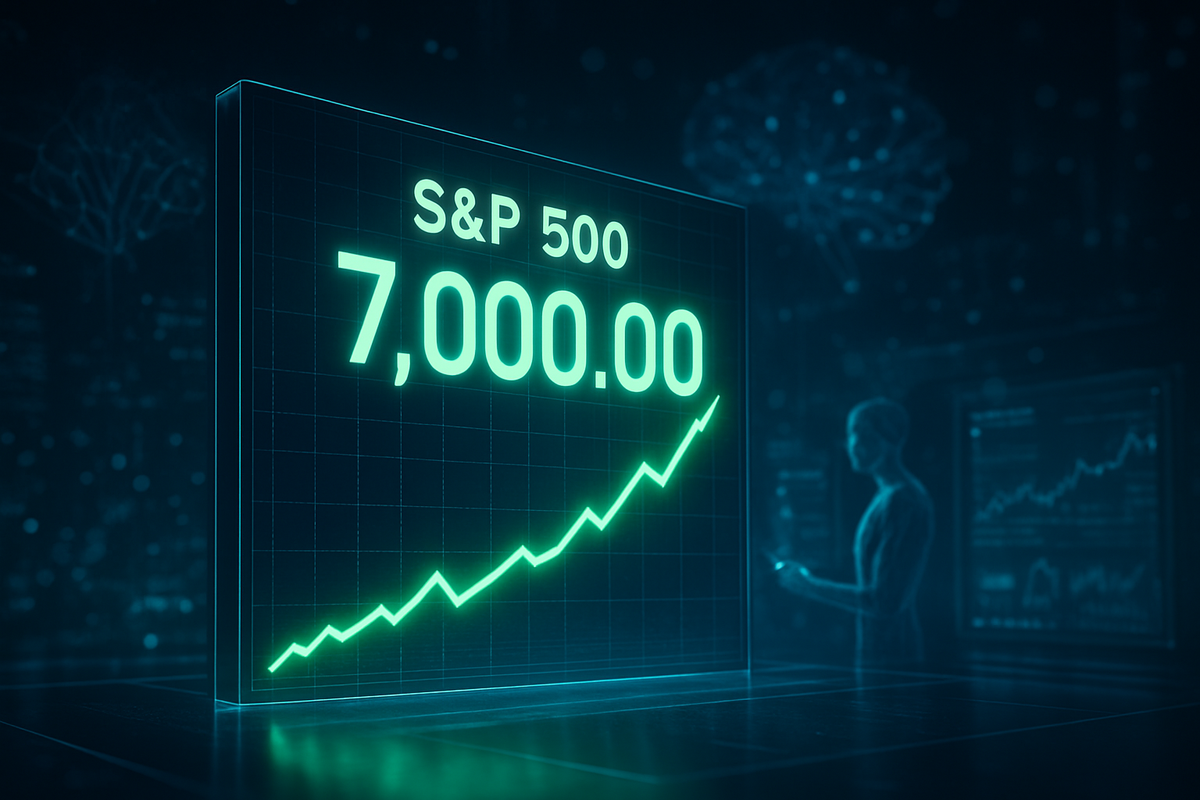
The financial world witnessed a watershed moment on January 28, 2026, as the S&P 500 index breached the 7,000-point threshold for the first time in history. This milestone, coming just fourteen months after the index crossed the 6,000 mark in November 2024, underscores the relentless momentum of a bull market increasingly defined by the industrialization of artificial intelligence and a resilient, albeit complex, macroeconomic backdrop. While the index has since retreated slightly to settle near 6,941 as of February 12, 2026, the breach of "7K" represents a psychological and technical triumph for an equity market that many critics had labeled overextended a year ago.
The ascent to 7,000 was not a broad-based lift but rather a concentrated surge led by the "Magnificent Seven" and a select group of semiconductor giants. This historic peak was achieved during an intraday high of 7,002.28, a move catalyzed by a "perfect storm" of cooling inflation data and blockbuster fourth-quarter earnings from the tech sector. For investors, the milestone serves as a definitive signal that the "AI Revolution" has transitioned from speculative hype into a tangible driver of corporate profitability, though the resulting market concentration has raised fresh questions about systemic risk and valuation sustainability.
The Road to 7,000: A January to Remember
The breach on January 28 was the culmination of a high-stakes week on Wall Street, often referred to by traders as "Big Tech Week." The momentum shifted into high gear following a stellar earnings report from Microsoft Corp. (NASDAQ: MSFT), which revealed a staggering $281 billion backlog related to its AI services. This was followed by Meta Platforms Inc. (NASDAQ: META) announcing a 2026 capital expenditure plan exceeding $115 billion, signaling to the market that the appetite for AI infrastructure remains insatiable. These reports acted as the final propellant needed to push the index past the "Gamma Wall" of options resistance sitting at the 7,000 level.
The timeline leading to this moment has been remarkably compressed. After taking nearly three years to move from 4,000 to 5,000, the S&P 500 sprinted from 5,000 to 6,000 in a record-breaking nine months ending in late 2024. The journey from 6,000 to 7,000 took approximately 14 months, a pace that, while slower than the previous 1,000-point jump, still far exceeds historical averages. Key stakeholders, including institutional asset managers and retail "dip-buyers," have remained steadfast in their belief that the Federal Reserve’s pivot toward a steady easing cycle—having cut rates three times in late 2025—provided the necessary liquidity to support these record valuations.
However, the achievement of 7,000 was not without its volatility. On the day of the breach, the market saw intense profit-taking and technical selling as the index touched its intraday high. Market analysts noted that while the headline number was achieved, the S&P 500 struggled to maintain a daily close above the handle, illustrating the fierce tug-of-war between optimistic bulls and cautious bears wary of the Shiller CAPE ratio, which recently surpassed 40—a level only seen once before, during the height of the 1999 dot-com bubble.
A Tale of Two Markets: Winners and Laggards
The march to 7,000 has further deepened the "bifurcation" of the U.S. stock market. The primary victors are undoubtedly the titans of technology. NVIDIA Corp. (NASDAQ: NVDA) remains the standard-bearer, having reached a historic $5 trillion market capitalization in late 2025. In the current earnings season, NVIDIA’s dominance in the AI chip market continued to provide the fundamental gravity that kept the index afloat. Similarly, Apple Inc. (NASDAQ: AAPL) and Microsoft, both now members of the exclusive $4 trillion club, have utilized their massive cash reserves to buy back shares and integrate generative AI across their vast software ecosystems, further solidifying their weight in the index.
Conversely, the 7,000 milestone masks significant pain in other sectors. Rate-sensitive industries like Real Estate and certain segments of Healthcare have notably lagged. Equinix Inc. (NASDAQ: EQIX) and other commercial real estate firms have struggled against a "maturity wall" of debt due for refinancing in 2026 at rates significantly higher than those of the previous decade. In the healthcare space, UnitedHealth Group Inc. (NYSE: UNH) and Pfizer Inc. (NYSE: PFE) have faced headwinds from rising medical costs and a post-pandemic growth vacuum, respectively. This divergence has led some analysts to describe the S&P 500 not as a reflection of the "real economy," but as a highly specialized vehicle for capturing tech-driven growth.
Even within the tech sector, a "SaaSpocalypse" correction has occurred. Software firms that failed to demonstrate immediate AI monetization have seen their valuations slashed as investors rotate capital into "hardware-first" players like ASML Holding N.V. (NASDAQ: ASML). This selective enthusiasm suggests that the 7,000 level is supported by a narrower foundation than many investors realize, leaving the index vulnerable should the "Magnificent Seven" experience a synchronized downturn.
Historical Precedents and the Regulatory Shadow
The current market environment draws inevitable comparisons to the late 1990s, yet many economists argue the fundamentals are different this time. Unlike the dot-com era, the companies driving the S&P 500 today are generating massive free cash flows and record profits. However, the wider significance of S&P 7,000 lies in how it reflects a global shift in industrial policy. The race for AI supremacy has become a matter of national security, leading to unprecedented government subsidies and private investment that have effectively decoupled the stock market from traditional economic cycles.
This rapid growth has not escaped the notice of regulators. As the S&P 500 hit its milestone, the Federal Trade Commission (FTC) in the U.S. and the European Commission have intensified their scrutiny. Amazon.com Inc. (NASDAQ: AMZN) is currently navigating a significant antitrust suit regarding its "Nessie" pricing algorithm, while the EU’s AI Act has begun full enforcement in early 2026, targeting the data-scraping practices that fuel modern AI models. These regulatory hurdles represent a potential "ceiling" for the megacap tech firms, as any significant litigation or structural break-up orders could derail the momentum that took the index to 7,000.
Furthermore, the "higher-for-longer" interest rate narrative has not entirely disappeared. While the Fed eased in 2025, persistent inflation in the services sector (currently around 2.7%) has kept the 10-year Treasury yield high enough to pressure defensive sectors like Utilities. Only "growth-hybrid" utilities like NextEra Energy Inc. (NYSE: NEE), which provides the massive power requirements for AI data centers, have managed to keep pace with the broader rally, highlighting how the AI trend is reshaping even the most traditional corners of the market.
What Lies Ahead: The Path to 8,000?
As we look toward the remainder of 2026, the question for investors is whether the 7,000 level will become a new floor or a temporary ceiling. Short-term, the market is likely to remain in a consolidation phase as it digests the gains of the past 14 months. Strategic pivots are already underway; companies are moving from building AI infrastructure to focusing on "Edge AI" and software monetization. This transition is risky, as it requires consumers and enterprises to continue increasing their digital spending despite a backdrop of high consumer debt.
Market analysts at firms like Goldman Sachs and Oppenheimer have issued wide-ranging year-end price targets for the S&P 500, ranging from a conservative 7,100 to an aggressive 8,100. The emergence of new opportunities in autonomous robotics and quantum computing could provide the next leg of growth. However, the challenges are equally daunting: geopolitical trade tariffs and the potential for "AI fatigue"—where investors demand immediate returns on the massive capital expenditures of 2024 and 2025—could trigger a sharp correction.
One potential scenario for 2026 is a "catch-up" trade, where the 493 stocks outside the megacap leaders begin to participate in the rally. If the Federal Reserve continues to lower rates and a "soft landing" for the economy is fully realized, small-cap stocks and lagging sectors could provide the fuel needed to move the index toward the next thousand-point milestone. Conversely, a failure to monetize AI at scale could lead to a valuation reset reminiscent of the early 2000s.
The Verdict on a Milestone Era
The S&P 500 breaching 7,000 is more than just a numerical achievement; it is a testament to the transformative power of technological innovation and the resilience of the American corporate engine. The event summarizes a period where the traditional rules of valuation were rewritten by the sheer scale of the AI revolution. Moving forward, the market’s health will likely depend on its ability to broaden the rally beyond a handful of tech giants and successfully navigate the growing web of global regulations.
For investors, the key takeaways are clear: concentration remains the greatest risk, and earnings quality is the only defense against valuation bubbles. As the market moves deeper into 2026, the focus will shift from "who is building AI" to "who is making money from AI." The lasting impact of the 7,000 breach will be measured by how well the index can support these valuations when the initial wave of infrastructure spending inevitably cools.
In the coming months, market participants should watch for shifts in Federal Reserve rhetoric, the outcome of major antitrust trials, and the next phase of the labor market's evolution. While the 7,000 milestone is a reason for celebration, the journey to 8,000 will undoubtedly require a more diverse set of economic engines than the ones that brought us here today.
This content is intended for informational purposes only and is not financial advice.