Gold Surges Past $4,600 as Investigation Into Fed Chair Jerome Powell Ignites Independence Crisis
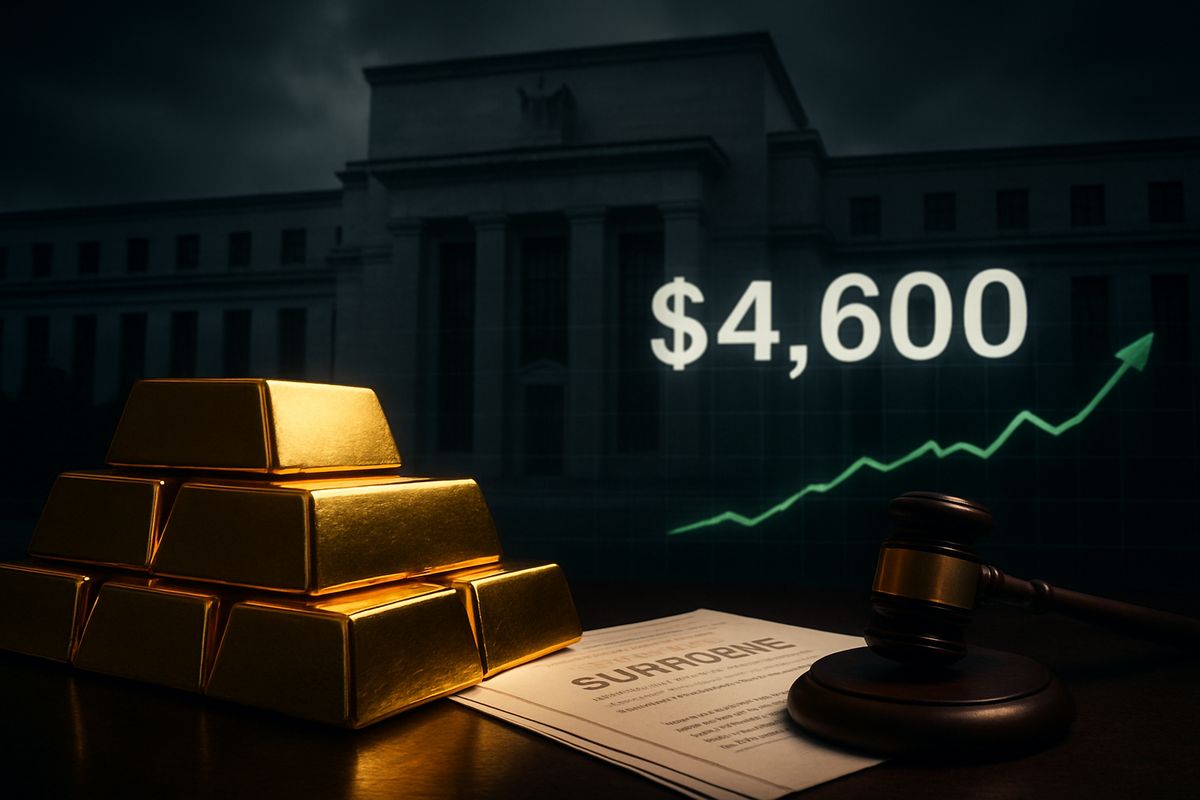
In a historic upheaval of global financial markets, the price of gold has shattered the $4,600 per ounce threshold, fueled by a constitutional standoff that threatens the very foundation of the United States Federal Reserve. The surge comes in the wake of a Department of Justice investigation into Fed Chair Jerome Powell, a move that market analysts and international observers are calling a thinly veiled attempt by the administration to seize control of monetary policy. As the "ultimate safe haven" asset reaches unprecedented heights, the global financial community is bracing for a period of extreme volatility and institutional uncertainty.
The immediate implications of this crisis are profound. Investors are fleeing dollar-denominated assets in a "flight to quality" not seen since the 2008 financial crisis, while the yields on U.S. Treasuries are spiking as the market prices in a "politicization premium." With the independence of the world's most powerful central bank under direct assault, the surge in gold reflects a broader loss of confidence in the predictability of U.S. economic governance, sparking a massive reallocation of capital into precious metals and hard assets.
A Targeted Investigation and an Institutional Standoff
The current crisis reached a boiling point in early January 2026, when the Department of Justice officially issued grand jury subpoenas to the Federal Reserve Board of Governors. The investigation ostensibly focuses on Chair Jerome Powell’s testimony and oversight regarding the multi-billion dollar renovation of the Fed’s Eccles Building headquarters. However, the timing of the probe has been met with extreme skepticism. For months, the administration has publicly castigated Powell, labeling his cautious stance on interest rate cuts as "monetary malpractice" and a deliberate attempt to stifle economic growth ahead of a critical election year.
The timeline of this escalation traces back to late 2025, when Treasury Secretary Scott Bessent floated the concept of a "Shadow Fed Chair"—an early nominee intended to signal the administration's future policy direction and effectively undermine Powell’s authority. When Powell refused to step down before his term ends on May 15, 2026, the administration pivoted toward legislative and legal pressure. The Federal Reserve Transparency Act of 2025, which sought to allow political audits of rate-setting deliberations, provided the legislative framework for this pressure, but the criminal investigation represents a dramatic and unprecedented escalation of executive power against the central bank.
The reaction from the international community was swift and unprecedented. In a rare joint statement of solidarity, Christine Lagarde of the European Central Bank and Andrew Bailey of the Bank of England warned that undermining the Fed’s autonomy is a "clear and present danger" to the global financial order. They characterized the investigation as a "pretext" to force a policy pivot, a sentiment echoed by market participants who see the move as a direct challenge to the Fed's dual mandate. This international "central bank alliance" has done little to calm the markets, instead highlighting the severity of the rift between the U.S. executive branch and its monetary authorities.
Winners and Losers in a High-Stakes Gold Super-Cycle
The primary beneficiaries of this institutional chaos are gold producers and precious metal investment vehicles. Newmont Corp (NYSE: NEM), the world’s largest gold miner, has seen its shares skyrocket as it benefits from the double tailwind of record-high spot prices and its massive reserve base. Similarly, Barrick Gold (NYSE: GOLD) has reported a significant boost in its margins, with its Tier One assets becoming increasingly valuable as investors look for companies with the highest leverage to the price of bullion. These companies are now trading at valuations that reflect their status as the new "defensive" cornerstones of a 2026 portfolio.
Exchange-traded funds have also become the primary pipes for the flood of capital leaving the equity and bond markets. The SPDR Gold Shares (NYSE Arca: GLD) and the iShares Gold Trust (NYSE Arca: IAU) have recorded record inflows over the past two weeks, as both institutional and retail investors scramble for exposure to gold without the logistical challenges of physical storage. These funds are now operating at volumes typically reserved for the most liquid tech stocks, serving as the frontline for a global shift away from the U.S. dollar as the primary store of value.
Conversely, the large commercial banks face a more complex and potentially perilous environment. JPMorgan Chase & Co. (NYSE: JPM), while often a beneficiary of market volatility, is navigating a minefield of counterparty risk and fluctuating Treasury yields. The spike in gold prices often coincides with a "de-anchoring" of inflation expectations, which can erode the value of long-term loan books. Furthermore, as the primary dealers of U.S. debt, banks like JPM are caught between an administration demanding lower rates and a market that is demanding a higher risk premium for holding "politicized" debt, potentially squeezing net interest margins and increasing systemic risk.
The Erosion of Independence and Historical Precedents
This event marks a significant departure from the post-Volcker era of central bank independence. Since the 1970s, the Federal Reserve has operated on the principle that monetary policy must be insulated from short-term political pressures to ensure long-term price stability. The current administration's attempt to use the DOJ as a tool for "monetary enforcement" shatters this consensus, drawing comparisons to the 1951 Treasury-Fed Accord, though in reverse. While that historical agreement established the Fed’s independence, the current trajectory suggests a return to a "subordinated" central bank model often seen in emerging markets.
The ripple effects of this crisis extend far beyond the gold market. The "weaponization" of legal and administrative processes against a sitting Fed Chair sets a dangerous precedent for other regulatory bodies. If the Fed's independence can be compromised through a "pretextual" criminal investigation, then no independent agency—from the SEC to the FDIC—is safe from executive interference. This has led to a "trust deficit" in U.S. institutions, prompting a rotation into decentralized assets and hard commodities that are beyond the reach of any single administration’s policy pivots.
Furthermore, the solidarity shown by the ECB and the Bank of England suggests a widening gap between the U.S. and its traditional allies in the management of the global economy. For decades, the Fed has acted as the "world's central bank," providing liquidity and stability through the dollar. If the dollar’s role as the global reserve currency is undermined by perceptions of political interference, the resulting fragmentation of the global financial system could lead to a permanent shift toward a multi-polar monetary world, with gold acting as the "neutral" anchor for this new reality.
Looking Ahead: The May 15 Deadline and Potential Pivots
The immediate focus for the market is May 15, 2026, the official end of Jerome Powell’s term as Chair. However, the crisis may not end there. Powell has hinted that he may stay on the Board of Governors until his governor term expires in 2028, potentially creating a "rival center of influence" within the Federal Open Market Committee (FOMC). This could lead to a fractured Fed, where the new Chair, potentially a political appointee like Kevin Hassett, faces internal opposition from established members who view his appointment as illegitimate or politically motivated.
Strategic pivots are already underway across the financial sector. Corporations are beginning to hedge their cash reserves with gold and other hard assets, moving away from the "cash is king" mantra of previous decades. If the administration succeeds in forcing a 100+ basis point rate cut against the Fed's better judgment, we may see a "crack-up boom" scenario—a period of rapid, inflation-fueled growth followed by a severe currency crisis. Investors must prepare for a scenario where "real" returns are the only metric that matters, as nominal gains are eaten away by the devaluation of the dollar.
Conclusion: A New Era for Global Markets
The surge of gold past $4,600 is more than a price movement; it is a siren song for the end of an era of institutional stability. The investigation into Jerome Powell has become the catalyst for a fundamental re-evaluation of the American financial system. Whether the investigation is a legitimate pursuit of justice or a calculated political maneuver, the damage to the Federal Reserve’s reputation for independence is already done. The markets have clearly signaled that they view this as a pretext for administrative control, and the resulting capital flight into gold is a vote of "no confidence" in the current trajectory of U.S. monetary policy.
As we move toward the mid-point of 2026, the significance of this event will be measured not just in the price of bullion, but in the lasting impact on the dollar’s credibility. Investors should keep a close watch on the FOMC's upcoming meetings and any further legal developments involving the DOJ. The "gold super-cycle" appears to have plenty of room to run as long as the constitutional tug-of-war continues. In this new landscape, the independence of the central bank is no longer a given—it is a battleground, and the winners will be those who recognize that the old rules of the game have been permanently rewritten.
This content is intended for informational purposes only and is not financial advice.