Global Gas Markets in Turmoil: Ras Laffan Attacks Ignite International Prices as US Markets Face Local Glut
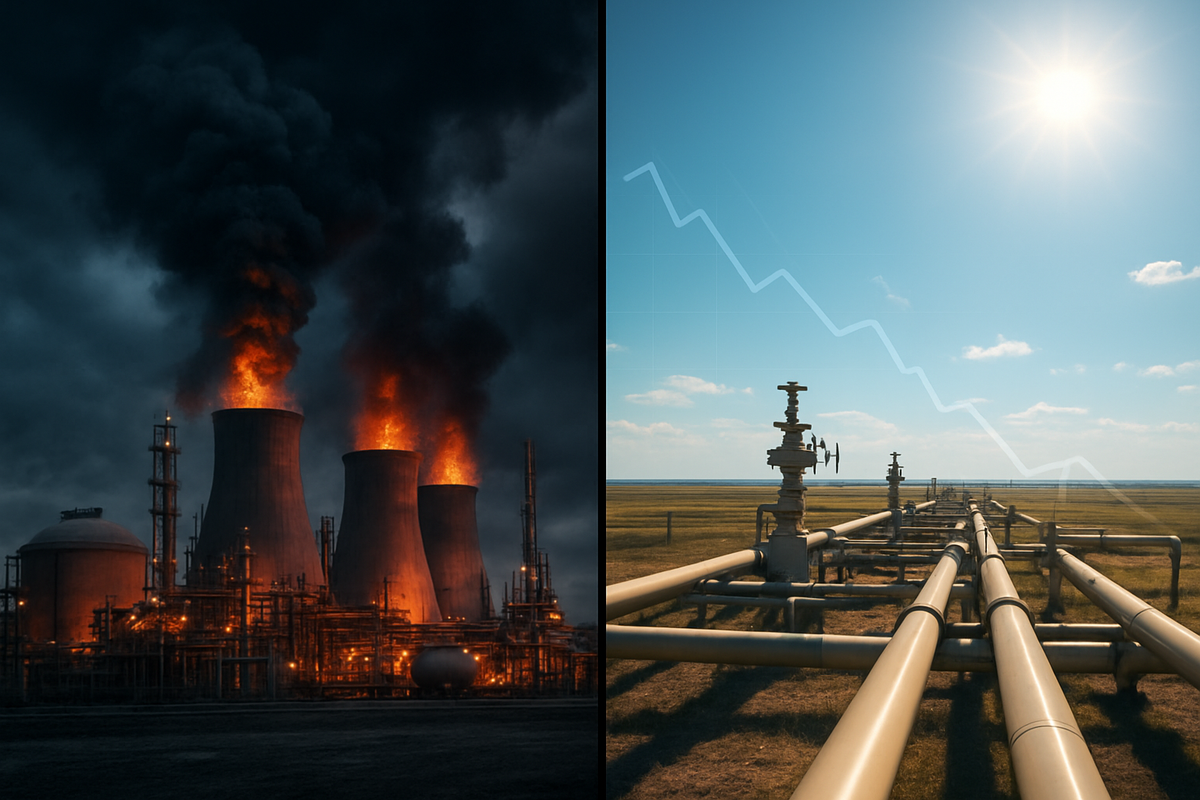
The global natural gas market has entered a period of unprecedented divergence as of late March 2026. While international benchmarks have skyrocketed following devastating attacks on Qatar’s primary export infrastructure, the United States domestic market is grappling with a historic "methane meltdown." A record 52.3% collapse in U.S. natural gas prices earlier this quarter has created a stark contrast to the energy crisis unfolding across Europe and Asia, highlighting a growing "regional decoupling" in global energy security.
The immediate implications are profound: European and Asian buyers are scrambling for limited supplies as the world’s largest LNG export hub faces a multi-year recovery. Meanwhile, the Energy Information Administration (EIA) has revised its 2026 forecast for Henry Hub spot prices to an average of $3.80 per million British thermal units (MMBtu), reflecting a domestic surplus that remains trapped behind limited export capacity despite the desperate need for gas overseas.
The Strike at the Heart of Global Energy
In mid-March 2026, the global energy landscape was permanently altered by a series of sophisticated drone and missile strikes targeting the Ras Laffan Industrial City in Qatar. As the world’s most critical node for liquefied natural gas (LNG), Ras Laffan accounts for the vast majority of Qatar’s export capacity. QatarEnergy officials confirmed that the strikes caused catastrophic damage to LNG Trains 4 and 6, effectively knocking out 12.8 million tonnes per annum (MTPA) of production. This represents roughly 20% of the entire world’s spare LNG capacity, creating a supply hole that cannot be easily filled.
The timeline of the event suggests a calculated escalation of regional tensions that caught market participants off guard. Following the initial strikes, CEO Saad Sherida Al-Kaabi announced that the specialized "cold boxes"—the massive heat exchangers required to liquefy natural gas—suffered structural damage that could take three to five years to repair. This long-term outage has triggered a panic in the Dutch TTF and Asian JKM benchmarks, which surged by as much as 70% in the days following the announcement as utility companies began outbidding one another for any available spot cargoes.
The market reaction was instantaneous and violent. While global prices surged, the U.S. domestic market barely flinched, hindered by "pipe-bound" logistics. The U.S. reached a record production level of 120 billion cubic feet per day (Bcf/d) just as the attacks occurred, but because export terminals were already operating at 100% capacity, the surplus gas had nowhere to go but into storage, further depressing domestic prices.
Winners and Losers in a Bifurcated Market
The primary beneficiary of this global chaos has been Cheniere Energy (NYSE:LNG). As the largest U.S. LNG producer, Cheniere’s stock has surged to all-time highs as investors bet on the company’s increased commercial leverage and the potential for higher margins on its uncontracted volumes. While the majority of its output is tied to long-term contracts, the sheer desperation of European and Asian buyers has placed Cheniere in a dominant position for future expansion and short-term optimization of its shipping fleet.
Conversely, some of the world's largest integrated energy firms are facing significant headwinds. ExxonMobil (NYSE:XOM) is among the most heavily impacted, holding a 34% stake in the damaged Train 4 and a 30% stake in Train 6 at Ras Laffan. The multi-year production halt is expected to shave billions from the company’s projected earnings over the next several years. Similarly, Shell (NYSE:SHEL) reported that its Pearl GTL (Gas-to-Liquids) plant, a crown jewel in its global portfolio, suffered collateral damage during the attacks. Analysts estimate the short-term financial hit to Shell at approximately $500 million, with long-term recovery costs still being calculated.
The U.S. independent producers like EQT Corporation (NYSE:EQT) are also in a difficult position. Despite the high global demand, the 52.3% drop in domestic prices has eroded their margins. While these companies would love to sell their gas at the €100/MWh prices seen in Europe, they are physically unable to move more gas to the coast than existing pipelines and terminals allow, leaving them at the mercy of a saturated domestic market.
A New Era of Market Decoupling
The current crisis underscores a significant shift in energy market dynamics: the "decoupling" of the U.S. Henry Hub from global benchmarks. Historically, high global prices would eventually pull U.S. prices upward as exports increased. However, the current bottleneck in liquefaction capacity means that the U.S. is effectively an "energy island." The EIA’s forecast of $3.80/MMBtu for 2026, a downward revision from earlier projections, highlights that domestic supply growth is currently outpacing the industry’s ability to export it, even in the face of a global shortage.
This event mirrors the 2022 energy crisis following the invasion of Ukraine but with a more permanent structural impact. Whereas the 2022 crisis was driven by a loss of pipeline gas, the 2026 Ras Laffan attack strikes at the heart of the global maritime LNG trade. This has forced a rethink of "just-in-time" energy security, with several European nations now reconsidering long-term contracts they had previously shunned in favor of the spot market. Regulatory bodies in the U.S. are also facing renewed pressure to fast-track LNG export permits, which have become a matter of international diplomacy rather than just economic policy.
Historically, natural gas was a regional commodity. The last decade saw a push toward a unified global market, similar to oil. The 2026 volatility suggests that until the world develops significant redundant liquefaction and regasification capacity, the market remains vulnerable to "localized gluts and global famines." The 52.3% price crash in the U.S. during a global shortage is the definitive proof of this systemic fragility.
Navigating the Volatile Road Ahead
Looking forward, the natural gas market is likely to remain bifurcated for at least the next 36 months. In the short term, U.S. producers will have to curtail drilling to address the domestic oversupply, which could eventually lead to a price floor around the $3.50 to $4.00 range. However, the true "pivot" will come from the midstream sector. Companies that can accelerate the construction of LNG terminals and cross-border pipelines will find themselves at the center of the next decade's energy transition.
The long-term scenario involves a massive shift in capital toward the U.S. Gulf Coast. With Qatari production hobbled until at least 2029, the U.S. is the only viable candidate to fill the void. This will likely lead to a "second wave" of LNG investment, though these projects will take years to come online. In the meantime, the market will have to adapt to high-priced volatility in the JKM and TTF benchmarks, potentially leading to industrial demand destruction in energy-sensitive regions of Asia and Europe.
Conclusion and Investor Outlook
The attacks on Ras Laffan have served as a violent reminder of the vulnerabilities inherent in the global energy supply chain. The resulting 2026 market landscape—characterized by a $3.80 Henry Hub average amid a global supply vacuum—presents a complex puzzle for investors. The key takeaway is the stark reality of infrastructure bottlenecks; having the resource is meaningless if you cannot move it to the consumer.
Moving forward, the market will be defined by the pace of repairs in Qatar and the speed of export expansion in North America. Investors should keep a close eye on the EIA’s monthly STEO reports and any shifts in U.S. energy policy regarding LNG export authorizations. While the current 52.3% domestic price drop is painful for producers today, the long-term fundamentals suggest that the U.S. natural gas industry is now the world’s primary "lender of last resort" for energy, a position that will eventually harmonize domestic and international prices—though likely not until the end of the decade.
This content is intended for informational purposes only and is not financial advice