Fragile Thaw in the Strait: Gabon-Flagged Tanker MSG Tests Hormuz Ceasefire Amid Strict Transit Caps
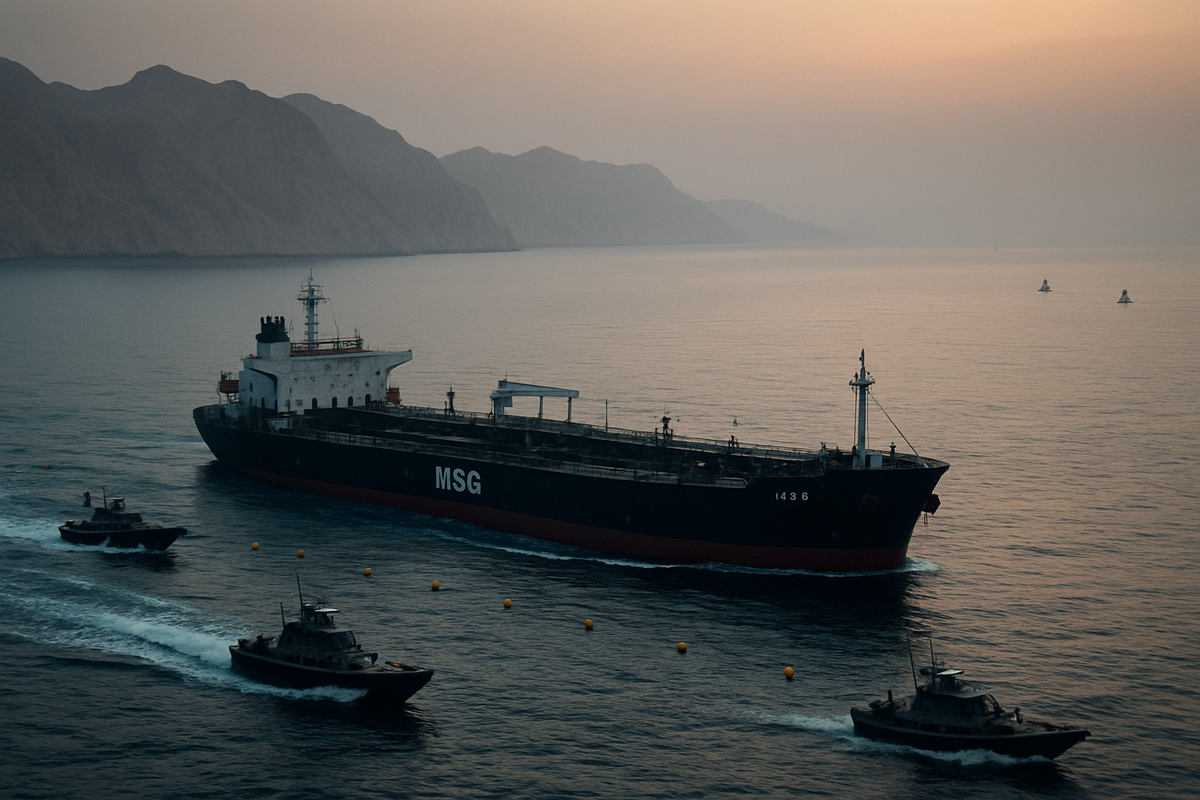
BANDAR ABBAS, Iran – In a move watched closely by global energy markets and maritime security experts, the Gabon-flagged tanker MSG (IMO 9466623) successfully navigated the Strait of Hormuz on Thursday, April 9, 2026. The transit marks the first time a non-Iranian commercial vessel has traversed the world’s most vital oil chokepoint since a fragile, Pakistan-brokered ceasefire took effect on April 7. The 118-meter bitumen and oil products tanker, laden with approximately 7,000 tonnes of Emirati fuel oil, cleared the Islamic Revolutionary Guard Corps (IRGC) checkpoints and is currently signaling its destination as Mundra, India.
The successful passage of the MSG serves as a critical "test case" for an industry that has been largely paralyzed by the explosive regional conflict of early 2026. However, maritime analysts warn that the "opening" of the Strait is far from a return to normalcy. Under the terms of the "supervised pause" agreed upon by the U.S. and Iran, transit is currently capped at just 10 to 15 passages per day—a staggering reduction from the pre-conflict average of 135 daily crossings. Furthermore, vessels are being routed through narrow, IRGC-monitored corridors around Larak Island to avoid vast sea-mine fields laid during the hostilities of the past two months.
A Supervised Pause Following "Operation Epic Fury"
The current situation is the tense aftermath of "Operation Epic Fury," a joint U.S.-Israeli military campaign launched on February 28, 2026, which involved nearly 900 strikes in a 12-hour window. The operation, which followed a year of escalating tensions starting with the "Twelve-Day War" in June 2025, resulted in the assassination of several high-ranking Iranian officials and a de facto closure of the Strait by Iranian naval forces. In retaliation, Iran deployed advanced drone swarms and naval mines, effectively halting global energy shipments and sending oil prices to historic highs.
The two-week ceasefire, brokered by Islamabad, began earlier this week on the condition that the U.S. suspend all offensive operations against Iranian territory. In exchange, Iran agreed to allow a limited volume of commercial traffic, albeit under heavy military supervision. The transit of the MSG, owned by Marshall Islands-registered MSG Shipping Inc., was treated with extreme caution. The vessel was required to pay a controversial "reconstruction toll," reportedly amounting to $2 million—a new fee structure proposed by Iran and Oman to fund the repair of infrastructure damaged during the U.S. strikes.
Industry reaction has been one of "guarded optimism." While the MSG did not encounter military interference, the presence of IRGC boarding parties for "technical inspections" remains a significant deterrent for Western shipowners. Most major carriers, including A.P. Moller - Maersk (CPH: MAERSK-B), have indicated they will continue to utilize land-bridge alternatives, moving cargo by truck from ports like Jeddah and Khor Fakkan, rather than risk their hulls in the supervised corridors.
Market Winners and Losers: The Tanker Super-Cycle
The ongoing constraints in the Strait have created a bifurcated market for shipping companies. Tanker giants like Frontline (NYSE: FRO) have found themselves in the midst of a "super-cycle." With the Strait restricted to just 15 ships a day, the scarcity of available oil on the global market and the massive increase in "ton-miles"—as ships reroute around the Cape of Good Hope—has driven freight rates to astronomical levels. In March 2026, daily rates for Very Large Crude Carriers (VLCCs) peaked at over $420,000 per day. Frontline’s stock, currently trading near $36.57, has benefited from this volatility, though the company’s $1.2 billion fleet renewal plan highlights the long-term pressure to move toward more efficient, "ECO" vessels.
Conversely, the insurance sector has faced a reckoning. The London specialty market, led by firms like Hiscox (LON: HSX), has been forced to renegotiate war-risk terms from scratch. In early 2026, premiums surged to as high as 5% of a vessel’s total hull value for a single transit through the Strait. This pricing effectively sidelined smaller operators. The acquisition of Beazley by Zurich Insurance Group (SWX: ZURN) for $10.8 billion in March was seen as a move to stabilize one of the region's largest insurers after it was hit by fears of catastrophic maritime losses.
Scorpio Tankers (NYSE: STNG) has taken a different strategic pivot, using the crisis to accelerate its "technology-first" narrative. The company recently announced a partnership with AMPERA, Inc. to develop micronuclear power solutions for its fleet, aiming to bypass traditional refueling hubs that have become geopolitical flashpoints. While Scorpio’s modern fleet is commanding a premium in the refined products market, the company’s heavy investment in share repurchases suggests a belief that the current supply bottleneck—and the high rates associated with it—will persist well into the latter half of the year.
Wider Significance and Geopolitical Ripple Effects
The 10-passage limit in the Strait of Hormuz is more than a logistical hurdle; it is a profound shift in the global energy security architecture. For decades, the "freedom of navigation" in these waters was a cornerstone of the global economy. By successfully imposing a toll and a quota system, Iran is testing a new reality where it acts as the primary regulator of the world’s most important energy artery. This fits into the broader "10-point peace plan" demanded by Tehran, which includes the total lifting of Western sanctions and the withdrawal of U.S. forces from the Persian Gulf.
The regulatory implications are significant. The U.S. International Development Finance Corporation (DFC) has had to launch a $20 billion sovereign reinsurance program to prevent a total collapse of the energy supply chain to allied nations. This intervention marks a departure from traditional free-market maritime insurance, suggesting that shipping through the Strait may permanently require state-backed guarantees. Historical precedents, such as the "Tanker War" of the 1980s, pale in comparison to the technological sophistication and the sheer economic scale of the 2026 crisis.
Competitors in the energy sector, such as ExxonMobil (NYSE: XOM) and Shell (NYSE: SHEL), have been forced to rethink their midstream strategies. The sudden unreliability of the Strait has accelerated the development of trans-continental pipelines and alternative fuel sources. If the 10-passage limit becomes a permanent fixture, the "Hormuz Risk Premium" will likely become a structural component of oil pricing, permanently elevating costs for Asian consumers who rely most heavily on Middle Eastern crude.
The Path Ahead: A Two-Week Window of Uncertainty
What comes next depends entirely on the diplomatic developments of the next ten days. The ceasefire is currently set to expire on April 21, 2026. If a broader agreement regarding Iran’s nuclear program and regional influence is not reached, the Strait could close entirely once more. In the short term, we may see a "transit lottery" system emerge, where the limited 15 daily slots are auctioned off to the highest bidder or allocated based on geopolitical alliances—a scenario that would favor state-owned oil companies over independent traders.
Strategically, the maritime industry is preparing for a "long-tail" recovery. Even if the ceasefire holds, the process of clearing the Strait of naval mines and debris from the February strikes will take months, if not years. We may see a shift toward smaller, more maneuverable "shuttle tankers" that can navigate the IRGC corridors more easily than the massive VLCCs that defined the pre-war era.
Market opportunities will likely emerge in the logistics and "land-bridge" sectors. Companies capable of bypassing the Strait through overland routes in Saudi Arabia and the UAE are seeing record investment. However, these alternatives can only handle a fraction of the 20 million barrels of oil that typically flow through the Strait daily, leaving the global economy tethered to the fragile stability of the Hormuz corridors.
Final Assessment for Investors
The transit of the MSG is a symbolic victory for the ceasefire, but it is not a signal to return to "business as usual." The Strait of Hormuz remains a high-risk, low-volume environment governed by military necessity rather than commercial law. Investors should view the current 10-15 ship limit as a de facto production cut for the global oil market, one that will keep energy prices volatile and tanker rates elevated for the foreseeable future.
In the coming months, the key metrics to watch will be the "reconstruction toll" amounts and whether Western insurers begin to re-enter the market without DFC backstops. If the daily passage count does not increase beyond 15 by the end of April, expect a further rerouting of global trade that will benefit long-haul shipping routes and alternative energy providers at the expense of traditional Gulf-dependent industries. The era of "open water" in the Middle East has ended; the era of "supervised navigation" has begun.
This content is intended for informational purposes only and is not financial advice.