Energy’s New Era: Why Exxon and Chevron Have Reclaimed the Safe-Haven Crown in 2026
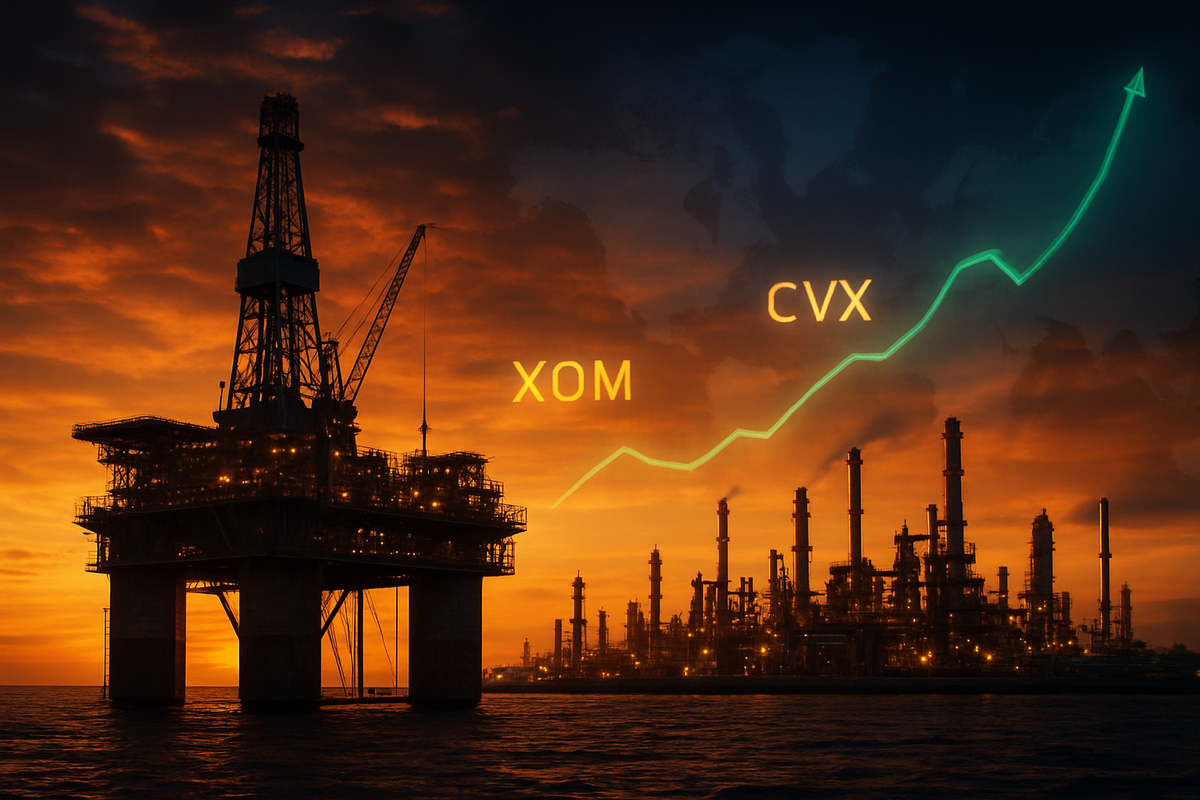
NEW YORK — As the first quarter of 2026 draws to a close, the global financial landscape has undergone a seismic shift. The "growth at any cost" mantra that defined the early 2020s has been replaced by a desperate search for stability, dividends, and tangible assets. As of March 31, 2026, institutional investors have completed a massive rotation into large-cap energy stocks, specifically Exxon Mobil (NYSE: XOM) and Chevron (NYSE: CVX), which are now being traded as the definitive safe havens of the mid-decade market.
This flight to quality comes as geopolitical volatility reaches a boiling point, particularly in the Middle East. With crude oil prices hovering between $110 and $112 per barrel, the Energy Select Sector SPDR Fund (NYSEArca: XLE) has surged an astonishing 36% year-to-date. In stark contrast, the broader S&P 500 (NYSEArca: SPY) has tumbled nearly 5% over the same period, weighted down by cooling valuations in the technology sector and fears of a conflict-induced global recession.
The "Iran War Shock" and the Flight to Energy Security
The catalyst for this market transformation was the "Iran War Shock" of late February 2026. On February 28, the United States and Israel launched "Operation Epic Fury," a targeted joint strike against Iranian military infrastructure. The subsequent threat by Tehran to close the Strait of Hormuz—the world’s most vital oil artery—sent immediate shockwaves through global commodities. Unlike previous cycles where investors might have fled to gold or U.S. Treasuries, the unique inflationary environment of 2026 has made energy the hedge of choice.
The timeline leading to this moment was defined by a steady tightening of the global supply chain. Earlier in February, OPEC+ reaffirmed its decision to pause production increases, removing any potential supply cushion. This was followed by the "Arctic Express" weather system in January, which temporarily knocked out over 1 million barrels per day of North American shale production. For asset managers, the primary concern was no longer just price, but physical security and geographical insulation.
Exxon Mobil and Chevron have emerged as the primary beneficiaries of this "energy security" premium. Following the successful integration of Pioneer Natural Resources by Exxon and the Hess acquisition by Chevron in 2025, both companies have drastically increased their footprints in the Western Hemisphere. Their massive operations in the Permian Basin and Guyana are viewed by investors as "insulated" from the chaos of the Eastern Hemisphere, providing a reliable stream of cash flow that is effectively shielded from the closure of the Strait of Hormuz.
The Winners and Losers of the Great Rotation
The clear winners in this environment are the "Supermajors" with integrated well-to-wheel models. Exxon Mobil (NYSE: XOM) is currently trading near all-time highs of $171, supported by a staggering $52 billion in operating cash flow for the previous fiscal year. Its ability to return $37.2 billion to shareholders through dividends and buybacks has made it an indispensable pillar for pension funds and retirement accounts. Similarly, Chevron (NYSE: CVX) has reached an inflection point, with its stock price hitting $212 following the realization of synergies from the Hess merger, which added high-margin assets in the Bakken and Guyana.
Conversely, the losers of this shift are found in the high-growth technology and AI sectors. Companies like Meta Platforms Inc. (NASDAQ: META) and Alphabet Inc. (NASDAQ: GOOGL), which dominated the 2023–2024 bull run, have seen significant outflows as institutional giants like BlackRock (NYSE: BLK) rebalance toward defensive value. Small-cap independent drillers are also struggling to keep pace; while they benefit from high oil prices, they lack the refining capacity and balance sheet strength of the giants to navigate the "higher-for-longer" interest rate environment, which currently sits at 3.75%.
Logistics and shipping firms have also faced a bifurcated reality. While tankers have seen day rates skyrocket due to rerouting around the Cape of Good Hope, the increased cost of fuel and insurance has hammered general retail and consumer discretionary stocks. The divergence in the market is clear: if it isn't producing energy or securing it, it is likely losing value in the current Q1 2026 climate.
Broader Industry Trends and Historical Precedents
This shift fits into a broader trend of "Deglobalization 2.0," where energy independence has become the ultimate strategic advantage. The 2026 market closely mirrors the "Nifty Fifty" era of the 1970s, where stability and reliable earnings were valued far above speculative growth. For the first time in years, the energy sector’s weight in the S&P 500 is approaching double digits, a significant reversal from its 2020 lows of less than 3%.
The current situation also draws comparisons to the 2022 energy spike following the invasion of Ukraine, but with a critical difference: the integration of massive Permian assets. By 2026, the consolidation led by Occidental Petroleum (NYSE: OXY) and ConocoPhillips (NYSE: COP) has created a more disciplined industry. Gone are the days of "drill at any cost." The focus is now on capital discipline and returning cash to shareholders, a policy that has finally won back the trust of institutional investors who had previously shunned the sector for its ESG (Environmental, Social, and Governance) shortcomings.
Regulatory tailwinds have also played a role. In early 2026, the administration introduced "Section 122 Tariffs" on various global imports. While uncertainty surrounded many commodities, energy was largely exempted, reinforcing the status of domestic energy producers as the most stable components of the American industrial machine. This policy environment has solidified the belief that Exxon and Chevron are not just oil companies, but vital components of national security.
What Lies Ahead: Strategic Pivots and Scenarios
Looking forward to the remainder of 2026, the energy giants face a delicate balancing act. In the short term, if de-escalation in the Middle East occurs, we may see a "relief sell-off" in oil prices. However, analysts believe the floor for crude has structurally shifted higher, likely remaining above $85 per barrel due to the lack of spare global capacity. Exxon and Chevron must now decide how to allocate their record windfalls—whether to double down on fossil fuel expansion or accelerate their low-carbon hydrogen and carbon capture initiatives.
The long-term challenge remains the energy transition. While 2026 is the "Year of the Safe Haven" for oil, the pressure to decarbonize has not disappeared; it has merely been sidelined by immediate security concerns. Investors should watch for whether these companies use their current stock price strength to acquire more renewable energy infrastructure or if they will continue to focus on the "shale-to-shareholder" model that is currently driving their outperformance.
Furthermore, a potential pivot in Federal Reserve policy could change the math. If the "Iran War Shock" leads to a sharper-than-expected economic slowdown, the Fed may be forced to cut rates by late 2026. Such a move would typically favor growth stocks, but given the structural shortage of energy, the sector may hold its gains better than in previous cycles.
Market Wrap-Up: The New Defensive Standard
As we close out the first quarter of 2026, the primary takeaway for investors is that the definition of a "safe haven" has changed. The volatility of the 2020s has proven that digital growth cannot replace physical energy in a crisis. Exxon Mobil and Chevron have successfully transitioned from being "old economy" relics to the most sought-after stabilizers in a modern portfolio.
Moving forward, the market is likely to remain bifurcated. Investors should closely monitor the "Strait of Hormuz" premium; any permanent disruption there could push oil toward $150, further cementing the dominance of the supermajors. However, the true test will be the sustainability of their dividend yields as they navigate the highest interest rates in nearly two decades.
In conclusion, March 31, 2026, marks the point where energy reclaimed its seat at the head of the market table. For the institutional investor, the message is clear: in an uncertain world, the reliability of a quarterly dividend from a Texas-based energy giant is worth more than the promise of an AI-driven future.
This content is intended for informational purposes only and is not financial advice.