Energy Shock Ignites Inflation Fears: ISM Services PMI Reveals Historic Price Surge Amidst U.S.-Iran Conflict
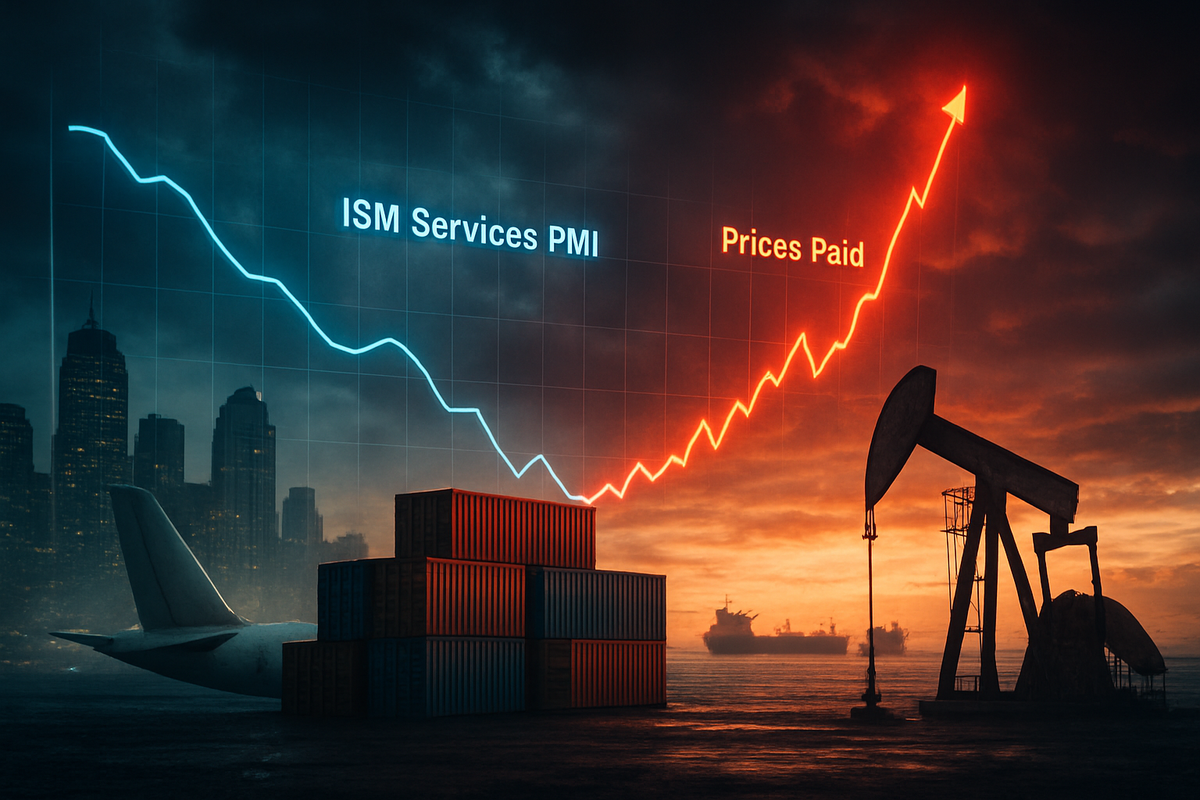
The U.S. economy faced a jarring reality check this week as the Institute for Supply Management (ISM) released its March 2026 Services PMI report. While the headline figure showed a sector still in expansion, the underlying data sent shockwaves through Wall Street. The headline PMI came in at 54.0, missing the consensus estimate of 54.7, but the real story lay in the "Prices Paid" component, which saw a staggering 8-point spike to 66.3—the largest one-month jump in 13 years.
This inflationary surge is directly tied to the escalating military conflict between the U.S. and Iran, which has effectively paralyzed energy markets and reignited fears of "stagflation." As of today, April 6, 2026, investors are scrambling to recalibrate their portfolios as the service sector—the engine of American economic growth—struggles to absorb the most rapid acceleration in input costs seen since the post-Hurricane Katrina era.
The Data Divergence: Slower Growth, Skyrocketing Costs
The March report provides a clear picture of a services sector under duress. While a reading of 54.0 indicates that the industry is still growing, the momentum has slowed significantly from February’s 56.1. The cooling was exacerbated by a contraction in the Employment Index, which plummeted to 45.2. Respondents to the ISM survey cited a "hiring pause" as companies wait to see the full economic fallout of "Operation Epic Fury," the U.S. military response to Iranian provocations in late February.
The timeline of this crisis moved with frightening speed. Following the escalation of hostilities, Iran moved to block the Strait of Hormuz, a chokepoint responsible for 20% of the world’s oil supply. In a matter of weeks, Brent Crude prices surged past $110 per barrel, with some analysts warning of a run toward $150 if the blockade is not broken soon. This energy shock hit the services sector immediately, reflected in that historic 8-point jump in Prices Paid.
Market participants were caught off guard by the magnitude of the price spike. While a rise in costs was expected, the 66.3 reading suggests that inflationary pressures are no longer a "simmer" but a "boil." Initial market reactions saw the S&P 500 drop 2.4% on the day of the release, while Treasury yields spiked as traders bet that the Federal Reserve would be forced to keep interest rates "higher for longer" to combat this new supply-side inflation.
Winners and Losers: Navigating the Energy Minefield
The impact of the March PMI report has been unevenly distributed across the market, creating clear winners in the energy space and significant losers in transportation and consumer-facing sectors.
The Winners: Energy "supermajors" like ExxonMobil (NYSE:XOM) and Chevron (NYSE:CVX) have emerged as the primary beneficiaries of the geopolitical turmoil. Their stock prices have surged as crude prices climbed, acting as a natural hedge for investors. Domestic producers like ConocoPhillips (NYSE:COP) are also seeing increased interest as the market pivots toward companies with significant non-Middle Eastern production capacity. These firms are seeing record-level margins as the gap between production costs and market prices widens.
The Losers: Conversely, the airline industry is in a tailspin. United Airlines (NASDAQ:UAL) and Delta Air Lines (NYSE:DAL) have seen their shares drop by nearly 18% over the last month. The surge in jet fuel prices—estimated to have hit $4.24 per gallon in March—is evaporating profit margins that were already thin. Logistics giants FedEx (NYSE:FDX) and United Parcel Service (NYSE:UPS) are also facing immense pressure; while they can pass on some costs through emergency fuel surcharges, the resulting increase in shipping rates is expected to dampen overall delivery volumes. Even Amazon (NASDAQ:AMZN) is not immune, as the cost of maintaining its massive "last-mile" delivery fleet continues to climb, potentially squeezing retail margins in the upcoming quarter.
Wider Significance: A Return to 2011-Era Volatility
This event marks a significant departure from the relative stability of the mid-2020s. The 8-point jump in the Prices Paid index is a rare phenomenon, with historical precedents found only in moments of extreme crisis. Analysts are drawing parallels to the 2011-2012 period during the Arab Spring and previous Iran nuclear tensions, where oil prices reached $125 per barrel. However, the current situation is arguably more dangerous due to the fragile state of global supply chains post-2024.
The broader industry trend is one of "defensive contraction." Services firms that had been investing in expansion are now pivoting toward cost-cutting and efficiency measures. There is a growing concern among policy analysts that this energy-driven inflation will lead to "secondary effects," where service providers (from restaurants to software firms) are forced to raise their own prices, further entrenching inflation in the economy. This puts the Federal Reserve in an impossible position: raising rates into a slowing economy (stagflation) or allowing inflation to run rampant to protect growth.
The closure of the Strait of Hormuz also has massive regulatory implications. We are likely to see a renewed push for energy independence and a potential acceleration of the transition to electric heavy-duty transport to mitigate future fossil fuel shocks. However, those transitions take years, leaving the market vulnerable in the immediate term.
What Comes Next: Strategic Pivots and Scenarios
In the short term, the market will be laser-focused on the Strait of Hormuz. If the blockade is lifted within the next 30 days, we could see a rapid "relief rally" as energy prices normalize. However, if the conflict drags into the summer, the "higher for longer" interest rate environment will likely become a permanent fixture of 2026, potentially pushing the U.S. into a formal recession by Q3.
Companies are already beginning to adapt. We should expect to see major logistics players like FedEx (NYSE:FDX) accelerate the retirement of older, less fuel-efficient aircraft and vehicles. In the retail sector, companies like Amazon (NASDAQ:AMZN) may increase the cost of Prime memberships or implement mandatory shipping fees for lower-tier orders to offset the energy tax.
For investors, the opportunity lies in volatility and energy-linked assets. However, the risk of a broader contagion—where high energy prices lead to a collapse in consumer discretionary spending—remains high. Watch for the upcoming retail sales data to see if the "Prices Paid" surge in the service sector has successfully dampened consumer appetite.
Final Assessment: The Road Ahead
The March 2026 ISM Services PMI report serves as a stark reminder of how quickly geopolitical events can derail economic progress. The headline miss to 54.0 is a warning of cooling growth, but the 66.3 Prices Paid reading is a siren of impending inflationary pressure. The 8-point jump is a historic anomaly that underscores the severity of the U.S.-Iran conflict's impact on global energy markets.
Moving forward, the market will be defined by its ability to absorb these costs. Investors should move away from high-leverage sectors that are sensitive to fuel prices and look toward companies with strong pricing power or direct energy exposure. The next three months will be critical; if the Prices Paid index remains above 65, the Federal Reserve will have little choice but to maintain a restrictive stance, regardless of the slowing headline growth.
The key takeaway for the public is clear: the era of low-cost energy and stable service prices has been interrupted. As the conflict in the Middle East continues, the "energy tax" on the American service economy will be the dominant story for the remainder of 2026.
This content is intended for informational purposes only and is not financial advice