Dow Jones Shatters 50,000 Milestone: AI Surge Powers Historic 1,200-Point Rally
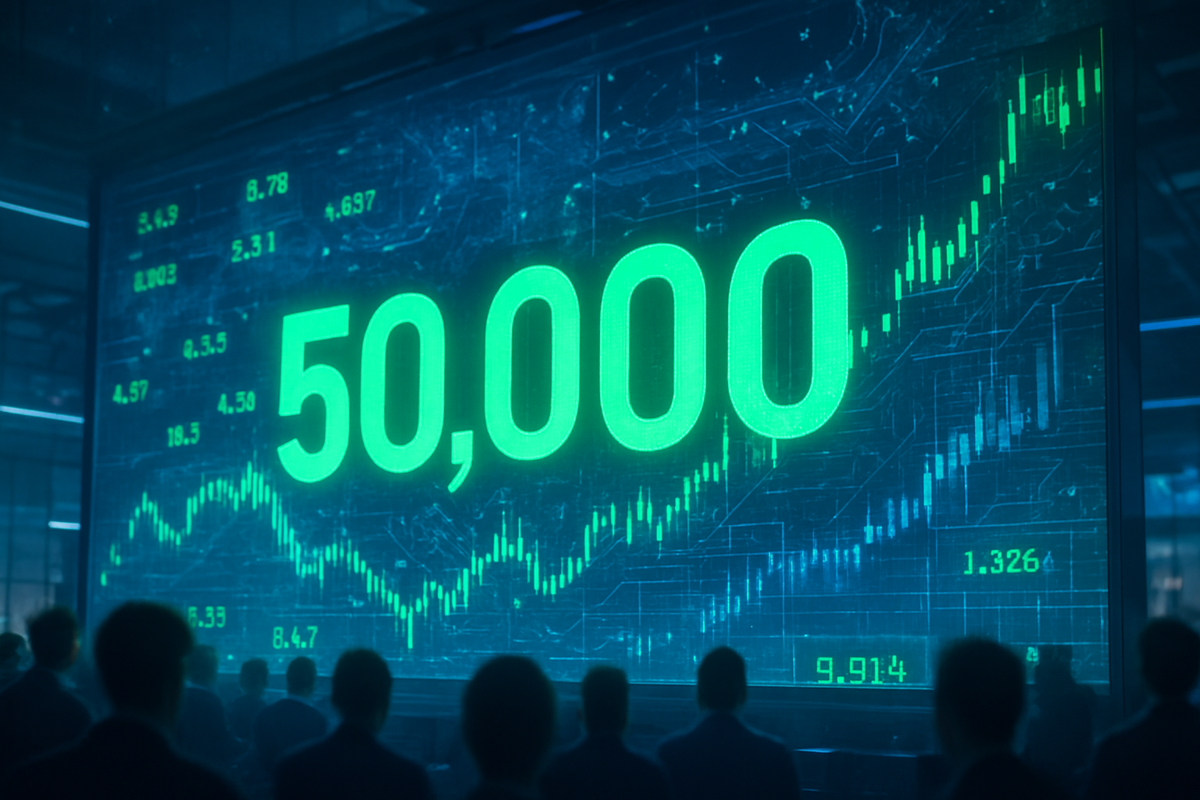
In a historic display of market resilience and technological optimism, the Dow Jones Industrial Average closed above the 50,000-point milestone for the first time in history on Friday, February 6, 2026. The blue-chip index surged by a staggering 1,200 points during the session, ending the day at 50,115.67. This monumental rally not only captured the world's attention but also effectively snapped a grueling three-week losing streak that had seen investors questioning the durability of the current bull cycle.
The crossing of the 50,000 threshold represents a psychological and symbolic triumph for the American economy. Driven by a potent combination of blockbuster earnings from artificial intelligence leaders and a stronger-than-expected January jobs report, the market's "February Frenzy" has redefined the trajectory of the 2026 fiscal year. As the closing bell rang at the New York Stock Exchange, the atmosphere was electric, marking the end of a 21-month journey from the 40,000 mark achieved in May 2024.
The Road to 50,000: A Friday for the History Books
The trading day began with an immediate gap up following the 8:30 AM release of the Department of Labor’s employment data, which showed the U.S. economy added 310,000 jobs in January—far exceeding analyst expectations. However, the true catalyst for the 1,200-point explosion was the "AI Halo Effect" trickling down from specialized tech firms into the broader industrial and financial components of the Dow. By mid-day, the index had already climbed 700 points, and the momentum only intensified in the final hour of trading as short-sellers were forced to cover their positions, fueling a classic "melt-up" scenario.
This milestone comes after a turbulent start to the year. For the previous three weeks, the Dow had been hampered by fears of persistent inflation and a "higher-for-longer" interest rate environment. Many analysts predicted a deeper correction, but those concerns were overshadowed on Friday by a resurgence in the "Old Economy" giants that have successfully integrated AI into their operations. The timeline from 40,000 to 50,000 took just under two years, a significantly faster pace than the 3.5 years it took to climb from 30,000 to 40,000, signaling a period of accelerated corporate productivity.
Key stakeholders, including institutional fund managers and retail "diamond-hand" investors, have been vindicated by this move. The inclusion of Amazon.com, Inc. (NASDAQ: AMZN) and NVIDIA Corporation (NASDAQ: NVDA) into the Dow over the last two years proved to be prophetic, as these components provided the necessary "high-octane" growth to drag the price-weighted index across the finish line. The reaction from the floor was one of pure jubilation, with many traders donning "Dow 50,000" hats that had been waiting in storage for months.
Winners and Losers: The AI Vanguard Takes the Lead
The primary architect of Friday’s rally was undoubtedly NVIDIA Corporation (NASDAQ: NVDA). Since replacing Intel in the index in late 2024, NVIDIA has become the Dow’s most influential growth engine. On Friday alone, NVIDIA shares rose 7.4%, contributing nearly 200 points to the Dow’s total gain. Investors are continuing to pile into the semiconductor giant as its next-generation AI architecture sees record adoption across global data centers. Similarly, Microsoft Corporation (NASDAQ: MSFT) saw a 4% jump, bolstered by its Azure cloud division’s latest AI-integrated enterprise tools.
Surprisingly, the day's winners extended far beyond Silicon Valley. Caterpillar Inc. (NYSE: CAT) emerged as a standout performer, hitting an all-time high as the company’s AI-driven autonomous mining and construction equipment division reported a record backlog. IBM (NYSE: IBM) also continued its multi-year turnaround, with its "Watsonx" AI platform proving to be a must-have for Fortune 500 companies looking to automate legacy processes. Even Goldman Sachs Group, Inc. (NYSE: GS), a heavyweight in the price-weighted index, surged as AI-driven trading efficiencies and a rebound in M&A activity boosted its bottom line.
However, not every company shared in the glory. Boeing Company (NYSE: BA) continued to struggle, ending the day nearly flat as persistent supply chain issues and regulatory scrutiny overshadowed the broader market euphoria. Additionally, some traditional consumer staples like Procter & Gamble Co. (NYSE: PG) saw modest gains that lagged far behind the index, as investors rotated capital out of defensive "safe havens" and back into aggressive growth and industrial stocks.
The Broader Significance: An Era of Productivity
The Dow's ascent to 50,000 is more than just a round number; it signifies a fundamental shift in the global economy. We are witnessing the "Blue-Chip Renaissance," where century-old companies are being reborn through the application of generative AI. This event mirrors the internet boom of the late 1990s but with a crucial difference: the companies leading this charge are already profitable behemoths with massive cash flows. The ripple effect is being felt across competitors; as Dow components like Honeywell International Inc. (NASDAQ: HON) successfully deploy AI to manage supply chains, their peers are being forced to adapt or face obsolescence.
From a policy perspective, the 1,200-point rally puts the Federal Reserve in a complex position. While the market is celebrating, the strength of the labor market and the surge in asset prices could potentially reignite inflationary pressures. However, many economists argue that the current growth is "non-inflationary" because it is driven by productivity gains rather than mere monetary expansion. This historical precedent is often compared to the mid-1950s or the late 1990s, where technological breakthroughs allowed for high growth and low inflation simultaneously.
The milestone also underscores the changing nature of the Dow Jones Industrial Average itself. By swapping out stagnant components like Intel Corporation (NASDAQ: INTC) and adding more dynamic players like Sherwin-Williams Company (NYSE: SHW) and NVIDIA, the index has become a more accurate barometer of the modern, tech-enabled economy. This evolution has allowed the Dow to keep pace with the tech-heavy Nasdaq, proving that "industrial" now encompasses everything from cloud computing to advanced robotics.
What Lies Ahead: Can the Momentum Hold?
In the short term, market participants are looking to see if the Dow can hold the 50,000 level as support. Strategic pivots are already underway at many firms; companies that have yet to announce a comprehensive AI strategy are feeling the heat from activist investors. We may see a wave of "catch-up" acquisitions as lagging firms attempt to buy their way into the AI space. The upcoming earnings season will be the ultimate test, as investors will look for concrete evidence that the 1,200-point surge is backed by rising margins and not just speculative fervor.
Longer-term, the challenge for the market will be managing the "valuation gap." With the Dow at 50,000, many stocks are trading at historically high multiples. Any hint of an economic slowdown or a geopolitical shock could lead to significant volatility. However, the potential for a "melt-up" toward 60,000 cannot be ignored if AI adoption continues to accelerate at its current pace. Investors should watch for the Federal Reserve's next meeting, as any hawkish pivot could quickly cool the market's current euphoria.
Conclusion: A New Benchmark for Global Finance
The Dow Jones Industrial Average closing above 50,000 is a watershed moment that will be studied by financial historians for decades. It marks the definitive end of the post-pandemic uncertainty and the beginning of a new era defined by artificial intelligence and industrial modernization. The 1,200-point rally on February 6, 2026, serves as a powerful reminder that the American equity market remains the world's premier engine for wealth creation, capable of overcoming even the most stubborn losing streaks.
Moving forward, the market’s health will depend on whether these gains can be sustained by actual earnings growth rather than just multiple expansion. Investors should remain optimistic but vigilant, watching closely for signs of overextension in the tech sector while keeping an eye on the reinvigorated industrial giants. As we look toward the horizon, the question is no longer when the Dow will hit 50,000, but how high this AI-fueled rocket can truly go.
This content is intended for informational purposes only and is not financial advice.