Diplomacy Deflates the 'Iran Premium': Oil Futures Plunge 4% as Geopolitical Tensions Recede
The global energy market experienced a sharp recalibration on Thursday, January 15, 2026, as oil futures tumbled by more than 4% in a single session. The sudden sell-off was triggered by a rapid de-escalation of rhetoric between Washington and Tehran, effectively neutralizing the "geopolitical risk premium" that had bolstered prices throughout early January. As the threat of a U.S. military strike on Iranian targets dissipated, traders were forced to confront a stark reality: a global market currently awash in crude.
The immediate implications of this shift are profound for both Wall Street and Main Street. By Monday, January 19, 2026, West Texas Intermediate (WTI) and Brent crude had stabilized at levels not seen since late last year, providing a much-needed reprieve for fuel-dependent industries. However, the drop also signals a pivotal transition for the energy sector, where the focus has moved from potential supply disruptions in the Middle East to a mounting domestic supply glut in the United States.
The 'Reversal Thursday': A Timeline of Diplomatic Cooling
The catalyst for the market's retreat began late on Wednesday, January 14, when President Donald Trump issued a statement suggesting a breakthrough in backchannel communications with Tehran. Following weeks of intensifying nationwide protests in Iran and fears of imminent U.S. intervention, the President signaled that the "killings of protesters in Iran had stopped." This diplomatic pivot was reportedly facilitated by a decisive exchange between U.S. Envoy Steve Witkoff and Iranian Foreign Minister Abbas Araghchi, who provided assurances that the Iranian government would halt executions of civil dissidents.
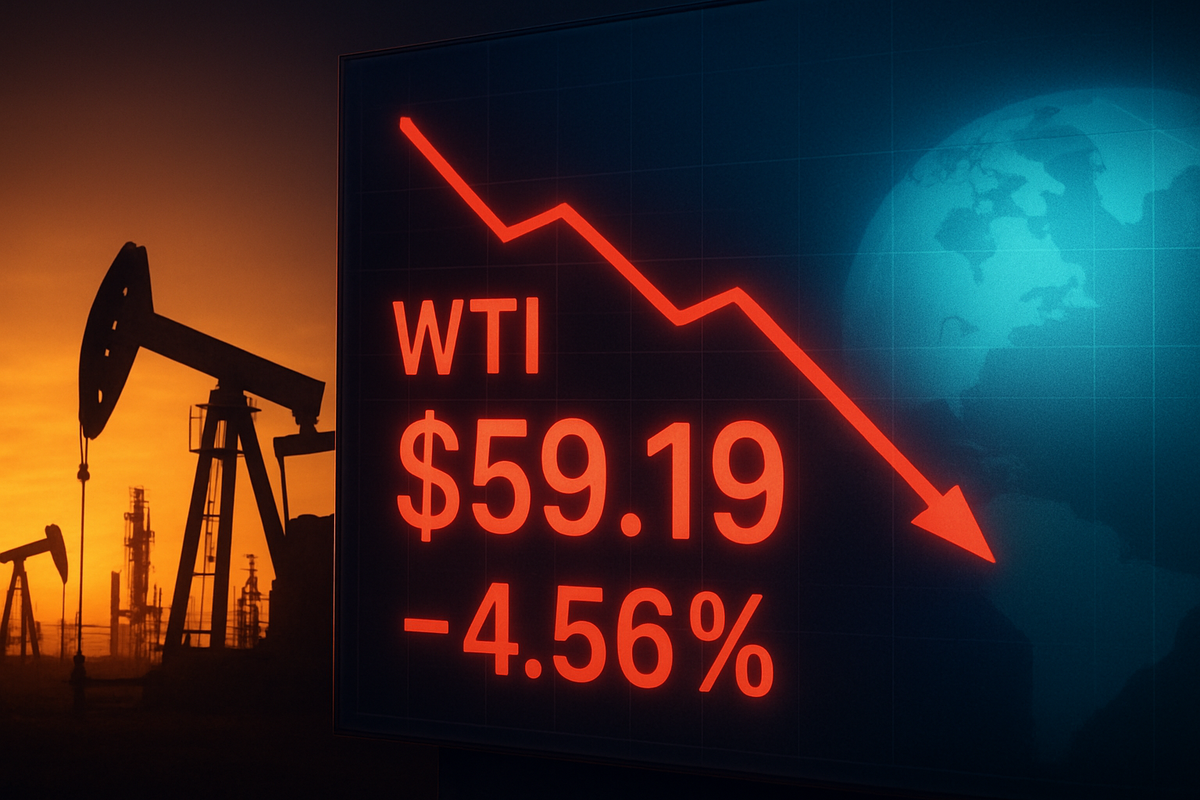
By the time the markets opened on Thursday, January 15, the "Iran premium"—which analysts estimated had inflated prices by 10% to 11%—began to evaporate. Brent crude, the international benchmark, settled down $2.76, or 4.15%, at $63.76 a barrel. Simultaneously, West Texas Intermediate (WTI) saw an even steeper decline, falling $2.83, or 4.56%, to close at $59.19 a barrel, breaking the critical $60 support level. The speed of the decline caught many speculative traders off guard, as the "war-drum" narrative that had dominated the first two weeks of 2026 was replaced by headlines of diplomatic pragmatism.
The sell-off was further exacerbated by cold, hard data from the Energy Information Administration (EIA). Just as the geopolitical news hit the wires, the EIA reported a massive build of 9 million barrels in U.S. gasoline inventories and a 3.4 million barrel increase in crude stocks. This combination of easing war fears and rising supply created a "perfect storm" for bears, leading to the sharpest single-day percentage drop for oil in months.
Winners and Losers: Transportation Gains While Energy Reels
The 4% slide in futures created a bifurcated landscape on the stock market. The primary beneficiaries were major airlines and logistics firms, which saw their projected fuel expenses—often their largest variable cost—sink in real-time. United Airlines (NASDAQ: UAL) emerged as a standout performer, with its stock price surging 4.76% to close at $116.02 on the day of the drop. Similarly, Delta Air Lines (NYSE: DAL) rose 4.16% to $71.34, recovering from an earlier slump as investors bet that cheaper jet fuel would bolster first-quarter margins.
In contrast, the energy sector faced significant headwinds, though the impact was uneven. Integrated giants like ExxonMobil (NYSE: XOM) showed defensive resilience, dipping only 0.82% to $129.13. Analysts noted that Exxon’s diversified portfolio and downstream refining capabilities helped insulate it from the raw volatility of crude prices. Chevron (NYSE: CVX) followed a similar pattern, falling a modest 0.65% to $166.16, supported by its recent expansion into Mediterranean gas fields. However, pure-play oilfield service providers and smaller shale explorers were hit much harder, with some smaller caps seeing double-digit percentage losses as the incentive for aggressive new drilling faded.
The logistics sector also found reason for optimism. Companies like FedEx (NYSE: FDX) and UPS (NYSE: UPS) saw moderate gains as lower diesel prices were factored into their 2026 operational forecasts. For these companies, the easing of US-Iran tensions represents more than just a lower fuel bill; it suggests a more stable global trade environment, which is essential for cross-border logistics.
Analyzing the Significance: Oversupply vs. Geopolitical Risk
This event marks a critical turning point in the 2026 energy narrative. For much of the previous year, the market had been balanced on a knife-edge between structural oversupply and the threat of conflict. With U.S. production reaching a staggering 13.8 million barrels per day (bpd) and Venezuelan crude returning to the market under revised U.S. policies, the physical market was already well-supplied. The "Iran premium" was effectively a psychological barrier that kept prices artificially high.
The January 15 drop serves as a reminder that geopolitical risk is often a transient factor in commodities. Once the immediate threat of a supply disruption in the Strait of Hormuz was removed, the market’s focus reverted to the fundamentals of supply and demand. Analysts have dubbed this shift "Tariffs over Tomahawks," suggesting that the administration is moving away from military brinkmanship in favor of economic and trade-based pressure. This shift has broader implications for the global economy, as it implies a lower-for-longer oil price environment that could help dampen the lingering inflationary pressures that have plagued the mid-2020s.
Historical precedents, such as the 2014 oil price collapse, suggest that when structural oversupply meets a sudden loss of geopolitical momentum, the floor for prices can fall quickly. Markets are now looking at a 2026 where Brent crude may average between $56 and $61, a range that would have seemed unlikely just ten days ago when tensions were at their peak.
The Road Ahead: Potential Scenarios and Market Pivots
Looking forward, the energy market is expected to remain in a state of "cautious bearishness." Short-term volatility is likely as traders wait for confirmation that the US-Iran de-escalation is permanent. If the diplomatic backchannel remains open, the focus will shift entirely to OPEC+ and its ability to manage production cuts in the face of relentless U.S. shale output. If OPEC+ chooses to defend its market share rather than the price floor, we could see a further slide toward the $50 level for WTI.
Investors should also watch for strategic pivots within the energy industry. With lower oil prices, the transition toward renewable energy and electric vehicles may face temporary headwinds as internal combustion remains economically attractive. However, major energy companies are expected to continue their "value over volume" strategy, prioritizing stock buybacks and dividends over aggressive capital expenditure for new exploration. For the transportation sector, the challenge will be to lock in these lower fuel prices through hedging strategies before any new geopolitical spark emerges.
Wrap-Up: What Investors Should Watch
The 4% fall in oil futures on January 15, 2026, was a watershed moment that stripped away the veneer of geopolitical anxiety to reveal a market saturated with supply. The immediate winners—airlines and logistics—provide a clear signal that lower energy costs will be a primary driver of corporate earnings in the first half of the year. Meanwhile, the resilience of integrated oil majors like ExxonMobil (NYSE: XOM) suggests that "Big Oil" is better prepared for a lower-price environment than in previous cycles.
Moving forward, the key indicators for investors will be the weekly EIA inventory reports and any shifts in trade policy. As the market moves away from the Persian Gulf drama, the focus is already shifting to U.S.-EU trade tensions and potential tariffs, which could dampen global demand. For now, the "Iran premium" is gone, and the market is once again ruled by the fundamentals of the drill bit and the storage tank. Investors should remain vigilant, watching for whether this $60 level for WTI becomes a new ceiling rather than a temporary floor.
This content is intended for informational purposes only and is not financial advice