Crude Awakening: Brent Oil Surges Past $100 as Middle East Conflict Paralyzes Global Energy Hubs
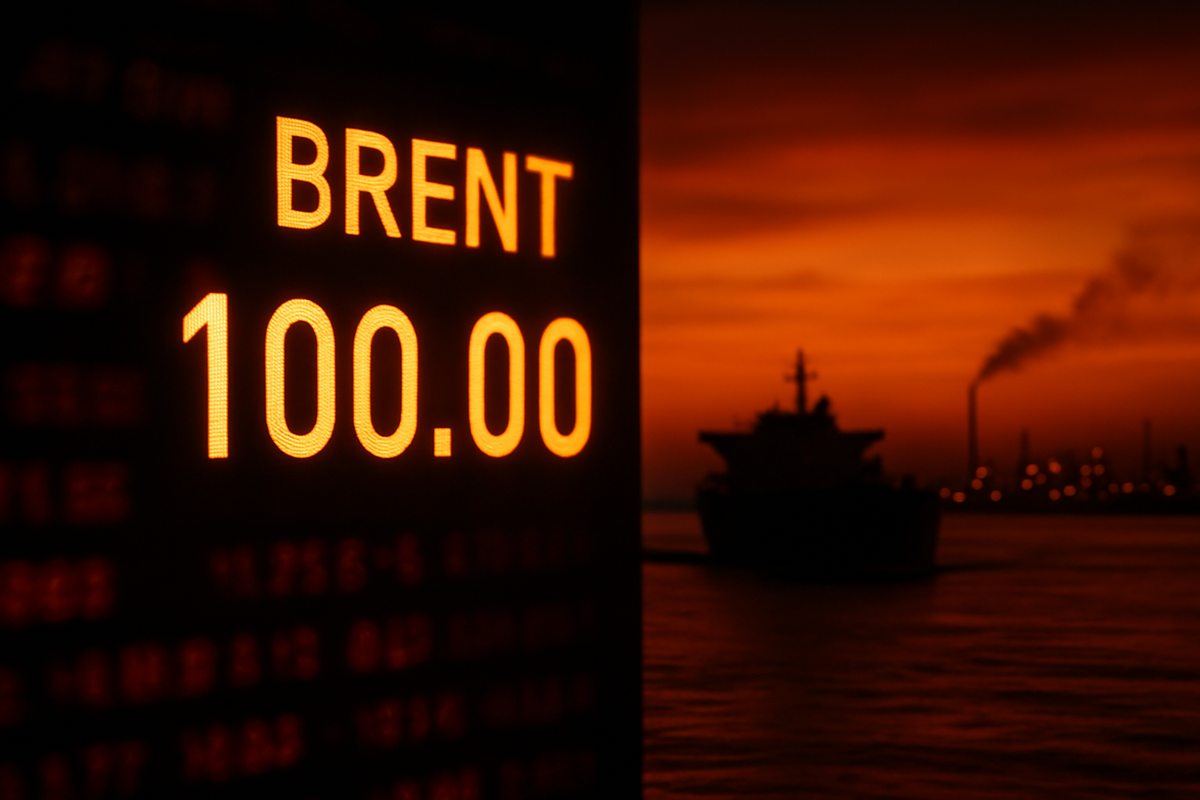
LONDON / NEW YORK — The global economy faced a jarring milestone on April 1, 2026, as Brent crude oil prices surged past the psychological threshold of $100 per barrel, eventually hitting an intraday high of $119.50. This marks the first time oil has sustained such levels since the volatile summer of 2022, signaling a new and dangerous era of energy insecurity. The rally is being driven by a sharp intensification of conflict in the Middle East, which has transitioned from localized skirmishes to a systemic threat against the world’s most critical oil and gas infrastructure.
The immediate implications are profound, as the "scarcity premium" replaces the "risk premium" that had kept prices in the $80 range for much of the previous year. With the Strait of Hormuz facing a near-total blockade and critical export terminals in Saudi Arabia and Qatar under fire, the market is grappling with the physical loss of millions of barrels per day. Financial markets have reacted with swift volatility, as energy stocks reach record highs while transportation and consumer-facing sectors brace for a severe inflationary shock.
Conflict and Catastrophe: The Road to $100
The escalation to $100 oil was not an overnight phenomenon but the result of a rapid deterioration in regional stability that began in late February 2026. What analysts are now calling the "Iran War"—a direct military confrontation involving Israel, the United States, and Iran—moved into a critical phase when maritime chokepoints became the primary battlefield. The Strait of Hormuz, which facilitates approximately 20% of the world’s daily petroleum liquids consumption, is currently seeing commercial traffic reduced to a trickle as Iranian naval forces and Western task forces exchange fire.
The timeline of the current crisis accelerated on March 15, when a series of drone and missile strikes targeted the Ras Laffan Industrial City in Qatar. As the world’s largest liquefied natural gas (LNG) export site, the damage to Ras Laffan sent shockwaves through both the oil and gas markets. Concurrently, Houthi militants in Yemen expanded their reach, striking Saudi Arabia’s Yanbu export terminal on the Red Sea. Yanbu had been the primary "Plan B" for global markets to bypass the Persian Gulf, and its neutralization has left traders with few options for moving crude from the region.
Key stakeholders, including the International Energy Agency (IEA) and OPEC+, have held emergency sessions to coordinate a response. While the United States has authorized further releases from the Strategic Petroleum Reserve (SPR), the volume is considered a "drop in the bucket" compared to the sustained loss of Gulf production. Initial market reactions saw Brent and West Texas Intermediate (WTI) climb 15% in a single week, with volatility indices reaching levels not seen since the onset of the Russia-Ukraine war.
Windfalls for Producers, Turbulence for Transporters
The surge has created a stark divide in the corporate landscape. Integrated oil majors like ExxonMobil (NYSE:XOM) and Chevron (NYSE:CVX) have seen their stock valuations reach all-time highs as the value of their non-Middle Eastern assets skyrockets. ExxonMobil’s market capitalization climbed toward $665 billion this week, as investors bet on the company’s diversified production base in the Permian Basin and Guyana. Similarly, European giants like Shell (NYSE:SHEL) and BP (NYSE:BP) have reported massive windfall profits, though they have been forced to declare force majeure on some Middle Eastern deliveries due to the Qatar disruptions.
On the losing end of the spectrum, the transportation and logistics sectors are reeling. For Delta Air Lines (NYSE:DAL) and United Airlines (NASDAQ:UAL), the return of $100 oil is an existential threat to 2026 profit margins. Airline stocks entered a tailspin in late March, with some carriers falling nearly 17% year-to-date. Having largely moved away from aggressive fuel hedging in 2025, these companies are now exposed to jet fuel prices that account for nearly 40% of their operating costs. Fare increases and "capacity discipline"—the industry term for canceling less profitable routes—are already being implemented.
The logistics industry is similarly strained. FedEx (NYSE:FDX) and United Parcel Service (NYSE:UPS) have both introduced "demand surcharges" and updated their fuel fee structures on a weekly basis to keep pace with rising diesel costs. FedEx recently introduced a $1.50 per-pound surcharge for Middle East-bound shipments, while UPS (NYSE:UPS) has flagged that rising energy costs are cooling consumer demand for e-commerce. As shipping costs rise, the "energy tax" is expected to ripple through the entire retail supply chain by early summer.
A Ghost of 2022: Significance and Precedents
This price action is a haunting echo of 2022, when the invasion of Ukraine by Russia drove Brent toward $140. However, economists note a critical difference: the 2022 crisis was characterized by a "sanctions premium," where the world was attempting to pivot away from Russian energy for political reasons. The 2026 crisis is a "physical scarcity" event. The infrastructure responsible for moving oil—tankers, pipelines, and terminals—is under direct kinetic attack.
The wider significance lies in the reversal of the disinflationary trend that had defined 2024 and 2025. Central banks, including the Federal Reserve, are now facing a "nightmare scenario" where they may be forced to hike interest rates to combat energy-driven inflation just as the economy begins to slow. Furthermore, this event has accelerated the "deglobalization" of energy, as nations move to secure bilateral supply deals, bypassing open market auctions in favor of secure, domestic, or "friendly" energy sources.
Regulatory implications are also mounting. In Washington and Brussels, there is renewed pressure for "emergency energy transition" funding. The argument is that fossil fuel dependence is no longer just a climate risk, but a fundamental national security vulnerability. This shift could see a massive redirection of capital toward nuclear and long-duration battery storage, though such projects will take years to mitigate the current price shock.
Navigating the Volatility: What Comes Next?
In the short term, the market remains on a "knife's edge." Any further escalation—specifically a direct hit on the world's largest processing plant at Abqaiq in Saudi Arabia—could theoretically push Brent past the $150 mark. Analysts at Goldman Sachs (NYSE:GS) have warned that without a diplomatic de-escalation by May, the global economy could enter a "synchronized recession" by the fourth quarter of 2026. Strategic pivots are already underway, as large industrial consumers begin to curtail production in energy-intensive sectors like aluminum and fertilizer.
A potential scenario involves a "demand destruction" phase where prices become so high that consumption drops off precipitously. While this would eventually lower prices, the collateral damage to global GDP would be severe. Investors are looking for signs of a "ceasefire premium" being priced out, but for now, the technicals suggest that $100 is the new floor rather than the ceiling. Market opportunities may emerge in renewable energy firms and domestic U.S. shale producers, who are shielded from the direct military risks of the Persian Gulf.
The Bottom Line for Investors
The surge of Brent crude past $100 in April 2026 is a watershed moment that confirms the fragility of global energy supply chains. The conflict-driven disruption of the Persian Gulf and Red Sea has removed the "buffer" that markets relied upon for the last three years. The key takeaways for the market are clear: energy is once again the primary driver of global inflation, and the geopolitical discount of the early 2020s has vanished.
Moving forward, the market will be characterized by extreme volatility and a widening gap between energy "haves" (producers with secure domestic supplies) and "have-nots" (import-dependent nations). Investors should closely watch for signs of further infrastructure damage in the Gulf and the potential for OPEC+ to deviate from current production quotas. As we move into the second quarter of 2026, the resilience of the consumer in the face of $5-per-gallon gasoline will be the ultimate test for the global economy.
This content is intended for informational purposes only and is not financial advice.