Cautious Fragility: The VIX Signals a New Era of High-Volatility Growth
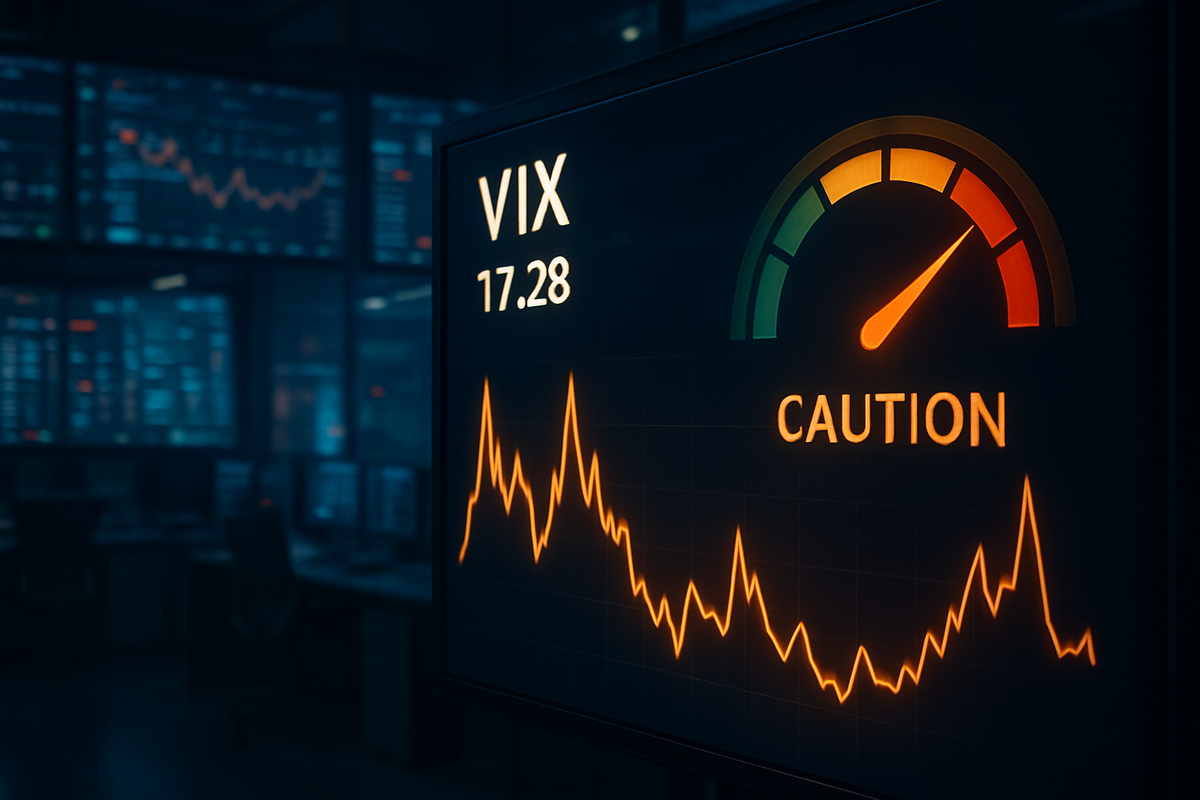
The CBOE Volatility Index (VIX), often referred to as Wall Street’s "fear gauge," sits at 17.28 as of December 18, 2025. While this level is a far cry from the panic-induced heights of the previous month, it remains stubbornly above its long-term historical anchor of 15. The current reading reflects a market characterized by "cautious fragility," where investors are no longer in a state of outright alarm but remain deeply skeptical of the stability beneath the surface of recent gains.
This moderate elevation in the VIX comes on the heels of a cooling Consumer Price Index (CPI) report released today, which showed annual inflation dropping to 2.7%. However, the relief rally typically expected from such news has been tempered by a softening labor market and lingering "data fog" from a recently resolved federal government shutdown. The market is currently navigating a delicate transition, moving away from the "complacency" of early 2025 toward a regime where hedging is no longer a luxury, but a necessity.
From Shutdown Shocks to Data Fog: The Path to 17.28
The journey to the current VIX level of 17.28 has been anything but smooth. Just one month ago, on November 18, 2025, the index experienced a historic surge, hitting an intraday high of 52.87. This "November Shock" was catalyzed by a 43-day federal government shutdown that paralyzed Washington and blinded financial markets to critical economic indicators. During this period, the lack of official data from the Bureau of Labor Statistics and other agencies created a vacuum filled by speculation and fear, sending volatility to levels not seen since the 2020 pandemic.
Since the resolution of the shutdown in early December, the VIX has gradually retreated, stabilizing in the 15 to 18 range. This stabilization was aided by the return of official data, which allowed institutional players like BlackRock and Vanguard to recalibrate their risk models. However, the damage to investor confidence has been lingering. The "data fog" of October and November has left a residual uncertainty about the true state of the economy, particularly as the unemployment rate recently ticked up to 4.6%, its highest level since 2021.
The Federal Reserve has also played a central role in this timeline. On December 17, Fed Governor Christopher Waller described the labor market as "very soft," signaling that while the central bank is aware of the cooling economy, it intends to cut rates at a "moderate pace" rather than an aggressive one. This stance has prevented a full-scale return to market complacency, as traders realize the "Fed Put" may not be as immediate or as large as previously hoped.
Winners and Losers in the Volatility Shift
The current environment of "moderate unease" has created a stark divide between sectors. The primary "losers" in this regime have been the high-flying technology giants that dominated the first half of the year. Alphabet Inc. (NASDAQ: GOOGL) and Nvidia Corp. (NASDAQ: NVDA) both saw significant declines today, falling 3.1% and 3.8% respectively. Investors are increasingly wary of the "AI monetization phase," questioning whether the massive infrastructure spending of 2025 will actually translate into bottom-line profits. This skepticism was further fueled by Oracle Corp. (NYSE: ORCL), which saw its shares plummet 12.7% earlier this week following rumors of a stalled $10 billion data center project.
Conversely, the energy sector has emerged as a surprising "winner" and a defensive haven. As geopolitical tensions rise—highlighted by a U.S.-led blockade of Venezuelan oil tankers—crude prices have stabilized, providing a tailwind for domestic producers. ConocoPhillips (NYSE: COP) and Devon Energy Corp. (NYSE: DVN) both outperformed the broader market today, rising 4.6% and 5.3% respectively. These companies are benefiting from a "geopolitical risk premium" that is currently being priced into the VIX, making energy a preferred destination for capital fleeing tech volatility.
The semiconductor industry is presenting a more nuanced picture. While Nvidia has struggled with high expectations, Micron Technology Inc. (NASDAQ: MU) surged 8.1% in after-hours trading following a significant earnings beat. This suggests that while the "AI exhaustion" narrative is real, companies that can demonstrate tangible demand and supply-chain resilience can still find favor in a high-volatility environment.
The Broader Significance: Modern Mercantilism and AI Exhaustion
The current state of the VIX is more than just a reflection of daily price swings; it is a signal of a shifting global economic order. Analysts from major institutions are pointing to "modern mercantilism"—a trend of escalating trade hostilities and protectionist policies—as a permanent driver of higher baseline volatility. The era of low-cost global supply chains is being replaced by "friend-shoring" and strategic blockades, which inherently introduce more risk into the system.
Furthermore, the transition from AI infrastructure building to the monetization phase is proving to be a volatile pivot. In 2024 and early 2025, the market rewarded any company spending on AI; now, the market is demanding results. This "AI exhaustion" is a broader industry trend that could lead to a significant rotation of capital away from the "Magnificent Seven" and toward more traditional, value-oriented sectors.
Historically, this environment mirrors the mid-to-late 1990s, where the VIX averaged above 20 even as the market continued to climb. This "high-volatility growth" regime suggests that the stock market can still move higher, but the ride will be significantly bumpier than the steady climb of the previous decade. For regulators and policymakers, this means that market stability can no longer be taken for granted, and the risk of a "flash crash" remains elevated as long as the VIX stays above its historical floor.
What Comes Next: Navigating the Hard Landing Fear
In the short term, the market's focus will remain squarely on the labor market. If the unemployment rate continues to climb toward 5%, the narrative will likely shift from "cautious fragility" to "recession panic," potentially pushing the VIX back into the 30s. Investors should prepare for a period where "bad news is bad news"—where weak economic data is viewed as a sign of a looming hard landing rather than a reason for the Fed to cut rates faster.
Strategic pivots will be required for both institutional and retail investors. The "buy the dip" strategy that worked so well in the low-volatility era of 2024 may be replaced by a more defensive "sell the rip" mentality. Market opportunities are likely to emerge in sectors that provide essential services or commodities, such as utilities and energy, while the technology sector will face a rigorous "show-me" period regarding AI profitability.
Long-term, the VIX may establish a new "normal" in the high teens. This would reflect a world where geopolitical risk and rapid technological disruption are constant features of the landscape. The ultimate outcome depends on whether the Federal Reserve can orchestrate a "soft landing" despite the data fog, or if the recent labor market softening is the precursor to a more significant downturn.
A Summary of Market Stability and Investor Outlook
The current VIX level of 17.28 is a clear indication that the market is in a state of transition. The extreme panic of the November government shutdown has subsided, but it has been replaced by a lingering sense of unease. The cooling of inflation is a positive sign, but it is being overshadowed by concerns over a softening labor market and the sustainability of the AI boom.
Moving forward, investors should watch for two key triggers: the next unemployment report and any further escalation in geopolitical tensions. These factors will determine whether the VIX returns to the low teens or embarks on a new upward trajectory. The "easy gains" of the past few years are likely over, and the new regime will favor those who can navigate a more turbulent and unpredictable market environment.
In summary, while the market is not currently in a state of crisis, the "fear gauge" is whispering a warning. The stability of the market is fragile, and the shadow of the November shock still looms large. For those trading in the months ahead, the message from the VIX is clear: stay vigilant, stay diversified, and expect the unexpected.
This content is intended for informational purposes only and is not financial advice.