Bond Market Revolt: 10-Year Yield Hits 4.23% as Fed Eyes Pause Amid Political and Trade Turmoil
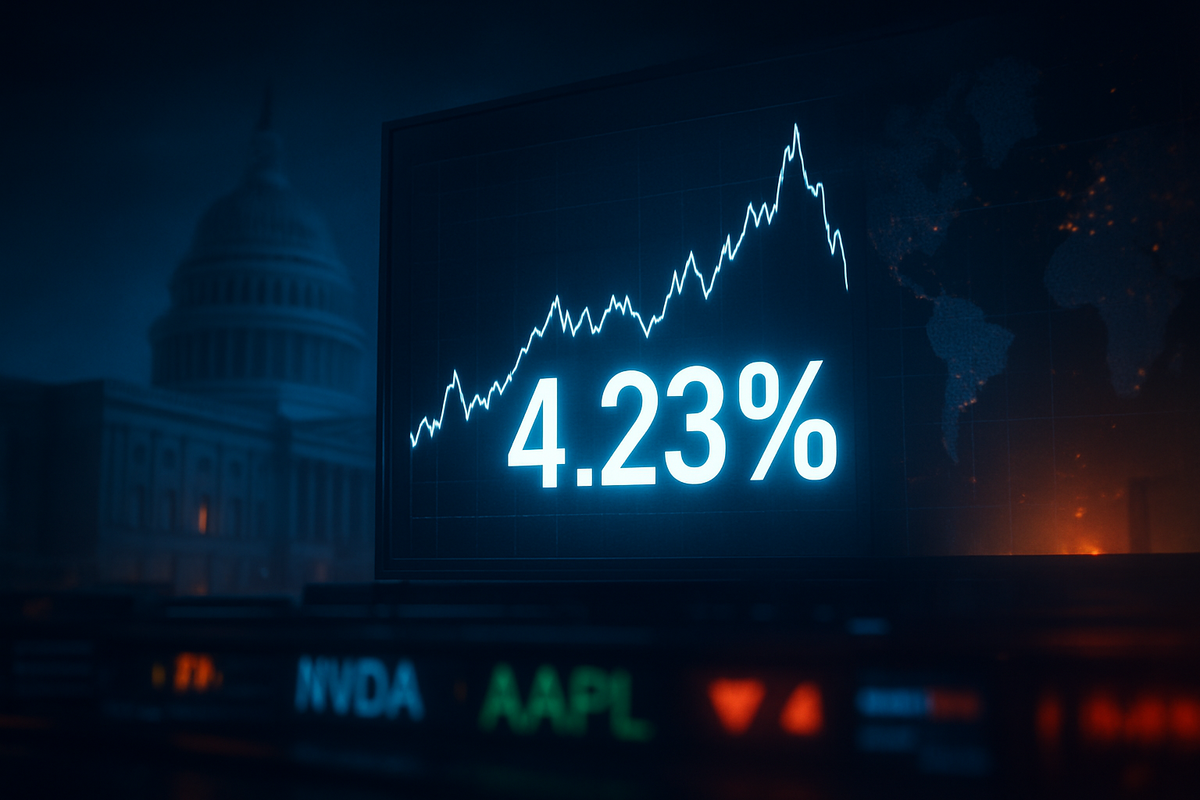
The relationship between the Federal Reserve and the U.S. bond market has reached a state of "stabilized weakness" as of January 22, 2026. Despite the Federal Open Market Committee (FOMC) delivering three consecutive quarter-point interest rate cuts in the final months of 2025, the benchmark 10-year Treasury yield remains stubbornly high, holding around 4.23%. This divergence highlights a growing rift: while the central bank is attempting to engineer a soft landing for a cooling labor market, investors are demanding a higher "risk premium" due to an unprecedented combination of geopolitical trade wars and internal political pressure on the Fed itself.
As the market approaches the first FOMC meeting of 2026 on January 28, investors have overwhelmingly priced in a "Fed pause." The optimism that fueled the late-2025 rally has been replaced by a cautious realism, as bondholders grapple with the reality that borrowing costs may not fall much further. For equity and bond investors alike, the 4.23% yield has become a formidable "anchor," weighing down valuations of high-growth technology stocks while providing a tailwind for domestic financial institutions.
The Triple Threat: Tariffs, Lawfare, and Succession
The current volatility in the Treasury market is the culmination of three distinct shocks that hit the economy in early January 2026. First was the "Greenland Trade War," which saw the administration threaten 10% to 25% tariffs on major European NATO allies—including Germany, France, and the UK—following their opposition to a proposed U.S. acquisition of Greenland. This geopolitical friction sparked a "sell America" trade among European sovereign wealth funds, which liquidated U.S. Treasuries in retaliation, pushing the 10-year yield from 3.90% in December to its current 4.23%.
Simultaneously, the Federal Reserve’s independence has come under intense scrutiny. In mid-January, it was revealed that the Justice Department had served criminal subpoenas to Fed Chair Jerome Powell regarding the financing of headquarters renovations—a move many market participants interpreted as "lawfare" intended to pressure the Fed into more aggressive rate cuts. This political interference has led investors to demand a higher yield to compensate for the perceived risk to the central bank's autonomy.
Finally, the looming expiration of Chair Powell’s term in May 2026 has introduced the "Warsh Factor." Rumors that the administration may nominate Kevin Warsh—widely viewed as a hawk—over the more dovish Kevin Hassett have forced markets to re-evaluate the long-term path of interest rates. This uncertainty, combined with a 25% "Silicon Surcharge" on advanced semiconductors announced on January 14, has created a backdrop where inflation expectations are rising even as the Fed tries to ease policy.
Winners and Losers in a High-Yield, High-Tariff Era
The current market environment has created a sharp divide between domestic-oriented financial giants and globally exposed technology leaders. JPMorgan Chase & Co. (NYSE: JPM) has emerged as a primary winner, with its stock showing resilience. As a domestic heavyweight, JPM is less vulnerable to European trade retaliation and stands to see its Net Interest Income (NII) expand by an estimated 7% in 2026 thanks to the steepening yield curve. Furthermore, JPM is poised to capture additional market share as it takes over the Apple Card partnership, consolidating its position as the premier U.S. consumer bank.
Conversely, the "Silicon Surcharge" and high yields have battered the tech sector. NVIDIA (NASDAQ: NVDA) shares have faced significant downward pressure, falling over 4% in mid-January as the new 25% tariff on Taiwan-made AI chips threatens to add thousands of dollars to the cost of advanced GPUs. Similarly, Apple Inc. (NASDAQ: AAPL) is trading nearly 9% below its late-2025 peaks. Apple faces a "perfect storm" of high discount rates affecting its valuation and its massive global supply chain being caught in the crossfire of the Greenland-related trade disputes.
In the real estate sector, American Tower (NYSE: AMT) and other interest-rate-sensitive REITs have seen significant underperformance. With the 10-year yield anchored at 4.23%, the risk-free return of government bonds has become a more attractive alternative to REIT dividends. For international players, the picture is mixed; Volkswagen (OTC: VWAGY) saw its ADRs rebound 5.6% today, January 22, following a "framework deal" at Davos that suggested a potential walkback of the Greenland tariffs, providing a rare glimpse of hope for European-exposed industrials.
The Erosion of Fed Autonomy and Global Ripple Effects
The broader significance of this moment lies in the potential permanent shift in how the Federal Reserve operates. The "lawfare" against Chair Powell and the open discussion of his replacement have signaled to global markets that the era of a completely insulated U.S. central bank may be ending. Historically, when the independence of a central bank is questioned, the "term premium" on long-term bonds rises—exactly what we are seeing with the 10-year yield holding above 4.20% despite the Fed's recent cuts.
Furthermore, the shift toward "AI Sovereignty" through tariffs like the Silicon Surcharge represents a fundamental change in industry trends. This protectionist pivot is designed to force high-tech manufacturing back to U.S. soil, but the immediate ripple effect is inflationary. As companies like Intel Corporation (NASDAQ: INTC) scramble to accelerate domestic fabrication, the short-term result for consumers and partners is higher prices, which complicates the Fed’s mandate to maintain price stability.
This event bears a striking resemblance to the "bond vigilante" era of the 1980s and early 1990s, where the market forced the government’s hand by pushing yields higher regardless of central bank policy. The 2026 version, however, is complicated by a national debt that has become significantly more expensive to service at these yield levels, creating a feedback loop that may limit the federal government’s fiscal maneuverability in the coming years.
What Comes Next: The January 28 Decision and Beyond
In the short term, all eyes are on the January 28 FOMC meeting. A pause is all but guaranteed, but the language used by Powell in the post-meeting press conference will be critical. Investors will be looking for any signs that the Fed is prepared to combat the "tariff-induced inflation" that many economists expect to hit in mid-2026. If Powell signals that the Fed will remain "data-dependent" despite political pressure, it could help stabilize the bond market; if he appears cowed by the DOJ subpoenas, yields could spike even further.
Longer-term, the strategic pivot for many corporations will be a "U.S.-First" supply chain realignment. Companies that can successfully navigate the transition from global to domestic sourcing will likely outperform. However, this transition is capital-intensive and slow. In the interim, we may see a "bifurcated market" where domestic banks and industrial firms with localized supply chains thrive, while the high-flying tech names that dominated the previous decade struggle to justify their multiples in a 4%+ yield environment.
The most critical scenario to watch is the nomination of the next Fed Chair. If a "hard hawk" like Kevin Warsh is nominated, we could see a massive repricing of the entire yield curve. Conversely, a more political or "dovish" appointment might lead to a further "sell America" trade as international investors lose confidence in the U.S. dollar’s long-term stability.
Final Assessment for the 2026 Market
The standoff at 4.23% is more than just a number; it is a signal of a market in transition. The "easy money" era that briefly teased a return in late 2025 has been snuffed out by the realities of geopolitical tension and political friction. Investors must now navigate a landscape where the Federal Reserve is no longer the only pilot in the cockpit of the U.S. economy.
The key takeaway is that the "Fed Pause" is not necessarily a sign of economic health, but rather a strategic retreat as the central bank waits to see the full impact of the trade wars and its own internal leadership crisis. Moving forward, the market will likely remain volatile, with yields serving as the primary barometer for geopolitical risk.
For the coming months, investors should keep a close watch on the January 28 FOMC minutes, the developments in the Greenland trade negotiations, and the short-list for the Fed Chairmanship. The resilience of domestic financial institutions like JPMorgan Chase & Co. offers a potential haven, but the broader equity market will remain tethered to the movement of the 10-year yield.
This content is intended for informational purposes only and is not financial advice.