Billionaire Philanthropy Meets Public Policy: Ray Dalio's Impact on "Trump Accounts" and Long-Term Market Dynamics
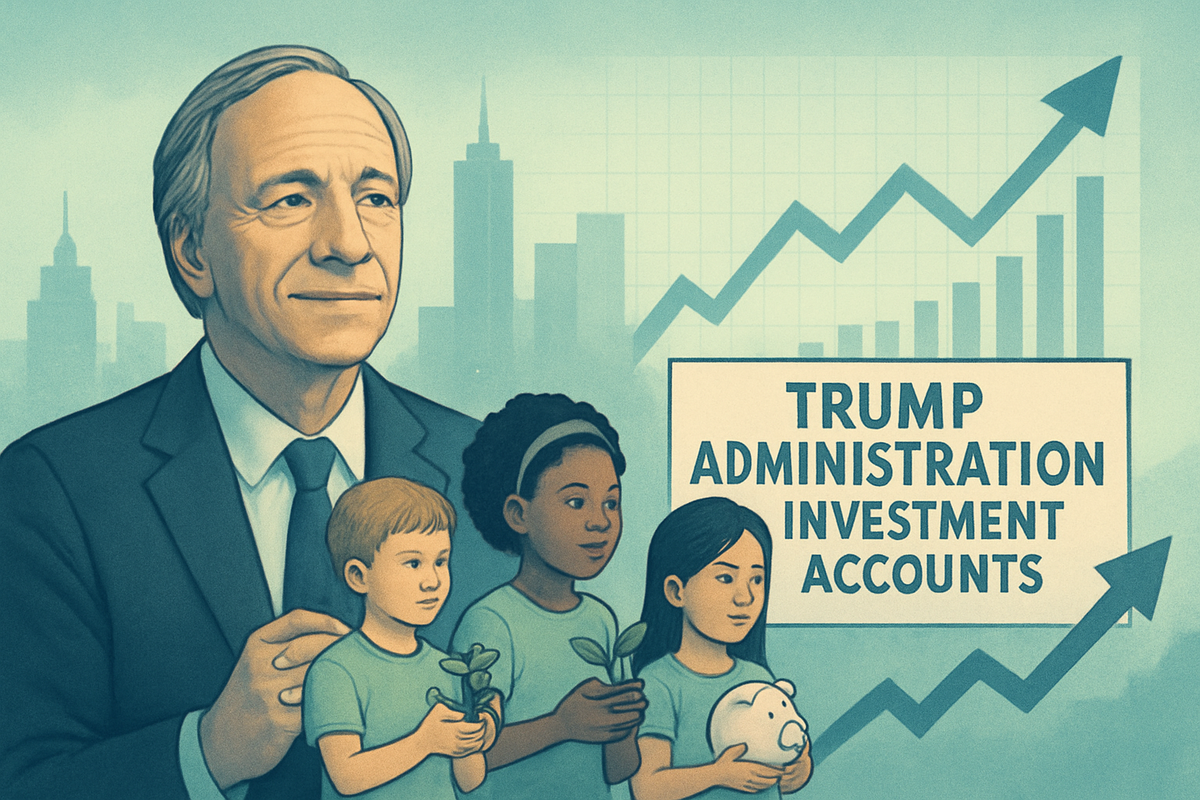
Billionaire investor and Bridgewater Associates founder Ray Dalio, through Dalio Philanthropies, has recently made a significant philanthropic commitment that intertwines with a major government initiative, potentially shaping long-term market trends and financial literacy for a new generation. On December 17, 2025, Dalio and his wife Barbara pledged an additional $250 per child for approximately 300,000 Connecticut children into the "Trump Administration investment accounts," a program established under President Donald Trump's "One Big Beautiful Bill Act." This move, totaling around $75 million from the Dalios, is set to inject capital into broad market index funds over the coming decades, representing a unique convergence of private wealth and public policy aimed at fostering financial independence.
While not expected to trigger immediate market volatility, Dalio's involvement in this government-backed savings program signals a gradual, sustained inflow of capital into passive investment vehicles. This initiative, which mandates investment in the broader stock market, suggests a long-term bullish undertone for index funds, and underscores a growing emphasis on early financial education. Beyond the direct capital injection, Dalio's broader macroeconomic warnings about political division and rising debt continue to resonate, urging investors to consider diversification and international exposure amidst evolving domestic policy landscapes.
Dalio's Philanthropic Gambit: Fueling the "Trump Accounts" Initiative
The "Trump Administration investment accounts" initiative, enacted earlier in 2025 as part of President Trump's "One Big Beautiful Bill Act," is a landmark program designed to provide a financial head start for American children. Under this act, the federal government will deposit $1,000 into investment accounts for every child born between 2025 and 2028. These funds are specifically mandated to be invested in index funds that track the broader stock market, with accounts officially opening on July 4, 2026. The capital will become accessible when the child turns 18, intended for purposes such as higher education, job training, or entrepreneurial endeavors.
Ray and Barbara Dalio's commitment on December 17, 2025, amplifies this federal effort by adding $250 per child for Connecticut residents in zip codes with a median household income below $150,000. This targeted contribution, totaling approximately $75 million from Dalio Philanthropies, follows a similar large pledge from Michael and Susan Dell, highlighting a growing trend of billionaires leveraging their wealth to support public policy initiatives. Treasury Secretary Scott Bessent lauded Dalio's decision as a significant boost to the administration's nationwide drive to secure donor and corporate backing for the scheme.
Key players in this unfolding narrative include Ray and Barbara Dalio, whose philanthropic vision extends beyond traditional charity to direct engagement with systemic economic empowerment. President Donald Trump and his administration are central, having legislated the "One Big Beautiful Bill Act" and championed the investment accounts. Michael and Susan Dell's prior pledge sets a precedent for private sector involvement. This initiative also falls under the broader umbrella of Dalio Philanthropies, which continues to support diverse areas like education (e.g., Games for Change Student Challenge in March 2025, Hack Club in October 2024), ocean exploration (OceanX, with a Bio-logging Innovation Grant Program deadline of March 31, 2025), and community development. The initial market reaction to these contributions is not one of immediate price surges but rather a reinforcement of sentiment around long-term savings and financial literacy, with a gradual but consistent capital inflow into broad market index funds expected over many years.
Market Beneficiaries and Potential Losers in the Long Game
The "Trump Administration investment accounts" initiative, bolstered by philanthropic contributions from figures like Ray Dalio, creates clear winners and potential losers within the financial markets, primarily due to its mandated investment in broad market index funds.
The most direct beneficiaries will be index fund providers and the underlying companies they track. Major asset management firms that offer popular index funds, such as BlackRock (NYSE: BLK) with its iShares products, Vanguard with its extensive suite of ETFs and mutual funds, and State Street (NYSE: STT) through its SPDRs, are poised to see a steady, long-term increase in assets under management. As millions of children's accounts are established and funded, a continuous stream of capital will flow into these passive investment vehicles, reinforcing the trend towards index investing. This consistent demand could provide a stable, albeit gradual, tailwind for the broader stock market, particularly for large-cap companies that dominate major indices like the S&P 500. Furthermore, companies involved in financial literacy education and technology platforms that facilitate these investment accounts could also see increased demand for their services.
Conversely, the initiative could pose a subtle, long-term challenge to active fund managers who rely on outperforming market benchmarks. As a significant portion of new, long-term investment capital is automatically directed into passive index funds, the competitive landscape for active management might become even tougher. While the immediate impact will be negligible, over decades, a generation of investors raised on index funds might be less inclined to pay higher fees for active management, potentially accelerating the shift towards lower-cost passive strategies. Additionally, Dalio's broader macroeconomic warnings about increasing political division, government debt, and the potential for "constitutional crisis" could negatively impact companies highly sensitive to domestic policy uncertainty or those with significant exposure to U.S. federal spending and debt. His concerns about a shift towards "state capitalism" also suggest potential headwinds for companies that thrive in purely free-market environments, should government intervention increase significantly.
Ultimately, while the Dalio-backed initiative provides a clear benefit to the passive investment industry and promotes long-term market participation, it also subtly reinforces the challenges faced by traditional active management. The broader market implications are intertwined with the success and expansion of such government-backed savings programs, and the ability of the U.S. economy to navigate the macroeconomic headwinds that Dalio frequently highlights.
Broader Implications: A New Era of Philanthro-Policy and Market Evolution
Ray Dalio's engagement with the "Trump Administration investment accounts" transcends a simple act of charity; it represents a significant intersection of philanthropic capital and public policy, potentially ushering in a new era of "philanthro-policy" with wide-ranging implications for financial markets and societal trends. This event fits squarely into several broader industry trends, most notably the continued ascent of passive investing and the increasing role of private wealth in addressing societal challenges traditionally handled by government.
The mandated investment in index funds for these accounts further solidifies the dominance of passive investment strategies. This trend, driven by lower fees and often superior long-term performance compared to active management, has been reshaping the asset management industry for years. Dalio's contribution, alongside the federal mandate, will introduce millions of new investors to passive vehicles from a young age, potentially embedding this investment philosophy into future generations. This could accelerate the consolidation of assets under management by large index fund providers and intensify competitive pressures on actively managed funds.
The ripple effects could be substantial. Other high-net-worth individuals and philanthropic organizations might be inspired to contribute to similar government-backed savings programs, creating a more robust and widespread network of early-stage investment accounts. This could lead to a broader societal shift towards greater financial literacy and long-term savings habits. For competitors in the financial education space, this initiative presents both a challenge and an opportunity: to either partner with such programs or develop complementary educational tools. Regulatory and policy implications are also noteworthy; the success of the "Trump accounts" could pave the way for similar government-backed universal savings programs, potentially leading to policy debates around funding mechanisms, investment choices, and wealth redistribution.
Historically, while there have been government-backed savings programs (like 529 college savings plans or various retirement accounts) and significant philanthropic contributions to education, the direct integration of private billionaire philanthropy into a federal, universal child investment scheme is relatively novel. It draws comparisons to universal basic income discussions but with a focus on capital ownership and market participation rather than direct consumption. This unique blend signifies a potential evolution in how societal wealth is leveraged to address long-term economic disparities and foster financial inclusion, with the capital markets playing a central role in the solution.
The Road Ahead: Long-Term Growth and Evolving Investment Strategies
Looking ahead, the "Trump Administration investment accounts," bolstered by philanthropic support, present a fascinating long-term experiment with significant implications for market dynamics and individual wealth creation. In the short term, the direct market impact will be a gradual, consistent inflow of capital into broad market index funds as new accounts are opened and Dalio's and other donors' pledges are fulfilled. This steady demand could provide a modest, consistent underpin for the broader equity market, particularly for the large-cap companies that constitute major indices.
In the long term, the potential for these accounts is transformative. As millions of children grow into financially literate adults with seed capital, it could foster a generation with a greater understanding of investing and a direct stake in the capital markets. This could lead to increased retail investor participation and a more equitable distribution of wealth over decades. Market opportunities may emerge for financial advisors specializing in long-term planning for these new account holders, as well as for fintech companies developing user-friendly platforms for managing these types of accounts. Asset managers will need to continue adapting their offerings, potentially further emphasizing low-cost index products and developing educational content for this new cohort of investors.
Potential strategic pivots for financial institutions include a greater focus on passive product development and enhanced financial literacy initiatives. Investment platforms might see a surge in demand for educational tools and simplified investment interfaces. Challenges could arise if the program faces political headwinds in future administrations, or if the returns on index funds are disappointing over long periods, potentially eroding public confidence. However, if successful, this initiative could serve as a blueprint for other nations or states, leading to a global trend of government-backed, philanthropically-supported universal savings programs. Investors should watch for the expansion of this program, the performance of the underlying index funds, and any shifts in public policy regarding universal savings accounts, as these factors will dictate the long-term market opportunities and challenges that emerge.
Conclusion: A Blueprint for Future Market Participation and Financial Empowerment
Ray Dalio's philanthropic commitment to the "Trump Administration investment accounts" marks a pivotal moment where private wealth converges with public policy to influence future market participation and financial empowerment. The key takeaway is the long-term, systemic impact of directing capital into broad market index funds for millions of children, fostering a generation of financially literate investors. While not a catalyst for immediate market shifts, this initiative promises a sustained, gradual inflow of capital into passive investment vehicles, solidifying their dominant position in the asset management landscape.
Moving forward, the market will likely see continued growth in assets under management for major index fund providers like BlackRock (NYSE: BLK), Vanguard, and State Street (NYSE: STT). The initiative underscores the increasing importance of financial literacy education and could spur further innovation in accessible investment platforms. Dalio's broader warnings about political division and debt remain a crucial backdrop, reminding investors of the importance of diversification and resilience in their portfolios amidst evolving geopolitical and economic landscapes.
The lasting impact of this initiative could be profound, potentially reshaping societal attitudes towards saving and investing, and creating a more inclusive financial system. It serves as a compelling example of how philanthropic capital, when strategically aligned with government policy, can create sustained market opportunities and address long-term societal challenges. Investors should closely monitor the growth and expansion of these universal savings programs, the performance of the underlying market indices, and the ongoing dialogue around financial literacy and wealth distribution. The success of this "philanthro-policy" model could set a precedent for future collaborations between the private and public sectors, with significant implications for capital markets for decades to come.
This content is intended for informational purposes only and is not financial advice