Bank of America Price Target Hits $63 as Analysts Eye 'Strong Setup' for 2026
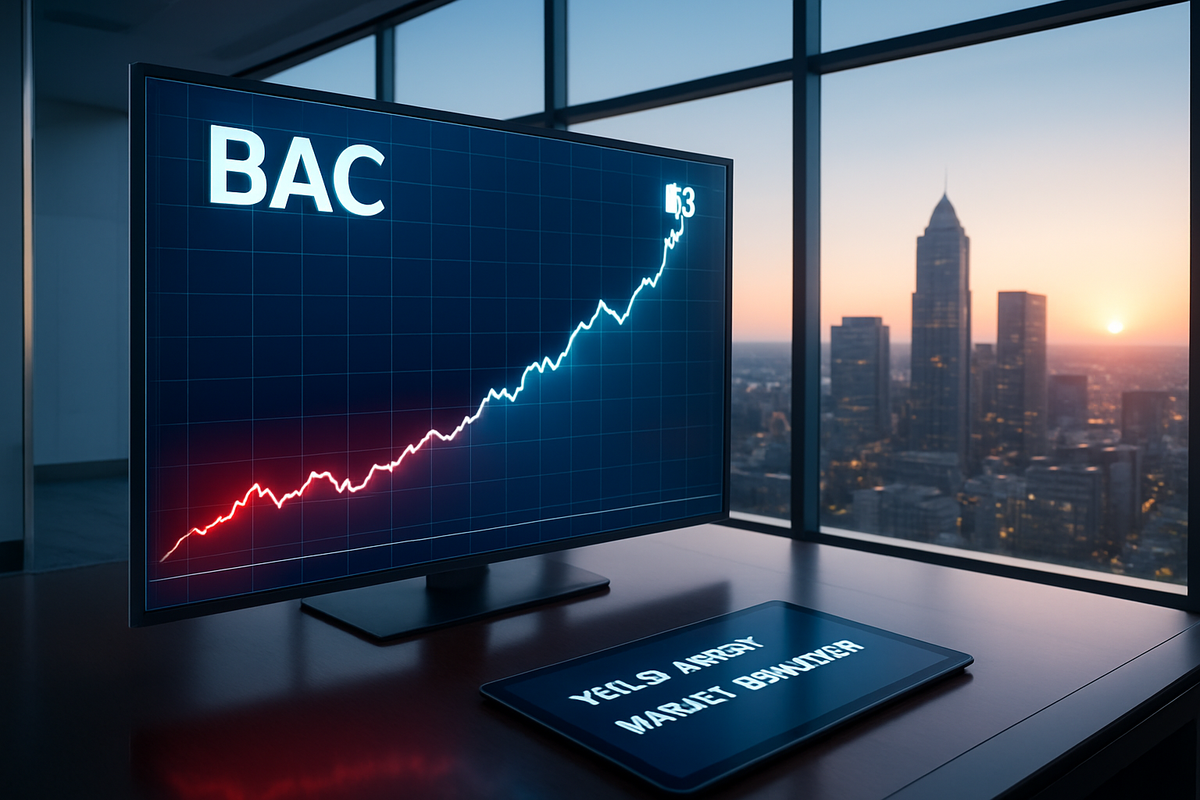
In a move that has sent ripples through the financial sector, analysts at Oppenheimer have aggressively raised their price target for Bank of America (NYSE: BAC) to $63, citing a "Goldilocks" economic environment as we head into 2026. The upgrade, issued on December 18, 2025, reflects a growing consensus that the combination of cooling inflation and stabilizing interest rates is creating the most favorable operating backdrop for large-cap banks in over a decade.
The revised target represents a significant leap from the previous $55 estimate, signaling a 15% upside from current trading levels. This bullish pivot is predicated on the bank’s ability to capture higher yields on its massive loan portfolio while simultaneously benefiting from a resurgence in investment banking activity. As the Federal Reserve moves toward a terminal rate of approximately 3.0% by mid-2026, Bank of America is positioned to see its net interest margins expand, even as the broader economy maintains a healthy growth trajectory.
The Path to $63: A Convergence of Tailwinds
The upgrade from Oppenheimer is not an isolated event but rather the culmination of a year-long trend of improving fundamentals for the Charlotte-based lender. Throughout 2025, Bank of America has successfully navigated the transition from the "higher-for-longer" interest rate regime to a more balanced monetary environment. Analysts point to the bank’s disciplined expense management and its aggressive expansion—including the opening of over 165 new financial centers across 63 markets—as key drivers that will bear fruit in 2026.
The timeline leading to this moment has been marked by a steady recovery in capital markets. After a period of relative dormancy in 2023 and 2024, merger and acquisition (M&A) activity and initial public offerings (IPOs) have surged in the latter half of 2025. This "security supercycle," as some analysts call it, has provided a massive boost to Bank of America’s advisory fees. Furthermore, the bank’s management has guided for a 5% to 7% annual growth in Net Interest Income (NII) through 2026, supported by the repricing of older, lower-yielding fixed-rate assets into the current rate environment.
Winners and Losers in the New Financial Landscape
While Bank of America (NYSE: BAC) stands as the primary beneficiary of this specific upgrade, the broader banking sector is also feeling the lift. JPMorgan Chase & Co. (NYSE: JPM) and Wells Fargo & Company (NYSE: WFC) have seen their own price targets revised upward as the market re-rates the entire industry. These "Big Three" institutions are winning by leveraging their massive deposit bases to keep funding costs low while reaping the rewards of a more active corporate sector.
Conversely, some market participants may find themselves on the losing end of this rotation. Defensive sectors such as Utilities (NYSEArca: XLU) and Consumer Staples (NYSEArca: XLP), which often serve as "bond proxies" during periods of economic uncertainty, are seeing capital outflows as investors chase the higher growth and dividend potential of the financial sector. Additionally, smaller regional banks that lack the diversified revenue streams of a global powerhouse like Bank of America may struggle to keep pace with the technological and physical expansion of the industry leaders.
A "Goldilocks" Setup: The Wider Significance
The significance of the $63 price target extends beyond a single stock; it serves as a barometer for the health of the U.S. economy. The "strong setup" for 2026 is largely due to the successful "soft landing" engineered by the Federal Reserve. With inflation finally settling near the 2% target, the central bank has the flexibility to maintain rates at a level that supports growth without sparking a recession. This stability is the "holy trinity" of banking: manageable credit losses, healthy loan demand, and a steepening yield curve.
Historically, Bank of America has traded at a discount to its peers due to its sensitivity to interest rate fluctuations. However, the current trend suggests a "mean reversion" where the bank’s valuation multiples align more closely with its historical averages. This shift indicates that the market is finally rewarding the bank for its "responsible growth" strategy, moving away from the fear-based discounting that characterized the post-2023 regional banking crisis era.
Looking Ahead: The Road to 2026
As we look toward the short and long-term future, the primary challenge for Bank of America will be execution. While the macro environment is supportive, the bank must continue to integrate its digital banking technologies with its physical expansion to maintain its market-leading position in consumer banking. Investors should expect a continued focus on share buybacks and dividend increases, as the bank’s Tier 1 capital ratios remain robust.
Potential risks remain, including the possibility of a "hard landing" if global geopolitical tensions disrupt supply chains and reignite inflation. However, the current trajectory suggests that 2026 will be a year of significant profitability. Market opportunities in AI-driven commercial lending and the transition to a green economy are also expected to provide new avenues for loan growth that were not present in previous cycles.
Summary and Investor Outlook
The upgrade to a $63 price target for Bank of America is a clear signal that the "Goldilocks" economy of 2026 is within sight. With cooling inflation providing the necessary breathing room for the Federal Reserve to normalize rates, the banking sector is entering a period of renewed strength. The key takeaways for investors are the bank's projected 5-7% NII growth, its dominant position in the rebounding capital markets, and its aggressive physical expansion.
Moving forward, the market will be watching for the bank's Q4 2025 earnings report and its updated guidance for the first half of 2026. If the current trends in loan growth and expense control hold steady, the $63 target may even prove to be conservative. For now, the "strong setup" is in place, and Bank of America appears ready to lead the charge into a prosperous 2026.
This content is intended for informational purposes only and is not financial advice