Apple’s High-Stakes Earnings: iPhone 17 Cycle and the AI Pivot Face a Market Litmus Test
As Apple Inc. (NASDAQ:AAPL) prepares to pull back the curtain on its fiscal first-quarter earnings for 2026, the technology world is holding its breath. This upcoming report, scheduled for late January, arrives at a pivotal moment for the Cupertino giant. For the first time, investors will get a clear look at the full impact of the iPhone 17 product cycle and the real-world adoption of "Apple Intelligence." With the stock trading at a forward P/E of roughly 32x, the pressure is on CEO Tim Cook to prove that the company’s slow-and-steady AI strategy is yielding the massive "supercycle" that analysts have predicted for years.
The stakes extend beyond mere hardware sales. This quarter represents the first major test of Apple’s ability to monetize its 2.4 billion-device installed base in an era dominated by generative artificial intelligence. While peers have focused on cloud infrastructure and enterprise software, Apple has staked its future on a consumer-first, privacy-centric AI model. As of January 23, 2026, the market sentiment is a mix of cautious optimism and intense scrutiny, as the company attempts to justify its premium valuation against a backdrop of evolving global economic conditions and a resurgence in key markets like China.
The China Comeback and the 12GB RAM Threshold
The primary narrative of the December 2025 quarter has been the surprising strength of Apple’s recovery in the Greater China region. After years of losing ground to local rivals, Apple reclaimed a 22% market share in China by the end of 2025. This resurgence is largely attributed to the iPhone 17 Pro and Pro Max models, which are the first to feature the full suite of on-device Apple Intelligence capabilities powered by the A19 Pro chip. Analysts are expecting total revenue to land between $137.47 billion and $138.45 billion, which would represent a robust 10% to 11% year-over-year growth.
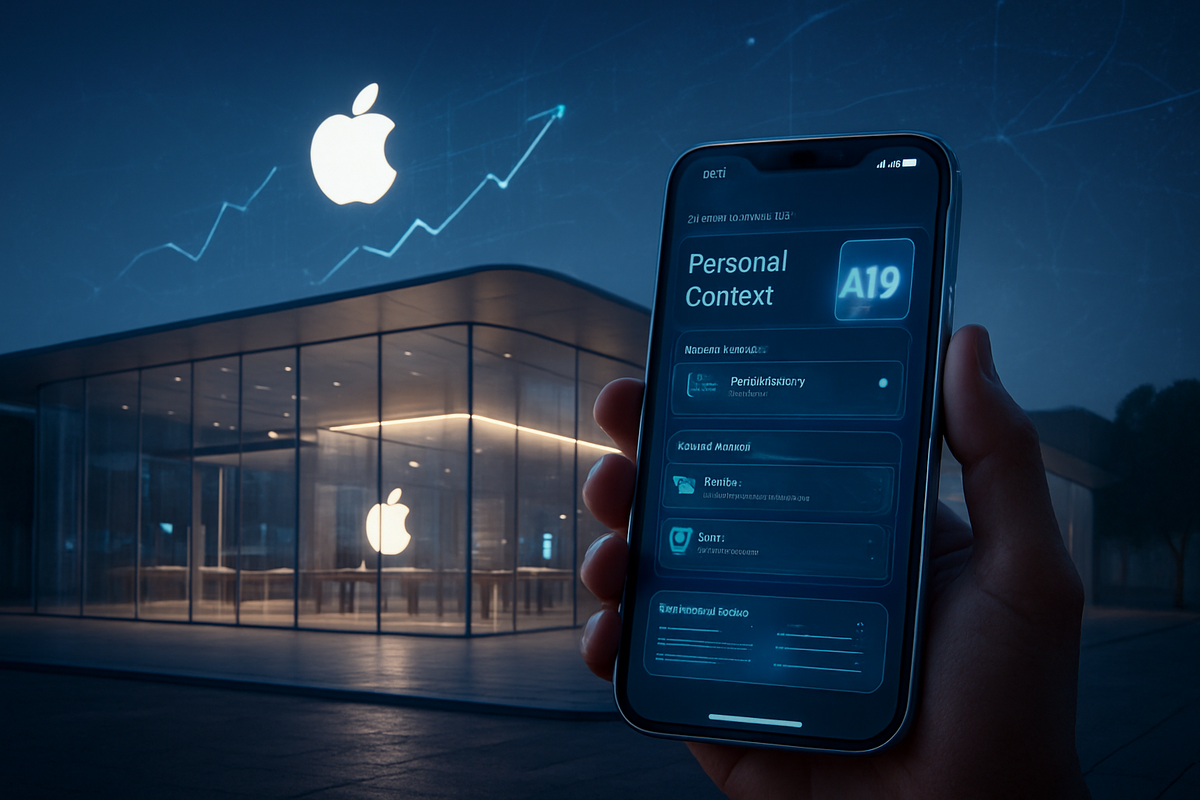
However, the hardware story is one of divergence. The iPhone 17 Pro models, equipped with a minimum of 12GB of RAM, have reportedly outperformed expectations, as consumers realize that the 8GB standard models struggle with the most advanced "Personal Context" Siri features. Conversely, the experimental "iPhone 17 Air"—an ultra-thin model designed to replace the "Plus" variant—has seen underwhelming demand. Early channel checks suggest the Air has captured only a low single-digit market share, as its $999 price tag and compromises in battery life failed to resonate with power users. This "Pro-heavy" mix is expected to drive record-high Average Selling Prices (ASPs), potentially pushing earnings per share (EPS) to a consensus estimate of $2.66.
Winners and Losers in the AI-Driven Ecosystem
The clear "winners" heading into this earnings report are the high-end component suppliers and Apple’s own Services division. Taiwan Semiconductor Manufacturing Co. (NYSE:TSM), which produces the 3nm A19 chips, continues to benefit from the shift toward more complex silicon required for on-device AI. Furthermore, Apple’s Services segment—encompassing the App Store, iCloud, and the newly launched "Apple Intelligence+" subscription tier—is projected to maintain double-digit growth with margins exceeding 70%. This software-driven stability provides a crucial floor for the stock’s valuation, even when hardware cycles fluctuate.
On the losing side of the ledger are the mid-tier smartphone manufacturers and Apple’s own "standard" model lineup. As consumers increasingly view 12GB of RAM as a necessity for future-proofing their devices for AI, the standard iPhone 17 is being squeezed. Competitors like Samsung and Google, which is owned by Alphabet Inc. (NASDAQ:GOOGL), have also struggled to match Apple’s tight integration of hardware and software. However, Alphabet remains a complex partner-rival; while its Gemini model powers some of Apple’s cloud-based AI requests, the potential loss of the multi-billion dollar Google Search default deal on iPhones continues to loom as a long-term regulatory shadow.
The Great AI Catch-Up: Consumer Privacy vs. Enterprise Power
The broader significance of this earnings report lies in how it frames Apple’s position within the "Magnificent Seven." While Nvidia Corp. (NASDAQ:NVDA) and Microsoft Corp. (NASDAQ:MSFT) have reaped the rewards of the AI infrastructure boom, Apple has been criticized for being "late" to the generative AI party. The 2026 fiscal year is meant to be Apple’s rebuttal. By prioritizing on-device processing and "Personal Context"—the ability for Siri to perform actions based on a user’s specific data across multiple apps—Apple is attempting to create a unique moat that enterprise-focused giants cannot easily replicate.
This strategy fits into a broader industry trend where the focus is shifting from training massive models to deploying "agentic" AI that can actually do things for the user. Apple’s release of iOS 26.3 in early January 2026, which finally unlocked full cross-app Siri actions, is the historical equivalent of the App Store launch in 2008. It marks the transition from the smartphone as a tool to the smartphone as an autonomous assistant. The market will be watching closely to see if management provides any data on "AI engagement," which could become the new north star for tech valuations in 2026 and beyond.
Looking Ahead: The iPhone 18 and Beyond
The immediate future for Apple involves navigating the "trough of disillusionment" that often follows a major tech rollout. In the short term, the company must manage supply chains for the upcoming iPhone 18, which is rumored to feature even more advanced neural engines. There is also growing speculation about a "folding" iPad or Mac device entering production in late 2026, a move that would represent Apple’s first major hardware form-factor shift since the Vision Pro.
Strategic pivots may also be required in the Services sector. As AI agents begin to handle more user tasks, the traditional "App Store" model—based on discovery and downloads—could be disrupted. Investors will be looking for clues on how Apple plans to monetize AI beyond hardware sales, perhaps through more aggressive "AI-as-a-service" offerings for developers. The challenge will be maintaining the delicate balance between the high-margin walled garden and the increasingly open world of AI collaboration.
Conclusion: A Turning Point for the Cupertino Giant
Apple’s Q1 2026 earnings will likely be remembered as the moment the "AI Supercycle" was either validated or debunked. The key takeaways for investors will be the sustainability of the China recovery, the adoption rates of the 12GB RAM Pro models, and the growth trajectory of AI-linked Services revenue. While the hardware mix shows some weakness in the "Air" experiment, the overall financial health of the company appears robust, supported by a massive buyback program and a loyal, high-spending user base.
Moving forward, the market will transition from asking if Apple can do AI to asking how much they can charge for it. The lasting impact of this quarter will be its role in defining Apple’s identity for the next decade: no longer just a hardware company, but an AI-orchestration platform. For investors, the coming months will require a close watch on iOS adoption rates and any signs of regulatory headwinds that could break the company's lucrative default search and AI partnerships.
This content is intended for informational purposes only and is not financial advice.