$7 Trillion "Witching Hour": Unprecedented Derivatives Expiration Sparks Volatility on Wall Street
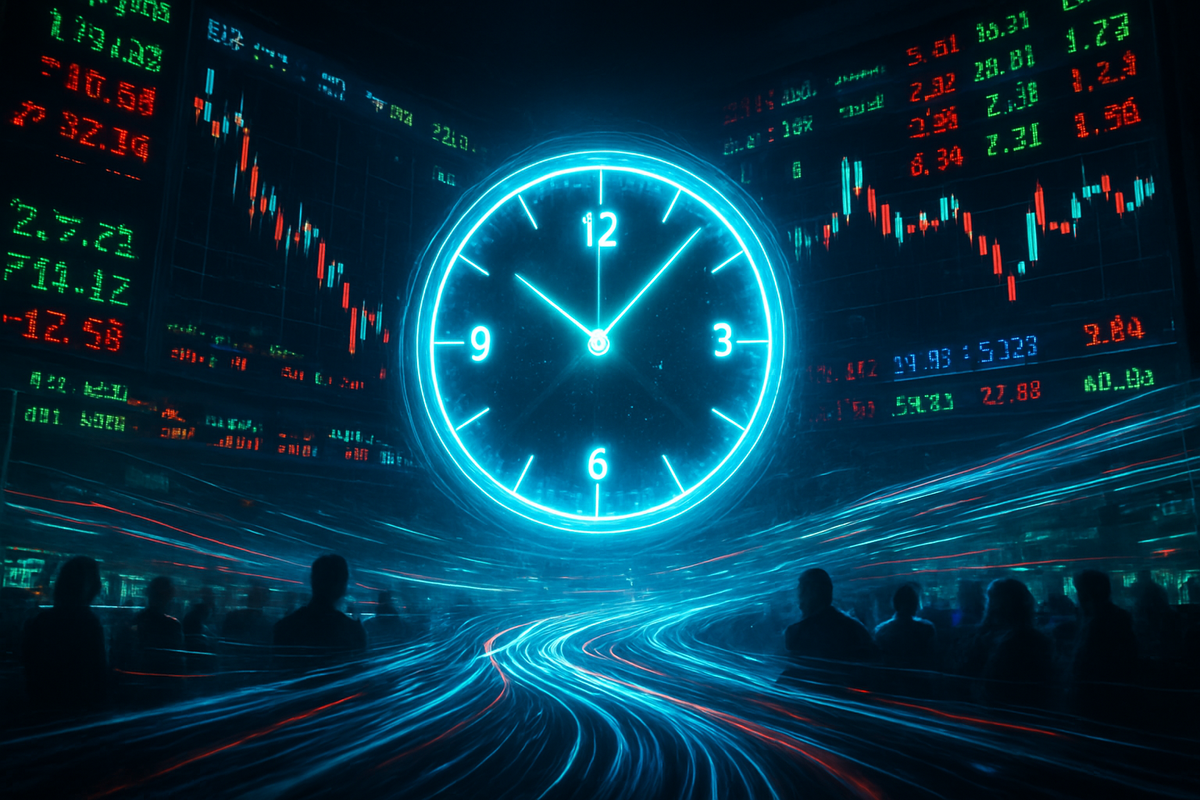
Today, December 19, 2025, marks the arrival of "Triple Witching" Friday, a quarterly phenomenon that has reached historic proportions this year. With an estimated $7.1 trillion in notional value of derivatives contracts set to expire simultaneously, the market is bracing for a surge in volume and price swings that could redefine the closing landscape of 2025. This "Triple Witching" refers to the synchronized expiration of stock options, stock index options, and stock index futures, a convergence that historically triggers massive institutional rebalancing and speculative activity.
The immediate implications are stark: market participants are navigating a "liquidity tsunami" as traders "roll" their positions into 2026 or close out massive hedges. Coming on the heels of a cooling inflation report and a recent Federal Reserve rate cut, today's session is more than just a mechanical expiration; it is a high-stakes tug-of-war between a year-end "Santa Claus Rally" and a potential "profit-taking reversal" that could see billions of dollars shift hands in the final hour of trading.
The $7.1 Trillion Cliff: A Perfect Storm of Expirations
The scale of today’s event is unprecedented, with the $7.1 trillion notional value representing a nearly 20% increase over the same period in 2024. This massive concentration of contracts means that roughly 10.2% of the entire Russell 3000 market capitalization is tied to these expiring derivatives. The timeline leading to this moment has been fraught with uncertainty; earlier in 2025, a 43-day federal government shutdown created a "Great Data Gap," leaving investors starved for reliable economic indicators for weeks. Consequently, today’s expiration serves as a pressure-release valve for a market that has been operating on incomplete information for much of the year.
The "Witching Hour"—the final hour of trading from 3:00 PM to 4:00 PM ET—is expected to be the epicenter of the storm. During this window, institutional players must finalize their trades to align with expiring contracts. Market makers, who provide liquidity by taking the opposite side of retail and institutional trades, are forced into "gamma rebalancing." This process requires them to buy or sell the underlying stocks rapidly to remain delta-neutral, often exacerbating price moves in whichever direction the market is already leaning.
Key stakeholders, including major hedge funds and passive index fund managers, are also contending with the annual reconstitution of the Nasdaq-100 and the quarterly rebalance of the S&P 500. Because these index changes technically take effect at the next Monday’s open, the massive volume required to adjust portfolios occurs during the Friday close. This convergence of derivative expiration and index rebalancing creates a unique environment where structural requirements, rather than fundamental news, dictate price action.
Winners and Losers: Index Shifts and the "Magnificent" Volatility
The most significant activity today is concentrated in the "Magnificent Seven" and companies undergoing index transitions. Nvidia (NASDAQ:NVDA) remains the primary focus for many traders, as nearly one-third of its total outstanding options are set to expire today. The stock is a prime candidate for a "gamma squeeze," where rapid hedging by market makers could propel the stock price higher—or cause a sharp drop if the $150 strike price fails to hold. Similarly, heavyweights like Apple (NASDAQ:AAPL) and Microsoft (NASDAQ:MSFT) are seeing intense "pinning" activity, where the stock price gravitates toward specific strike levels as traders battle to make options expire worthless.
In the realm of index changes, the clear winners in terms of liquidity and buying pressure are Seagate Technology (NASDAQ:STX) and Western Digital (NASDAQ:WDC), both of which are being added to the Nasdaq-100. These companies are expected to see massive institutional inflows as passive funds are forced to buy shares to match the new index weightings. Carvana (NYSE:CVNA) and CRH (NYSE:CRH) are also seeing elevated volume as they join the flagship S&P 500 index.
Conversely, those being removed from major indices face significant selling pressure. Lululemon Athletica (NASDAQ:LULU) and Biogen (NASDAQ:BIIB) are being deleted from the Nasdaq-100, leading to a forced exit by passive trackers. While these moves are often temporary and do not reflect the underlying health of the companies, the sheer volume of selling can lead to localized price depressions that may take days or weeks to normalize.
Wider Significance: Structural Volatility in a Post-Shutdown Market
This Triple Witching event fits into a broader trend of "financialization," where the tail (derivatives) often wags the dog (the underlying stock market). The sheer volume of options trading has grown to the point where expiration days can decouple from economic reality. Historically, Triple Witching has been a source of volatility, but the 2025 iteration is unique because of the "Great Data Gap." With traditional economic metrics obscured by the earlier government shutdown, the market has become more reliant on technical and structural triggers like today's expiration.
The ripple effects extend to competitors and partners of the affected companies. When a titan like Nvidia experiences massive volatility, it often drags the entire semiconductor sector and the broader tech-heavy Nasdaq with it. Furthermore, the regulatory environment is watching closely; the SEC and other bodies have expressed ongoing interest in how massive derivatives expirations affect market stability, especially when combined with the rapid-fire trading of high-frequency algorithms that dominate the "Witching Hour."
Compared to historical precedents, such as the December 2018 or December 2022 expirations, 2025 is distinguished by the sheer concentration of wealth in a handful of mega-cap stocks. This concentration makes the entire market more vulnerable to the hedging activities of a few large market makers, turning what used to be a routine quarterly event into a potential systemic risk.
What Comes Next: The "Options Cliff" and 2026 Strategy
In the short term, the primary concern is the "options cliff." If the $7.1 trillion in hedges are unwound faster than the market can absorb, it could trigger a sharp year-end correction, erasing the gains of the recent "Santa Claus Rally." However, if the market absorbs the volume smoothly, it could provide the necessary liquidity for a final push into the new year. Investors should expect "phantom" price movements over the next 48 hours that may not reflect long-term value but rather the mechanical closing of positions.
Looking toward 2026, many institutional investors are likely to pivot their strategies. The rotation from overextended tech giants into small-cap stocks, represented by the Russell 2000, has already begun to show in the futures rolling activity seen today. This suggests that the "Great Rotation" could be a dominant theme for the first quarter of 2026, as investors seek value in sectors that were overlooked during the AI-driven surge of 2024 and 2025.
Market opportunities may emerge in the "aftermath" of today's session. Stocks that were artificially depressed by index deletions or "pinning" may present attractive entry points on Monday morning once the mechanical selling pressure has subsided. Conversely, companies that saw artificial "gamma" boosts may be due for a mean-reversion correction.
Wrap-Up: Navigating the Tsunami
Today's Triple Witching Friday is a stark reminder of the complex, derivative-heavy nature of the modern financial system. The key takeaway for investors is that the volatility seen today is largely structural. While the $7.1 trillion figure is staggering, it represents a reshuffling of the deck rather than a fundamental shift in the global economy. The market's ability to handle this volume—despite the "Data Gap" and recent policy shifts—will be a testament to its underlying resilience.
Moving forward, the market remains in a delicate balance. The Federal Reserve's recent rate cut to the 3.50%–3.75% range provides a supportive backdrop, but the lack of clear economic data remains a hurdle. Investors should watch for how the market settles in the final week of December; a strong finish despite today's volatility would signal robust confidence for the year ahead.
In the coming months, the focus will shift back to fundamentals as the "Data Gap" is filled and the true impact of the 2025 economic disruptions becomes clear. For now, the best strategy for most is to look past the "witching" noise and remain focused on the long-term trajectory of their portfolios.
This content is intended for informational purposes only and is not financial advice.